ddos
ddos
ddos
Garuda Kernel Error System Claims France DDoS Attacks
> By Clara | May 07, 2026 | 4 min read
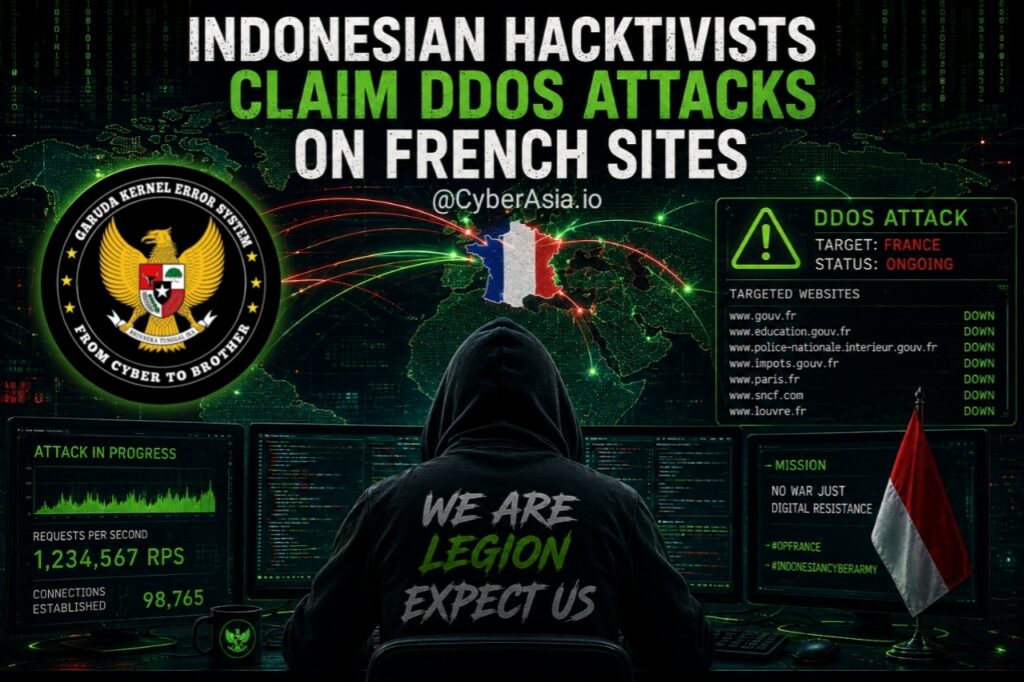
A self-identified Indonesian hacktivist collective has claimed responsibility for distributed denial-of-service attacks against at least two French websites, posting Check-Host verification links and anti-France messaging on social media.
What Happened
A hacktivist group identifying itself as the Garuda Kernel Error System has claimed credit for a wave of distributed denial-of-service (DDoS) attacks targeting French websites, according to posts circulating on social media and reviewed by CyberAsia.io.
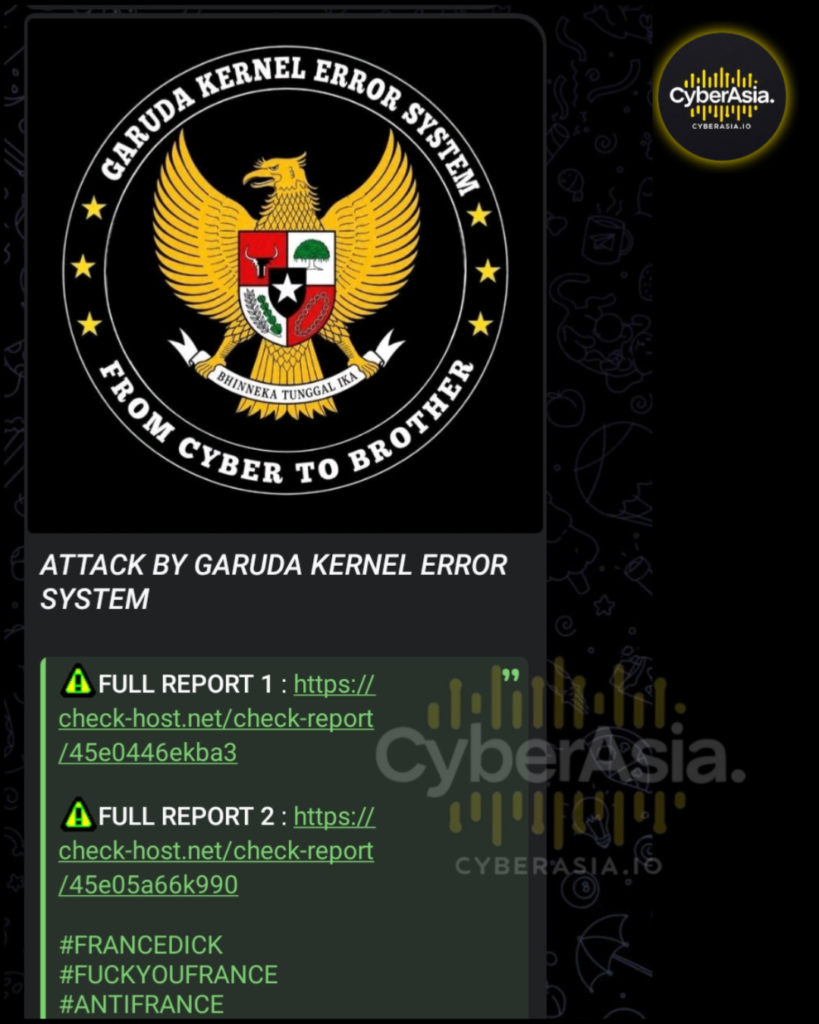
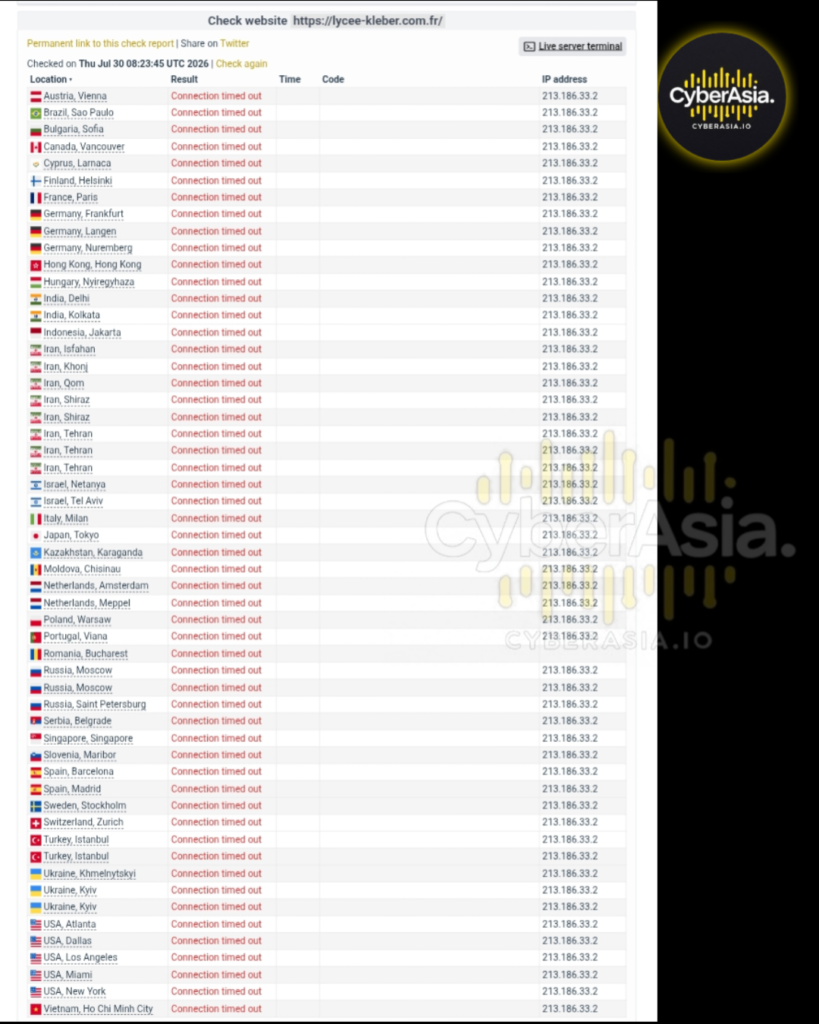
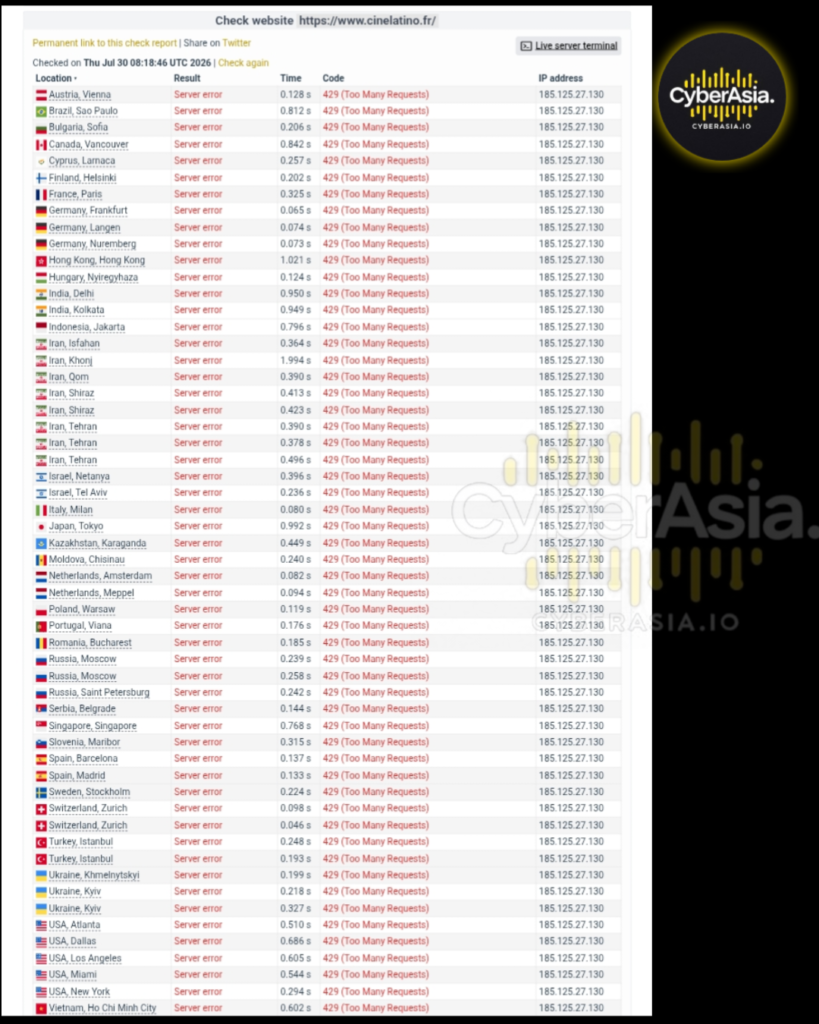
The group published a claim of responsibility accompanied by two verification links from Check-Host.net, a third-party service commonly used by threat actors to demonstrate that a target site is unreachable. Screenshots reviewed by CyberAsia.io show one report for the French cinema streaming platform cinelatino.fr, which returned HTTP 429 “Too Many Requests” errors across nearly every test location worldwide, and a second for lycee-kleber.com.fr, the website of Lycée Kléber, a school in Strasbourg, which showed connection timeouts from all tested regions. Both checks were logged on July 30, 2026.
Technical Details
The Check-Host reports show near-uniform failure results , 429 errors for cinelatino.fr and full connection timeouts for lycee-kleber.com.fr , across dozens of global test nodes, a pattern typically associated with request-flooding or resource-exhaustion attacks rather than an isolated regional outage. No further technical indicators, such as attack vectors, botnet infrastructure, or peak traffic volume, were disclosed in the material reviewed.
Proof / Source Reports
The group cited the following Check-Host.net reports as evidence of the claimed attacks:
> THREAT_INTELLIGENCE_DATA
Threat Actor Background
The group brands itself with imagery drawn from Indonesia’s national emblem, the Garuda Pancasila, alongside the slogan “From Cyber to Brother,” suggesting a nationalist or solidarity-driven hacktivist identity rather than a financially motivated operation. The group’s messaging included hostile, anti-France hashtags, indicating the attacks are being framed as politically or ideologically motivated. CyberAsia.io could not verify the group’s claimed nationality, size, or prior activity history from the material provided.
Potential Impact
If confirmed, the attacks would represent a temporary availability disruption for the named organizations rather than a data breach. DDoS attacks of this kind typically do not involve unauthorized access to internal systems or data exfiltration, though prolonged outages can affect service access for end users, students, or subscribers.
Response and Mitigation
No public statement from CineLatino France or Lycée Kléber has been identified at the time of writing. As is standard for DDoS mitigation, affected organizations would typically be expected to engage upstream DDoS protection or CDN providers to restore access.
Conclusion
Details around the Garuda Kernel Error System’s claimed campaign remain unverified beyond the third-party availability checks the group itself published. CyberAsia.io will update this report if the named organizations issue statements or if additional evidence of attribution emerges.
This article is based on claims made by a threat actor and third-party monitoring data. It should not be considered a confirmed incident report until validated by the affected organizations or independent security researchers.
Mitigation & Prevention Strategies
To defend against advanced Layer 7 and volumetric DDoS attacks observed in these campaigns, organizations should implement the following defensive postures:
- Edge Protection: Deploy robust Web Application Firewalls (WAF) and Anti-DDoS solutions configured to challenge anomalous request rates (e.g., CAPTCHA or JS challenges) before they hit origin servers.
- Geographic Rate Limiting: If the threat actor originates from or utilizes botnets concentrated in specific regions, enforce geo-blocking rules for non-essential traffic.
- Infrastructure Scaling: Ensure load balancers and auto-scaling groups are optimized to absorb sudden traffic spikes while maintaining core service availability.
Strategic Defense Matrix and Incident Hardening
Operational intelligence analysis of this ddos campaign indicates that the threat actors frequently exploit configuration oversights, unpatched external-facing gateways, and weak credential management policies across targeted organizations. Enterprise security operations centers (SOC) and defensive engineering teams must deploy layered perimeter safeguards to detect and neutralize similar threat vectors before lateral movement occurs.
- Continuous Asset and Perimeter Auditing: Maintain real-time inventory of all public-facing services, verifying SSL/TLS certificates and eliminating unauthenticated administrative interfaces following CISA Defensive Guidelines.
- Behavioral Anomaly and Zero-Trust Telemetry: Enforce strict hardware-backed multi-factor authentication (MFA) across all remote access nodes and implement endpoint detection and response (EDR) telemetry mapped to the MITRE ATT&CK Framework.
- Threat Intelligence Integration: Security teams are encouraged to correlate emerging indicators of compromise (IoCs) and evaluate network vulnerability profiles using our Cyber Risk Checker or submit anonymous confidential threat data via CyberAsia Secure Drop.
Disclaimer: The information presented in this threat intelligence report is for educational and cybersecurity research purposes only. CyberAsia reports on cyber incidents to help organizations understand and defend against emerging threats. We do not provide hacking instructions, host stolen data, or endorse illegal activities.
> INTELLIGENCE_NOTICE
The report above detailing Garuda Kernel Error System Claims France DDoS Attacks is part of the CyberAsia public archive. For organizations requiring real-time attack telemetry, check-host latency records, and edge firewall mitigation strategies for ddos incidents, please refer to our Secure Drop or contact the research desk.