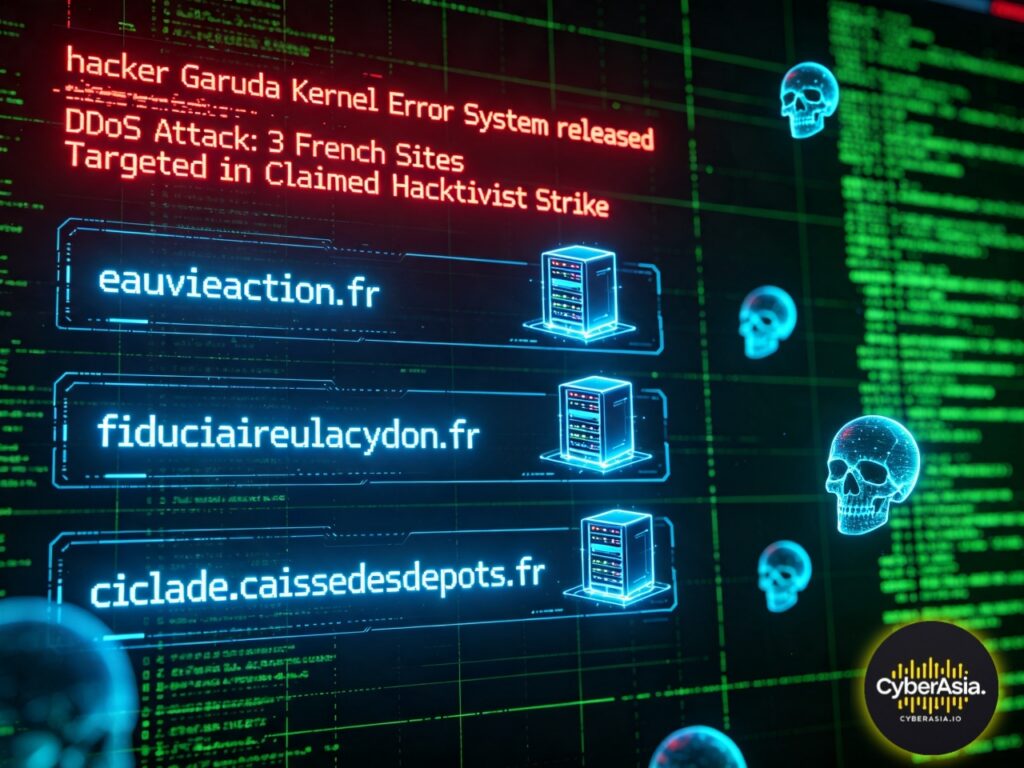
The Garuda Kernel Error System DDoS Attack represents a claimed distributed denial-of-service campaign against three French websites, announced by the Indonesian-linked hacktivist group on 26-27 July 2026.
Executive Summary
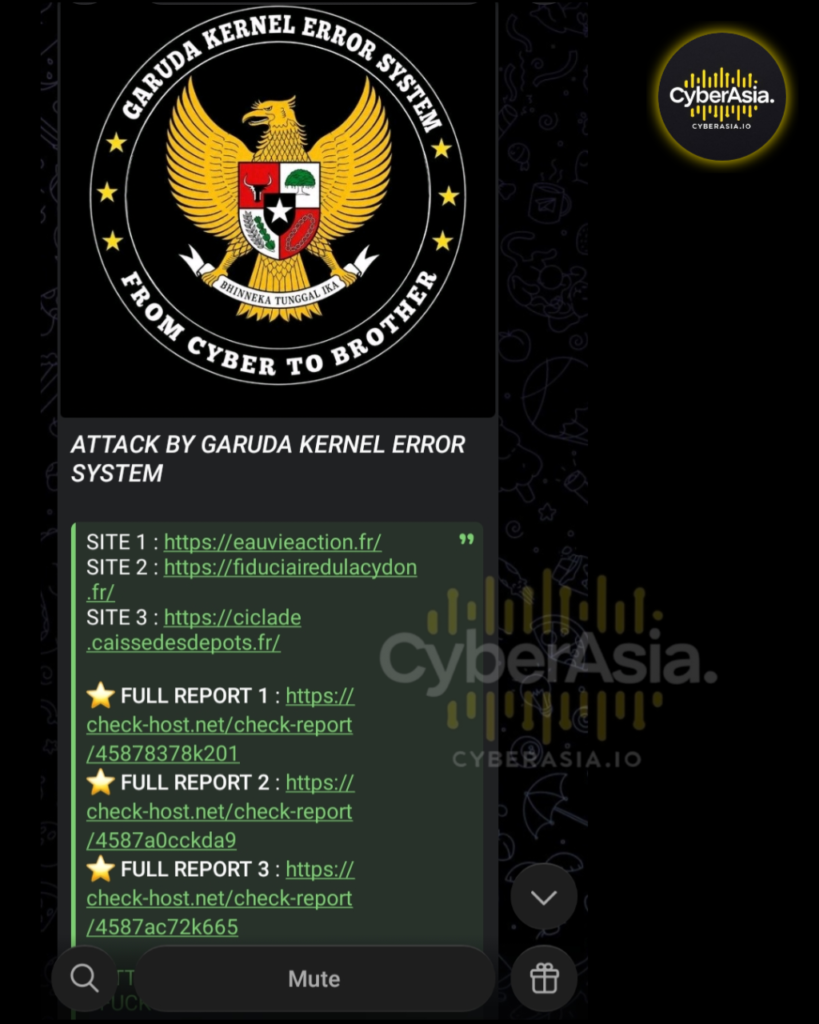
On 26 July 2026, the threat actor group identifying itself as Garuda Kernel Error System publicly claimed responsibility for a distributed denial-of-service (DDoS) operation against three French domains. The targets listed were eauvieaction.fr, fiduciaireulacydon.fr (also referred to as LACYDON TRUST), and ciclade.caissedesdepots.fr.
The group published check-host.net availability reports as supporting evidence. These reports indicated temporary unavailability from multiple geographic nodes. Independent verification of sustained outages beyond the actor-supplied data remains limited at the time of this advisory.
Garuda Kernel Error System has previously claimed similar low-to-moderate intensity DDoS activity, including earlier targeting of Israeli infrastructure. The group maintains a Telegram presence and has announced alliances with other Indonesian cyber teams.
Geopolitical Context & Motivation
Garuda Kernel Error System presents itself under Indonesian nationalist and hacktivist branding, incorporating national symbols such as the Garuda Pancasila emblem in its visual materials. The group has publicly declared alliances with other Indonesian cyber teams, framing its activities as collaborative defense of national cyber interests.
No explicit ideological manifesto accompanied the French website claims. Historical activity patterns from the group and affiliated Indonesian actors often align with opportunistic targeting of Western European and Middle Eastern entities during periods of heightened geopolitical tension. France maintains significant diplomatic and economic engagement in Southeast Asia, yet no specific bilateral trigger has been publicly linked to this incident by the actor or independent observers.
Ciclade.caissedesdepots.fr is operated under the Caisse des Dépôts, a French public financial institution responsible for managing unclaimed funds and inactive accounts under the Eckert Law. The other two domains appear to belong to private or specialized service entities. Selection of a public-sector financial services portal alongside private sites suggests opportunistic rather than highly selective targeting.
This Garuda Kernel Error System DDoS Attack fits within a broader pattern of Indonesian-linked hacktivist groups conducting visibility-driven campaigns rather than sophisticated persistent operations.
Technical Analysis: TTPs
Available evidence indicates a volumetric or application-layer distributed denial-of-service methodology. The actor supplied check-host.net reports showing elevated failure rates from multiple global probes. No malware samples, exploit chains, or secondary payloads have been associated with the claim.
Tactics observed align with common hacktivist DDoS practices:
- Use of publicly available or rented botnet capacity for traffic generation.
- Publication of third-party uptime monitoring screenshots as proof of impact.
- Telegram-based announcement and amplification through threat intelligence aggregators.
No evidence of credential stuffing, web application exploitation, data exfiltration, or website defacement has been presented. The operation appears limited to availability disruption. MITRE ATT&CK mapping places the activity primarily under Impact: Network Denial of Service (T1498) and potentially Resource Hijacking if botnet infrastructure was involved.
The group’s naming convention and visual identity reference Linux kernel error themes, yet no kernel-level exploits or sophisticated tooling have been demonstrated in this campaign. Technical sophistication remains consistent with commodity DDoS capabilities commonly accessible to low-resource hacktivist collectives.
Organizations monitoring the Garuda Kernel Error System DDoS Attack should note that such claims frequently exaggerate duration and impact. Actual traffic volumes and sustained effect require independent network telemetry for confirmation.
Impact Assessment
For the three targeted sites, temporary unavailability could disrupt user access to services. In the case of ciclade.caissedesdepots.fr, this includes public searches for unclaimed financial assets, a service used by individuals and notaries. Short-duration DDoS events typically produce limited financial or operational damage unless they coincide with peak usage periods or expose secondary weaknesses.
Broader industry impact remains low. The incident does not indicate a shift toward high-severity ransomware or supply-chain compromise by this actor. However, repeated claims against French infrastructure may increase monitoring requirements for organizations with French digital footprints or public-facing services.
Reputation risk for the targeted entities is moderate if downtime was visible to end users. For the threat actor, the primary objective appears to be visibility and recruitment signaling rather than measurable strategic disruption.
This Garuda Kernel Error System DDoS Attack underscores the continued use of basic volumetric techniques by regional hacktivist groups seeking media attention. It does not represent a novel or highly capable threat vector.
Defenders should treat the claim as an indicator of potential interest in French targets while awaiting corroborating network data. False or inflated claims remain common in this segment of the threat landscape.
Mitigation Recommendations
-
- Implement or review DDoS protection services capable of absorbing volumetric and application-layer floods, including cloud-based scrubbing and anycast routing.
- Ensure rate-limiting, CAPTCHA challenges, and behavioral analysis are active on public-facing web applications and APIs.
- Monitor for anomalous traffic spikes from known botnet source ranges and maintain updated blocklists through threat intelligence feeds.
- Validate business continuity plans for critical public services, including offline or alternative access methods for essential functions.
- Review third-party monitoring and status page accuracy to reduce the impact of actor-supplied screenshots.
- Follow guidance from authoritative sources such as the CISA DDoS guidance for detection and response procedures.
- Maintain internal documentation of similar claims for trend analysis; additional reporting is available on CyberAsia threat tracking resources.
Continued monitoring of Garuda Kernel Error System communications and related Indonesian hacktivist channels is recommended. Independent confirmation of impact should precede any elevation of threat level for French or European organizations.
This advisory is based on publicly available claims and open-source reporting as of 27 July 2026. Details may evolve as additional telemetry becomes available.