ddos
ddos
ddos
GitHub Down! 313 Team Launch DDoS Attack Against Github
> By Haider | Aug 12, 2026 | 4 min read
Is GitHub down? The world’s largest developer platform experienced a highly targeted disruption following a massive Layer-7 Distributed Denial of Service (DDoS) attack. The operation was claimed by the Islamic Cyber Resistance in Iraq (313 Team), a hacktivist collective that released an official statement via their encrypted Telegram channels detailing the disruption.
According to the group, the attack was specifically engineered to target vulnerable endpoints within GitHub’s server infrastructure, successfully disabling the website and core login panels across multiple global regions.
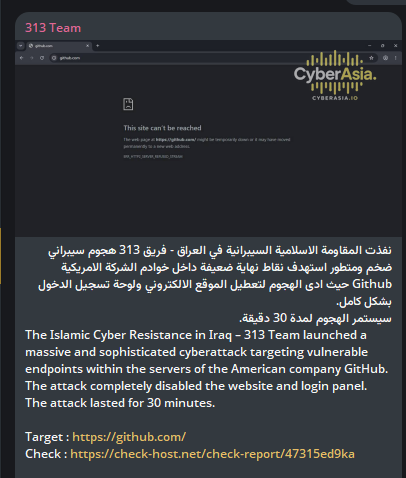
Anatomy of the GitHub DDoS Attack
While GitHub’s robust Anycast network and mitigation layers typically absorb volumetric traffic seamlessly, this particular HTTP/HTTPS flood managed to penetrate defense mechanisms long enough to register a severe spike in user reports. Monitoring platforms corroborated the group’s claims with independent telemetry.
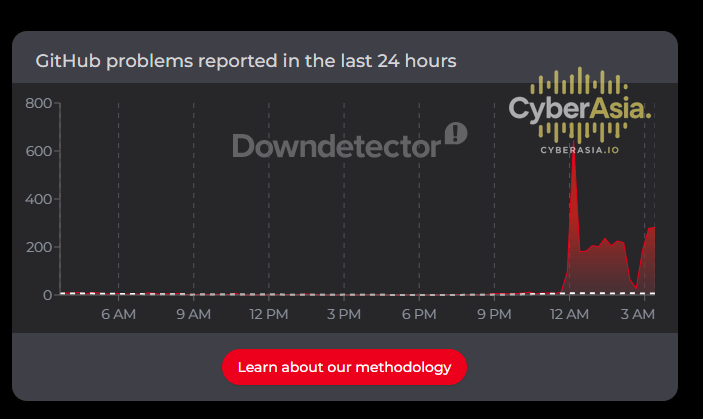
> THREAT_INTELLIGENCE_DATA: 313 TEAM OPERATION
- Target Infrastructure:
https://github.com/(Primary web interface and authentication panels). - Threat Actor: Islamic Cyber Resistance in Iraq (313 Team).
- Attack Vector: Highly sophisticated Layer-7 HTTP flood targeting authentication endpoints.
Global Outage Telemetry
Independent routing and availability checks confirmed the severity of the incident. Network diagnostics platforms such as Check-Host revealed systemic “Broken Pipe” and “503 Service Unavailable” errors originating from nodes spanning North America, Europe, and Asia.
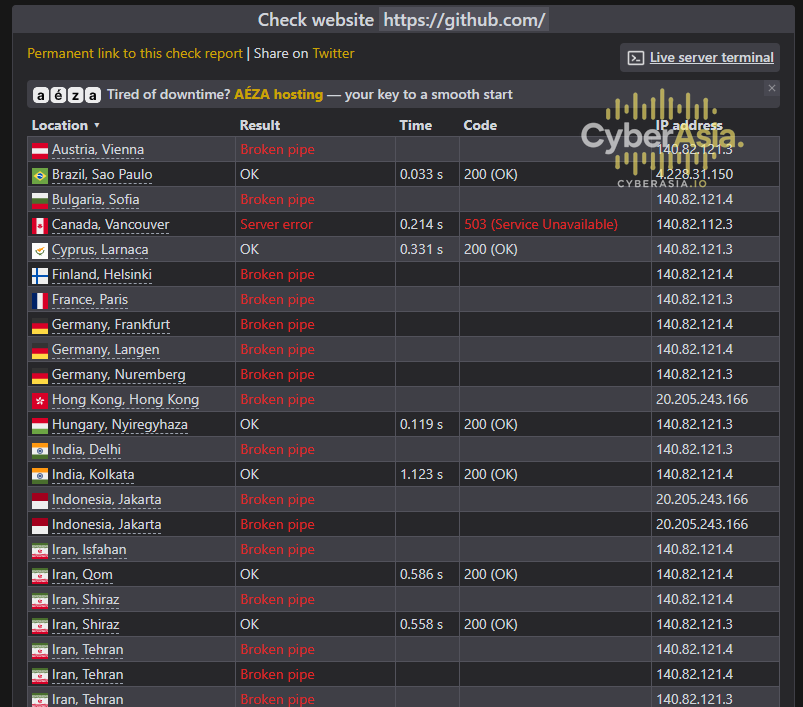
The geographical spread of the connection timeouts, from Vancouver to Frankfurt and Jakarta, indicates that the attack traffic successfully saturated GitHub’s edge nodes before automated traffic scrubbing and rate-limiting protocols could fully neutralize the threat. This pattern of hacktivist activity is consistent with prior Layer-7 campaigns documented in our NoName057(16) DDoS coverage.
Defensive Posture & Mitigation
Incidents involving platforms as massive as GitHub underscore the evolving potency of politically motivated hacktivist collectives. Organizations defending against similar Layer-7 campaigns are advised to:
- Enforce Strict API Rate Limiting: Attackers often target authentication APIs (
/login) because they require heavy backend database processing. Implement aggressive rate limits per IP and ASN on these endpoints. - Deploy Behavioral WAF Rules: Transition from static rule-sets to AI-driven Web Application Firewalls capable of distinguishing between legitimate user behavior and automated botnet traffic.
Strategic Threat Landscape & Layer 7 Disruption Analysis
The escalation of this specific cyber incident reflects a broader, systemic shift in the global threat landscape regarding distributed denial-of-service (DDoS) methodologies. Threat intelligence analysts continuously observe that the tactics, techniques, and procedures (TTPs) deployed here are rapidly becoming the standard operational blueprint for regionally aligned hacktivist collectives seeking high-visibility disruption.
In recent months, there has been a documented pivot away from traditional volumetric attacks (Layer 3/4) towards highly sophisticated Layer 7 application-layer disruptions. These attacks bypass traditional scrubbing centers by mimicking legitimate user behavior, exhausting server resources through complex database queries or API abuse. This evolution enables attackers to cripple critical infrastructure and governmental portals with significantly smaller botnets.
In addition, the convergence of geopolitical tensions and cyber operations has transformed DDoS from a mere nuisance into an instrument of international policy disagreement. Hacktivist syndicates now leverage decentralized proxy networks and compromised IoT devices to launch these campaigns anonymously, targeting organizations based on ideological alignment rather than financial gain.
Defensive Evolution & Proactive Mitigation
From a defensive standpoint, legacy perimeter security models and basic rate-limiting are no longer sufficient. Organizations must urgently transition to adopting advanced, AI-driven Web Application Firewalls (WAFs) capable of behavioral analysis and bot mitigation.
To combat this evolving threat matrix, continuous monitoring of web traffic baselines and the deployment of elastic, cloud-based infrastructure are critical. In addition, the integration of automated Threat Intelligence Platforms (TIPs) allows organizations to proactively block malicious IPs and known proxy exit nodes before an attack reaches critical mass.
> DISCLAIMER
The information provided in this article is for educational and threat intelligence purposes only. CyberAsia does not condone, promote, or encourage any illegal activities. The claims reported herein are based on open-source intelligence published by threat actors on dark web and encrypted channels.
> subscribe_to_intel
Join 5,000+ analysts. Get uncensored threat intelligence and breach alerts delivered directly to your inbox. Privacy Policy.
Mitigation & Prevention Strategies
To defend against advanced Layer 7 and volumetric DDoS attacks observed in these campaigns, organizations should implement the following defensive postures:
- Edge Protection: Deploy robust Web Application Firewalls (WAF) and Anti-DDoS solutions configured to challenge anomalous request rates (e.g., CAPTCHA or JS challenges) before they hit origin servers.
- Geographic Rate Limiting: If the threat actor originates from or utilizes botnets concentrated in specific regions, enforce geo-blocking rules for non-essential traffic.
- Infrastructure Scaling: Ensure load balancers and auto-scaling groups are optimized to absorb sudden traffic spikes while maintaining core service availability.
Disclaimer: The information presented in this threat intelligence report is for educational and cybersecurity research purposes only. CyberAsia reports on cyber incidents to help organizations understand and defend against emerging threats. We do not provide hacking instructions, host stolen data, or endorse illegal activities.
> INTELLIGENCE_NOTICE
The report above detailing GitHub Down! 313 Team Launch DDoS Attack Against Github is part of the CyberAsia public archive. For organizations requiring real-time attack telemetry, check-host latency records, and edge firewall mitigation strategies for ddos incidents, please refer to our Secure Drop or contact the research desk.