ddos
ddos
ddos
Pro-Palestinian Hacktivist Group Claims Downtime Attacks on Three Israeli Websites
> By Clara | May 10, 2026 | 3 min read
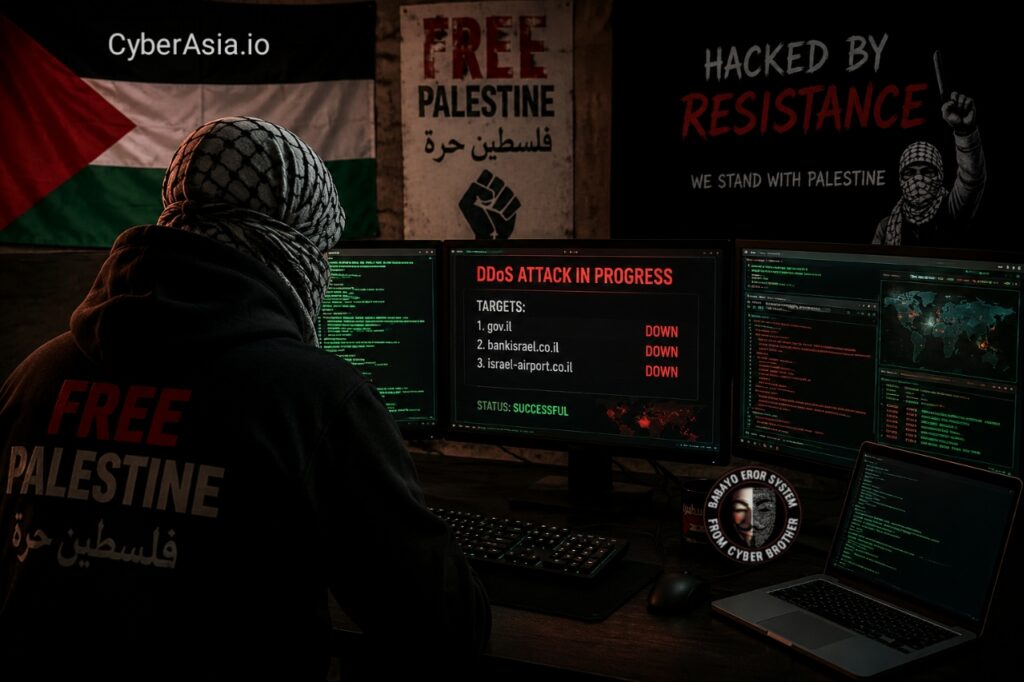
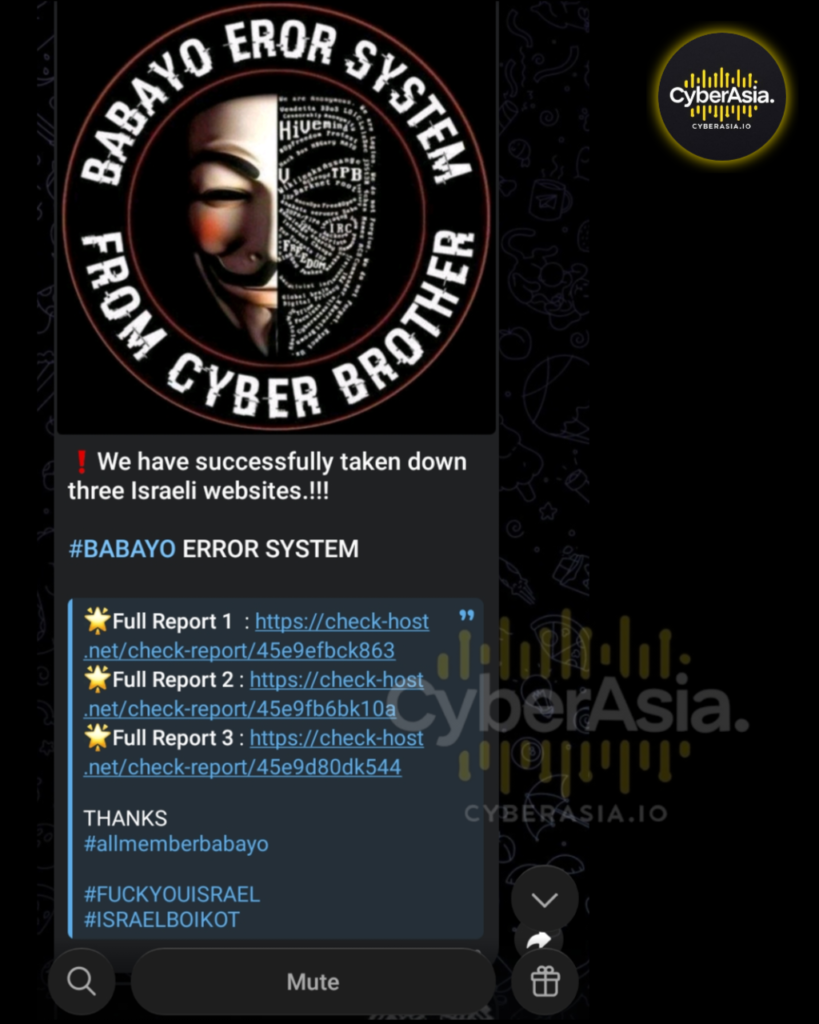
A hacktivist group identifying itself as the “BABAYO Error System” says it disrupted three Israeli websites, publishing Check-Host uptime reports as evidence. The claim has not been independently verified beyond the third-party monitoring data the group itself shared.
What Happened
The group posted an announcement across its channels stating it had knocked three Israeli websites offline, tagging the operation “#BABAYO Error System” and crediting an allied entity referred to as “Cyber Brother.” Alongside the claim, the actors linked to three separate Check-Host reports , a legitimate third-party service that tests whether a website is reachable from multiple global nodes , presenting the results as proof the sites were down at the time of testing.
Check-Host results reflect a snapshot of reachability at a single point in time and do not by themselves confirm the cause of an outage. They are commonly cited by hacktivist groups after distributed denial-of-service (DDoS) attempts, but a report showing downtime does not independently establish which technique , DDoS, server misconfiguration, hosting issues, or something else , was responsible.
Who Was Affected
The named targets are three Israeli-registered (.co.il) websites. Based on their domain names, they appear to belong to small or mid-sized private businesses rather than government, financial, or critical-infrastructure operators , a distinction that matters for assessing real-world impact.
toprope.co.il
ilanglass.co.il
goldenfestival.co.il
Note: These reports were supplied by the threat actor as self-reported evidence. CyberAsia has not independently confirmed the outages, their cause, or their duration.
Technical Details
No technical breakdown , such as attack vector, traffic volume, or duration , has been published by the group beyond the Check-Host links. There is no evidence at this time of data theft, defacement, or backend compromise; the claim, as presented, describes an availability disruption (the site becoming unreachable) rather than a breach.
Threat Actor Background
“BABAYO Error System” appears to be a hacktivist-branded identity that has previously used politically charged messaging alongside its claimed operations. Its stated motivation, based on the group’s own framing, is opposition to Israel, consistent with a wave of pro-Palestinian hacktivist activity , largely low-sophistication DDoS and defacement campaigns , that has targeted Israeli-linked web infrastructure intermittently since 2023. CyberAsia has not been able to independently verify the group’s size, location, or any affiliation with other named collectives.
Potential Impact
If accurate, the disruptions described would likely be temporary and limited to public-facing availability rather than a deeper compromise. For small business websites, a short outage can still mean lost sales, reputational friction, and support overhead, but it falls well short of the impact associated with data breaches or infrastructure-level attacks.
Response and Mitigation
None of the three named organizations has issued a public statement, and CyberAsia has not been able to confirm whether they were notified. Standard mitigation for suspected DDoS activity includes enabling a web application firewall or DDoS-scrubbing service, rate-limiting suspicious traffic, and monitoring hosting-provider status pages for corroborating outage data.
Bottom Line
This remains a claimed, self-reported incident. CyberAsia will update this report if the affected organizations, their hosting providers, or independent researchers confirm additional details.
Editorial note: This article omits promotional slogans and hashtags used in the original threat-actor post, as they constitute inflammatory rhetoric rather than verifiable information. All claims of impact are attributed to the threat actor and marked as unverified.
Mitigation & Prevention Strategies
To defend against advanced Layer 7 and volumetric DDoS attacks observed in these campaigns, organizations should implement the following defensive postures:
- Edge Protection: Deploy robust Web Application Firewalls (WAF) and Anti-DDoS solutions configured to challenge anomalous request rates (e.g., CAPTCHA or JS challenges) before they hit origin servers.
- Geographic Rate Limiting: If the threat actor originates from or utilizes botnets concentrated in specific regions, enforce geo-blocking rules for non-essential traffic.
- Infrastructure Scaling: Ensure load balancers and auto-scaling groups are optimized to absorb sudden traffic spikes while maintaining core service availability.
Disclaimer: The information presented in this threat intelligence report is for educational and cybersecurity research purposes only. CyberAsia reports on cyber incidents to help organizations understand and defend against emerging threats. We do not provide hacking instructions, host stolen data, or endorse illegal activities.
> INTELLIGENCE_NOTICE
The report above detailing Pro-Palestinian Hacktivist Group Claims Downtime Attacks on Three Israeli Websites is part of the CyberAsia public archive. For organizations requiring real-time attack telemetry, check-host latency records, and edge firewall mitigation strategies for ddos incidents, please refer to our Secure Drop or contact the research desk.