 ddos
ddos
NoName05716 Estonia Cyber Attack: 7 Critical Government Portals Targeted
> By Haider | Aug 31, 2026 | 6 min read
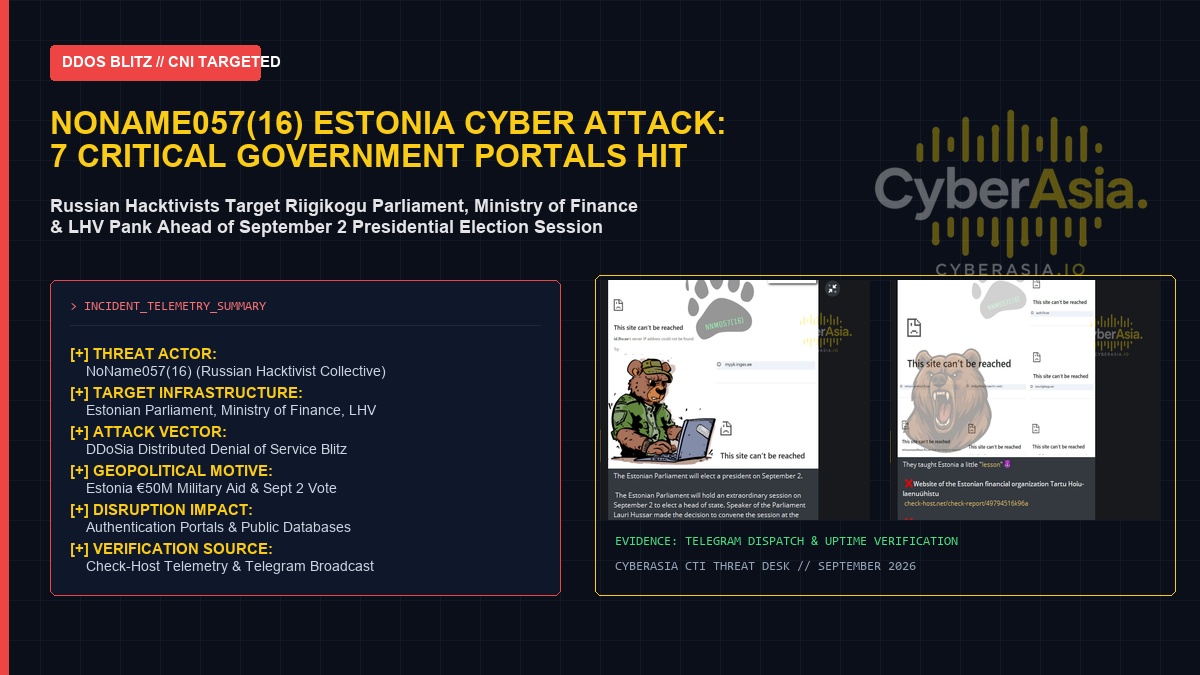
In a coordinated distributed denial of service campaign, the NoName05716 Estonia Cyber Attack has targeted seven critical government portals, parliamentary databases, and financial authentication gateways across Estonia. The pro-Russian hacktivist collective NoName057(16) launched the wave of digital assaults directly ahead of the extraordinary session of the Estonian Parliament (Riigikogu) scheduled for September 2 to elect the head of state. Threat actors explicitly cited Tallinn’s steadfast military assistance to Ukraine, which exceeded €50 million in 2026, as the primary geopolitical motivation for the synchronized offensive.
> TABLE_OF_CONTENTS [toggle]
Geopolitical Motive and Timeline of the NoName05716 Estonia Cyber Attack
The operational timing of this latest NoName05716 Estonia Cyber Attack is calculated to inflict maximum political and psychological disruption. On August 28, Speaker of the Parliament Lauri Hussar announced that an extraordinary parliamentary sitting would convene on September 2, 2026, following the formal suggestion of President Alar Karis to conduct the presidential election.
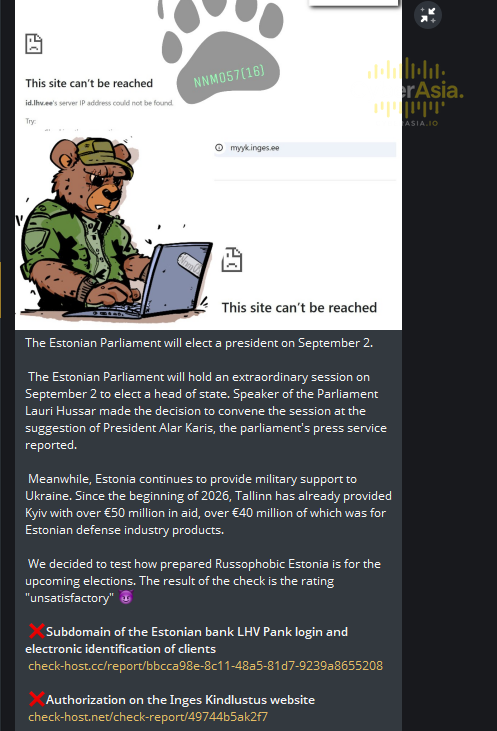
Simultaneously, Estonia remains one of Ukraine’s most committed European defense partners per capita. Since the beginning of 2026, Tallinn has delivered over €50 million in military aid to Kyiv, with more than €40 million allocated directly for Estonian defense industry procurement. In retaliation, NoName057(16) proclaimed on their public Telegram channels that they initiated the NoName05716 Estonia Cyber Attack to “test how prepared Russophobic Estonia is for the upcoming elections,” rating the nation’s baseline defensive readiness as unsatisfactory.
This incident reflects a broader pattern of hybrid digital aggression targeting Baltic NATO members whenever significant parliamentary votes or diplomatic aid packages are ratified. By concentrating packet swarms on legislative systems, the NoName05716 Estonia Cyber Attack seeks to manufacture an impression of institutional vulnerability.
Targeted Critical Infrastructure: 7 Key State and Financial Portals
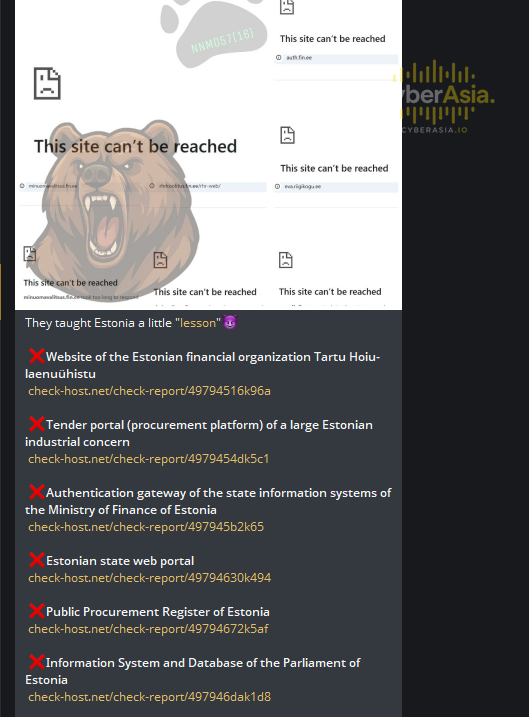
Telemetry reports verified through independent network latency benchmarks confirm that the NoName05716 Estonia Cyber Attack concentrated volumetric HTTP flood payloads against seven high-value targets spanning parliamentary administration, national procurement, and commercial banking:
> TARGETED_ESTONIAN_INFRASTRUCTURE_NODES
- Parliament Information System (
eva.riigikogu.ee): The legislative database and document management system utilized by Estonian lawmakers and parliamentary staff. - Ministry of Finance Auth Gateway (
auth.fin.ee): Central single sign-on (SSO) and client authentication portal for national financial administration systems. - LHV Pank Electronic ID Portal (
id.lhv.ee): Electronic identification and client login gateway for one of Estonia’s largest domestic retail and corporate banking institutions. - Public Procurement Register (
rhrkoolitus.fin.ee): State procurement portal managing governmental tenders and commercial bids across the republic. - Local Government State Web Portal (
minuomavalitsus.fin.ee): Municipal administrative platform connecting citizens with regional public services. - Tartu Hoiu-laenuühistu Financial System: Major regional financial and loan cooperative serving commercial and agricultural enterprises.
- Inges Kindlustus Insurance Platform (
myyk.inges.ee): Commercial policy issuance and client authorization portal.
By directing distributed packet floods at authentication endpoints like id.lhv.ee and auth.fin.ee, the NoName05716 Estonia Cyber Attack sought to lock legitimate citizens out of essential civil and banking workflows during a period of high national political attention.
Technical Analysis: The DDoSia Botnet Architecture
The technical engine driving the NoName05716 Estonia Cyber Attack is the group’s custom crowd-sourced botnet framework known as DDoSia. First identified in early 2022, DDoSia enables non-technical volunteer participants to install automated flooding clients across Windows, Linux, Android, and macOS workstations.
[CTI ANALYST INSIGHT] “NoName057(16) incentivizes its volunteer network through automated cryptocurrency payouts distributed via TON and Bitcoin wallets, rewarding operators whose client nodes contribute the highest volume of successful Layer 7 HTTP/HTTPS requests against targeted Western infrastructure.”
During the ongoing NoName05716 Estonia Cyber Attack, DDoSia nodes received dynamic target lists pushed via encrypted Telegram channels and command-and-control (C2) servers. The botnet executes multi-threaded Layer 7 requests designed to emulate legitimate user agent headers, bypassing basic rate-limiting controls and overwhelming backend application servers with computationally expensive TLS handshakes and complex database queries.
Threat intelligence analysts map the adversary’s operations against MITRE ATT&CK T1498 (Network Denial of Service) and MITRE ATT&CK T1499 (Endpoint Denial of Service). Similar to previous CyberAsia investigations into hacktivist botnet campaigns, the group emphasizes psychological visibility over permanent data destruction.
Because DDoSia relies on heavily distributed geographical client nodes, traditional IP-based blacklists often struggle to suppress incoming swarms without inadvertently blocking genuine international traffic. This tactical characteristic makes the NoName05716 Estonia Cyber Attack an ongoing challenge for incident response units guarding civic infrastructure.
Defensive Countermeasures and National Cyber Resilience
Estonia’s Information System Authority (Riigi Infosüsteemi Amet: RIA) and the national Computer Emergency Response Team (CERT-EE) maintain sophisticated automated scrubbers and Content Delivery Network (CDN) shielding to mitigate DDoS campaigns. To counter the NoName05716 Estonia Cyber Attack and protect public infrastructure during election cycles, organizations should implement the following defensive actions:
- Implement Geo-Blocking & ASN Rate Limiting: Enforce strict rate-limiting on ingress traffic originating from geographic regions and Autonomous System Numbers (ASNs) with no operational requirement to access domestic administrative portals during the NoName05716 Estonia Cyber Attack.
- Deploy Managed Web Application Firewalls (WAF): Configure behavioral Layer 7 inspection rules to challenge suspicious HTTP request floods that exhibit repetitive TLS client hello fingerprints characteristic of DDoSia binaries.
- Decouple Authentication Frontends from Backend Core Databases: Implement caching proxies for authentication gateways like
auth.fin.eeto ensure authentication services remain responsive even when public portals experience traffic spikes. - Establish Redundant DNS Anycast Routing: Route critical governmental domain names through globally distributed Anycast DNS infrastructure to prevent DNS resolution failures during high-volume UDP amplification attacks.
Frequently Asked Questions
Q1: What triggered the NoName05716 Estonia Cyber Attack?
The cyber assault was triggered by Estonia’s continued military support for Ukraine (€50+ million in 2026) and timed to disrupt national attention ahead of the Estonian Parliament’s extraordinary presidential election session on September 2.
Q2: What specific institutions were targeted in the attack?
Targets included the legislative database of the Estonian Parliament (Riigikogu), the Ministry of Finance authentication gateway, LHV Pank’s electronic identification portal, the Public Procurement Register, local government portals, and regional financial cooperatives.
Q3: Did the NoName05716 Estonia Cyber Attack result in data breaches or stolen funds?
No. The campaign was strictly a volumetric Layer 7 Distributed Denial of Service (DDoS) operation designed to cause temporary service unavailability. No database exfiltration, unauthorized fund transfers, or permanent server destruction occurred.
Disclaimer: The information presented in this threat intelligence report is for educational and cybersecurity research purposes only. CyberAsia reports on cyber incidents to help organizations understand and defend against emerging threats. We do not provide hacking instructions, host stolen data, or endorse illegal activities.
> INTELLIGENCE_NOTICE
The report above detailing NoName05716 Estonia Cyber Attack: 7 Critical Government Portals Targeted is part of the CyberAsia public archive. For organizations requiring real-time attack telemetry, check-host latency records, and edge firewall mitigation strategies for ddos incidents, please refer to our Secure Drop or contact the research desk.