 ddos
ddos
ddos
Azrieli Group DDoS Attack: OpZionist V2 Outage Alert
> By Clara | Oct 17, 2026 | 6 min read
The Azrieli Group DDoS attack began on paper on September 16, 2026, when the hacktivist collective RipperSec posted the Israeli property developer’s website, web ports and a launch time under its OpZionist V2 banner. Within minutes, outside probes in dozens of countries were reporting timeouts for azrieligroup.com.
Whether those timeouts mean a real outage or a partly successful defense is still unclear. The screenshots point both ways, and the material reviewed by CyberAsia.io contains no statement from Azrieli Group.
> TABLE_OF_CONTENTS [toggle]
- > OpZionist V2 Post Names Azrieli Group as the Target
- > Check-Host Reports and Attack Console Logs
- > RipperSec: The Collective Behind OpZionist V2
- > Later Captures in the Azrieli Group DDoS Attack Timeline
- > What the Evidence Shows and What It Does Not
- > Defense Steps for Web Teams Facing a Layer 7 Flood
- > Frequently Asked Questions (FAQ)
- > Educational Notice
OpZionist V2 Post Names Azrieli Group as the Target
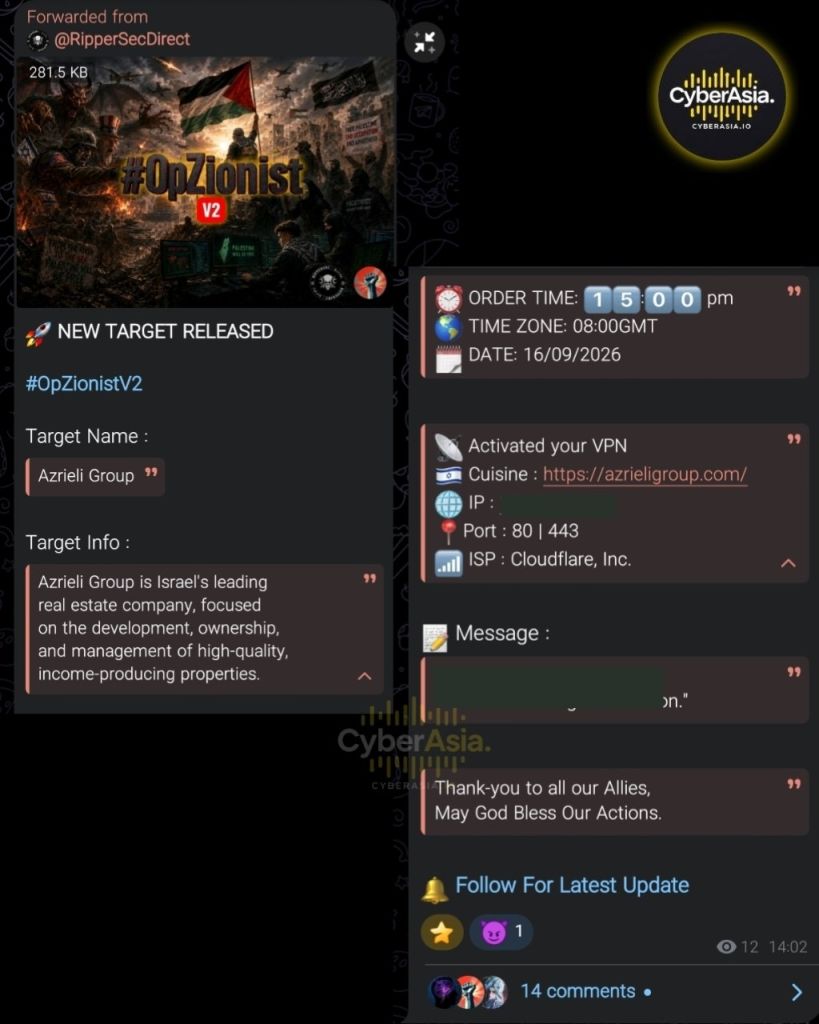
The announcement is labeled “NEW TARGET RELEASED” and carries the hashtag OpZionistV2. It names Azrieli Group and describes the business as Israel’s leading real estate company, focused on developing, owning and managing income-producing properties. Operators listed the website address, ports 80 and 443, and Cloudflare, Inc. as the network provider. The server IP address is blacked out.
The schedule is specific. The order time reads 15:00, the time zone line reads 08:00GMT, and the date is 16/09/2026. Read as GMT+8, that puts the start at 07:00 UTC. The post also tells followers to activate a VPN, which points to volunteer participation rather than a single operator. It closes by thanking allies and asking for a blessing on the group’s actions.
Check-Host Reports and Attack Console Logs
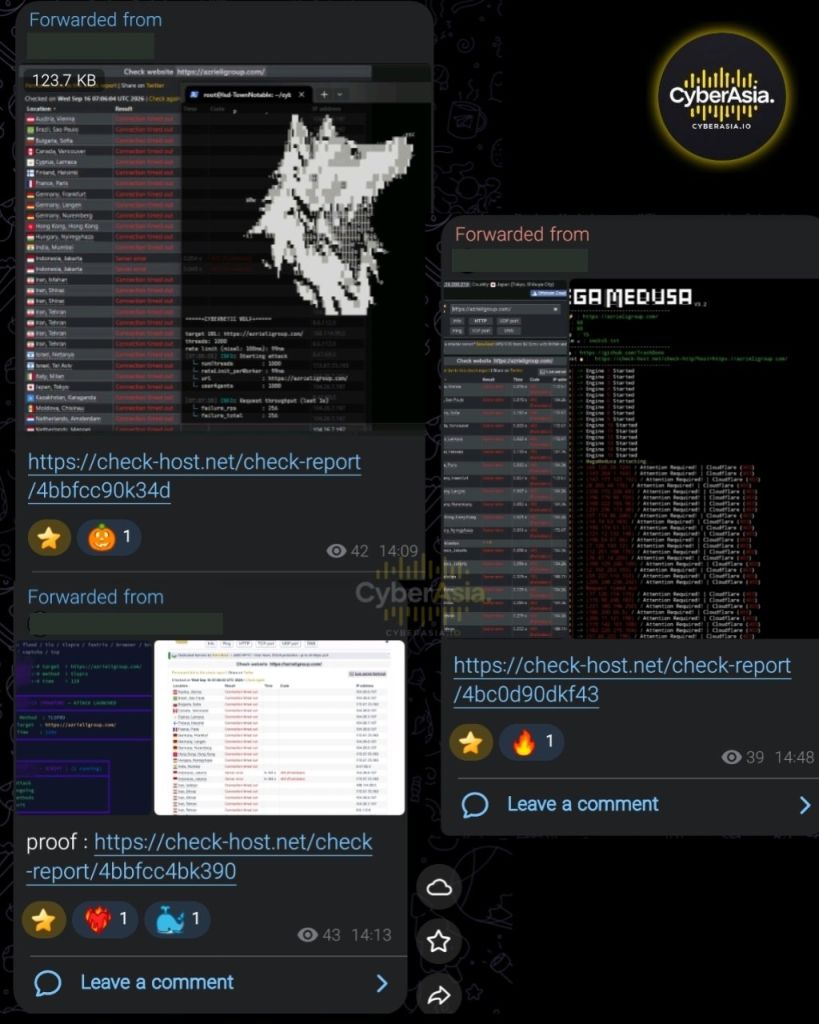
The second screenshot set bundles three forwarded posts, each pointing to a public check-host.net report. The first was captured at 07:06:04 UTC, about six minutes after the stated start. Most probe locations are marked red with connection timed out, including Austria, Brazil, Canada, Germany, Hong Kong, India, Israel and Japan. Jakarta returned a server error instead, which suggests some requests reached a server.
Terminal screenshots sit beside the reports. One shows a wolf banner and the name Cybernetic Wolf, with the Azrieli address and 1,000 threads. Another shows MegaMedusa, a Node.js Layer 7 flooding tool tied to RipperSec, and its output repeats Cloudflare “Attention Required” pages with a 403 status. A third capture shows a script listing a TLSPRO method aimed at the same address.
A 403 means Cloudflare saw the request and refused it. For defenders, that is the filter doing its job, even while outside probes reported timeouts.
RipperSec: The Collective Behind OpZionist V2
The third image is the group’s logo, a skull framed by crescent moons with the name in English and Arabic script. Threat intelligence firms describe RipperSec as a pro-Palestinian group, active since June 2023. Cyble’s profile says it has taken credit for nearly 200 DDoS operations, many aimed at Israeli government and private sector websites. Radware has analyzed MegaMedusa as the group’s public web DDoS tool.
Because the tooling is public, ordinary members can run their own floods after an announcement. For earlier operations by the same group, see related CyberAsia.io article on RipperSec hacktivist DDoS campaigns.
Later Captures in the Azrieli Group DDoS Attack Timeline
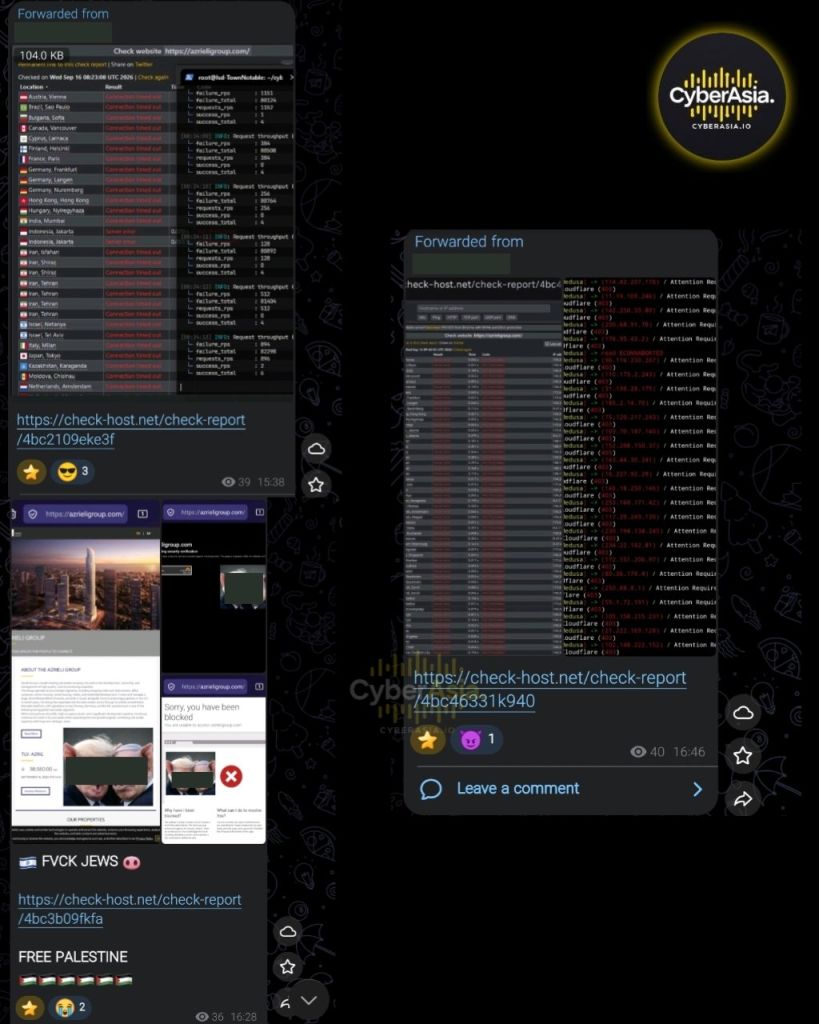
A second check-host report was captured at 08:23:00 UTC, 77 minutes after the first, and still lists connection timeouts across most of the same locations. Console lines beside it show request rates from about 130 to just over 1,100 per second, failure totals above 80,000 and success totals in single digits. Those numbers come from the attacker’s own console. They show how many requests were refused, not how the site behaved for ordinary visitors.
A browser capture shows what appears to be the company homepage, with the TLV: AZRG ticker visible, next to a page reading “Sorry, you have been blocked” in the format Cloudflare uses for firewall rejections. The post attached to it pairs a pro-Palestinian slogan with hateful language aimed at Jewish people, which CyberAsia.io does not reproduce. An edited image of two individuals has been obscured. Nothing in the material shows altered site content or access to internal systems.
What the Evidence Shows and What It Does Not
The Azrieli Group DDoS attack is documented well enough to describe its shape, but not its damage
- Shown: a named target, a scheduled start and Layer 7 requests aimed at the public website.
- Shown: repeated timeouts from outside probes at 07:06 and 08:23 UTC, plus Cloudflare 403 responses and block pages.
- Not shown: customer impact, losses on tenant or retail systems, trading effects, or data theft.
- Not shown: how long the site was truly unreachable for ordinary visitors.
Hacktivist floods usually hit public portals first, while core systems such as leasing, payments and building operations sit behind separate infrastructure. Only Azrieli Group can say what its own logs show.
Defense Steps for Web Teams Facing a Layer 7 Flood
These steps fit most setups behind a CDN or protection provider:
- Apply rate limiting per IP, session and path, and tighten it on login, search and form endpoints.
- Use managed WAF rules and bot challenges at the edge, and watch 403, 429 and 5xx rates in real time.
- Cache static pages so the origin server sees fewer requests.
- Let the origin accept traffic only from the CDN or protection provider.
- Keep a tested runbook with contacts at the CDN, the ISP and the incident team.
Frequently Asked Questions (FAQ)
Q1 : Did the Azrieli Group DDoS attack take the website offline?
The evidence is mixed. Outside probes showed timeouts from many locations, yet Cloudflare 403 responses and block pages suggest filtering was active. Without Azrieli Group’s own logs, the length and reach of any outage cannot be confirmed.
Q2 : Does a Cloudflare 403 or block page mean the attack failed?
Not by itself. It means a rule rejected that request. Large floods can still strain capacity or trip rate limits for real visitors while many requests are being refused.
Q3 : Was any Azrieli Group data stolen or any system breached?
Nothing in the screenshots indicates that. The material shows traffic floods and public posts, not data dumps or internal access. A DDoS attack targets availability, not confidentiality.
Q4 : How can administrators check whether a site is down for everyone?
A public tool such as check-host.net tests a site from many locations at once. Compare the results with your own uptime monitor and CDN dashboard, because firewall rules can block one probe network while real users are fine.
Q5 : What should an admin do in the first hour of a Layer 7 flood?
Confirm the pattern in CDN and server logs, enable stricter rate limits and bot challenges, restrict direct origin access, and contact the CDN and ISP support teams.
Educational Notice
This article is published for cyber security education and awareness only. It reports on public posts and screenshots reviewed by CyberAsia.io and does not encourage or provide instructions for any attack. Readers should not access, disrupt or test any system without written authorization.
Disclaimer: The information presented in this threat intelligence report is for educational and cybersecurity research purposes only. CyberAsia reports on cyber incidents to help organizations understand and defend against emerging threats. We do not provide hacking instructions, host stolen data, or endorse illegal activities.
> INTELLIGENCE_NOTICE
The report above detailing Azrieli Group DDoS Attack: OpZionist V2 Outage Alert is part of the CyberAsia public archive. For organizations requiring real-time attack telemetry, check-host latency records, and edge firewall mitigation strategies for ddos incidents, please refer to our Secure Drop or contact the research desk.