ddos
ddos
ddos
Proton Under Siege: Iraqi Threat Actor 313 Team Claims Massive Outage Disrupting Global Encrypted Services
> By Haider | Aug 27, 2026 | 5 min read
STRATEGIC_INCIDENT_ALERT // INFRASTRUCTURE_DISRUPTION_CAMPAIGN
THREAT_ACTOR: 313 TEAM (ISLAMIC CYBER RESISTANCE IN IRAQ)
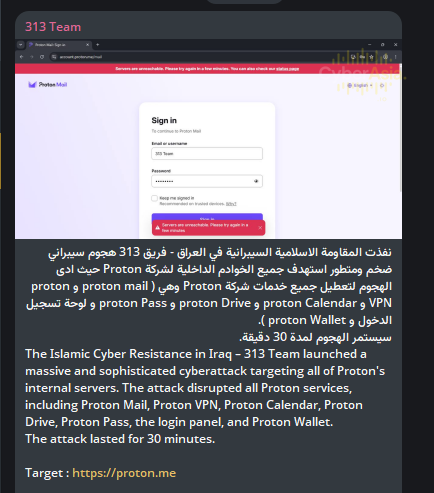
In a major escalation targeting global privacy and secure communications infrastructure, Iraqi threat group 313 Team claimed responsibility for launching a massive distributed denial of service (DDoS) assault against Swiss privacy giant Proton AG (proton.me). The coordinated attack triggered a cascading multi-hour blackout, knocking Proton Mail, Proton VPN, Proton Drive, Proton Pass, and Proton Wallet offline across international regions.
> TABLE_OF_CONTENTS [toggle]
- > 1. Attribution and Profile of 313 Team (Islamic Cyber Resistance in Iraq)
- > 2. Telemetry Verification: DownDetector Spikes and Global Service Paralysis
- > 3. Operational Defiance and The ‘Cooling Failure’ Narrative Dispute
- > 4. Technical Analysis: Layer 7 HTTP Flood vs Infrastructure Overload
- > 5. Actionable Defense: Hardening Privacy Infrastructure Against Multi-Vector DDoS
- - For Enterprise Privacy Providers and Infrastructure Architects:
- - For Privacy Advocates, Journalists, and Proton Users:
1. Attribution and Profile of 313 Team (Islamic Cyber Resistance in Iraq)
Operating under the banner of the Islamic Cyber Resistance in Iraq (المقاومة الاسلامية السيبرانية في العراق – فريق 313), the collective represents a prominent faction within the ideologically aligned Middle Eastern cyber axis. The group frequently conducts high-volume network disruption operations, target defacements, and infrastructure denial campaigns against Western corporate assets, regional government nodes, and critical communications backbones.
As highlighted in CyberAsia’s comprehensive intelligence report on Underground Hacktivist Alliances, Iraqi threat cells routinely coordinate tactical barrages with allied regional collectives, including the Cyber Islamic Resistance Axis (CIRA) and Holy League fronts, orchestrating synchronized Layer 7 application floods to saturate enterprise Anycast perimeter defenses.
> THREAT_ACTOR_DOSSIER // 313_TEAM_PROFILE
- Threat Collective: 313 Team (Islamic Cyber Resistance in Iraq)
- Primary Operational Vector: Distributed Denial of Service (Layer 4/7 DDoS), Infrastructure Saturation
- Targeting Scope: Western Critical Infrastructure, Enterprise Privacy Networks, Geopolitical Portals
- Regional Theater: Iraq, Middle East, and Transnational Cyber Confrontations
2. Telemetry Verification: DownDetector Spikes and Global Service Paralysis
Independent network telemetry rapidly corroborated the severity of the operational disruption. Internet monitoring platform DownDetector recorded an immediate vertical spike exceeding thousands of user-submitted error reports, with primary impact centers concentrated across Europe, North America, and parts of Asia.
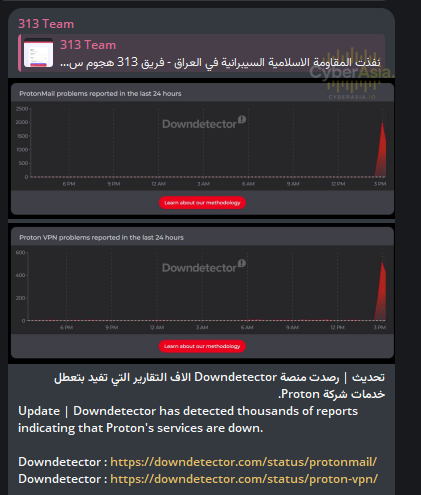
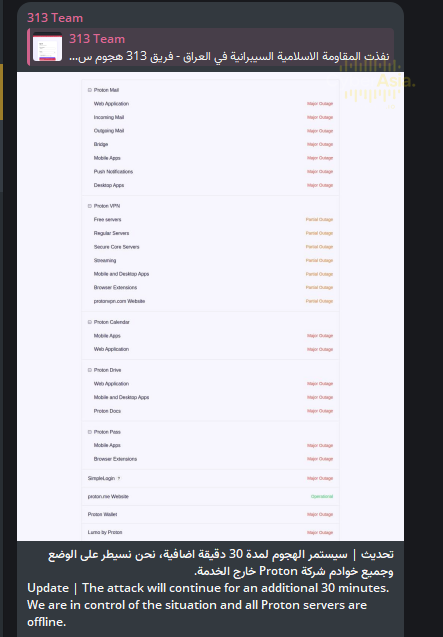
Concurrent telemetry captured from Proton’s official status monitoring node (status.proton.me) revealed comprehensive service paralysis. Rather than experiencing localized packet loss, the entire ecosystem registered an across-the-board “Major Outage” impacting all primary microservices:
- Proton Mail: Web Application, Incoming SMTP, Outgoing Mail Queues, Bridge, Mobile Apps, Desktop Clients, and Push Notification relays completely unreachable.
- Proton VPN: Free tier clusters, regular paid servers, Secure Core routing networks, streaming nodes, and browser extensions degraded into partial and major outages.
- Supporting Ecosystem: Proton Calendar, Proton Drive, Proton Pass, SimpleLogin, and Proton Wallet rendered inaccessible to end-users worldwide.
> INCIDENT_TELEMETRY // PROTON_OUTAGE_MATRIX
- Impacted Target: Proton AG Core Infrastructure (
proton.me) - DownDetector Telemetry: Severe concurrent spike exceeding 2,000+ incident reports.
- System Status: Complete “Major Outage” across Mail, VPN, Calendar, Drive, and Wallet infrastructure.
- Disruption Window: Sustained intermittent downtime exceeding two continuous hours.
3. Operational Defiance and The ‘Cooling Failure’ Narrative Dispute
As the disruption deepened, 313 Team intensified their psychological warfare campaign, publishing a photographic capture of Proton Mail’s authentication portal with the username field mocking the service with "313 Team Was Here!!" above the red system error warning: “Servers are unreachable. Please try again in a few minutes.”
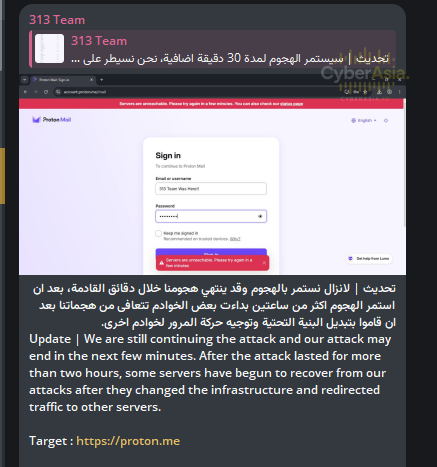
A significant point of contention emerged surrounding the root cause of the blackout. Following initial public inquiries, reports surfaced suggesting Proton attributed the widespread service collapse to internal data center cooling system failures. In a sharply worded rebuttal broadcasted on Telegram, 313 Team openly mocked this explanation, challenging the timeline and technical plausibility of the claim:
“I don’t think anyone with a brain believes Proton’s claim that the cooling systems failed and caused the Proton services to go down! If that’s the case, why didn’t you restore the service immediately? And why, two hours after the outage, did you announce that some services were restored while others weren’t?! The excuse Proton used is ridiculous.”
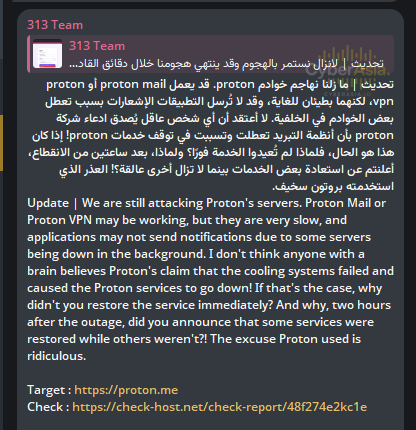
To substantiate their claims, the threat operators published live latency verification reports from Check-Host (check-host.net), showing high packet loss and complete connection timeouts across distributed global nodes during the height of the assault.
4. Technical Analysis: Layer 7 HTTP Flood vs Infrastructure Overload
While hardware failures in major data centers occasionally occur, sophisticated hacktivist syndicates frequently employ multi-vector Layer 7 application floods to overwhelm authentication endpoints (account.proton.me). Under the MITRE ATT&CK Framework, techniques cataloged under Network Denial of Service (T1498) and Endpoint Denial of Service (T1499) demonstrate how attackers exhaust backend database connection pools and cryptographic handshake threads, rendering frontend gateways entirely unresponsive.
When authentication services fail, cascading dependencies prevent secondary applications such as Proton VPN clients, mobile email sync engines, and encrypted drive vaults from validating user tokens, compounding single-point-of-failure vulnerabilities into an enterprise-wide blackout.
5. Actionable Defense: Hardening Privacy Infrastructure Against Multi-Vector DDoS
Safeguarding mission-critical privacy networks against sustained geopolitical cyber offensives demands resilient edge scrubbing, architectural redundancy, and proactive operational hygiene.
For Enterprise Privacy Providers and Infrastructure Architects:
- Deploy Anycast Edge Scrubbing with Layer 7 Challenge Proofs. Implement BGP Anycast routing distributed across geographically isolated data centers. Follow CISA DDoS Mitigation Guidelines by enforcing cryptographic proof-of-work challenges on authentication endpoints to filter malicious automated botnet queries.
- Decouple Authentication Gateways from Application Microservices. Ensure that high-volume request surges against web login interfaces do not exhaust backend database resources or block ongoing encrypted VPN tunnels and background mail delivery pipelines.
- Maintain Independent, Out-of-Band Status Pages. Host public incident status pages on fully independent, third-party infrastructure (such as Cloudflare or AWS CloudFront) to maintain uninterrupted communications during primary network outages.
- Implement Automated BGP Re-Routing and Scrubbing Pipelines. Configure automated traffic redirection to on-demand scrubbing centers the moment anomalous bandwidth or packet-per-second thresholds are breached. For secure incident reporting, utilize CyberAsia Secure Drop.
For Privacy Advocates, Journalists, and Proton Users:
- Establish Secondary Encrypted Channels for Critical Communications. During high-impact privacy infrastructure outages, maintain backup end-to-end encrypted communication avenues (such as Signal or self-hosted Matrix instances).
- Monitor Verified Out-of-Band Incident Portals. Always verify system recovery statuses via independent uptime telemetry monitors rather than attempting repeated rapid logins on degraded portals.
Disclaimer: The information presented in this threat intelligence report is for educational and cybersecurity research purposes only. CyberAsia reports on cyber incidents to help organizations understand and defend against emerging threats. We do not provide hacking instructions, host stolen data, or endorse illegal activities.
> INTELLIGENCE_NOTICE
The report above detailing Proton Under Siege: Iraqi Threat Actor 313 Team Claims Massive Outage Disrupting Global Encrypted Services is part of the CyberAsia public archive. For organizations requiring real-time attack telemetry, check-host latency records, and edge firewall mitigation strategies for ddos incidents, please refer to our Secure Drop or contact the research desk.