ddos
ddos
ddos
Twitch Down: 9,000 Critical Outage Reports Logged as 313 Team Strikes Core APIs
> By Haider | Aug 27, 2026 | 5 min read
CTI_INCIDENT // DISTRIBUTED_DENIAL_OF_SERVICE
RESEARCH_FOCUS: TWITCH DOWN INCIDENT
A massive Twitch Down incident has been confirmed following a targeted cyber offensive claimed by the Iraqi hacktivist group 313 Team (Islamic Cyber Resistance in Iraq). The distributed denial-of-service (DDoS) operation specifically targeted the Amazon-owned video streaming giant, overwhelming core Application Programming Interfaces (APIs) and disabling stream accessibility for millions of users worldwide.
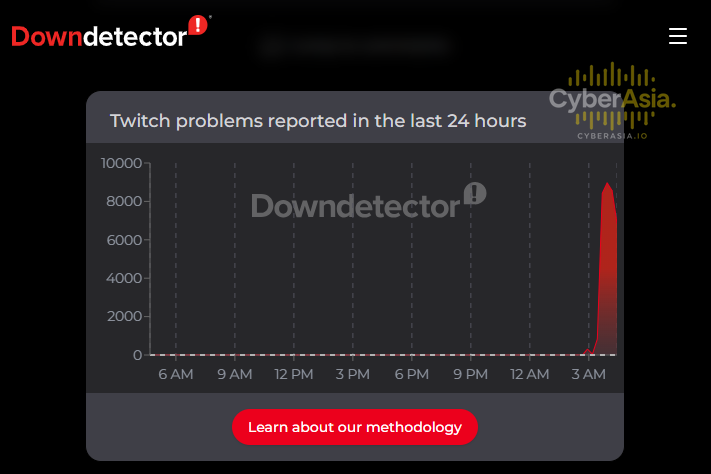
During the peak of the intrusion, users attempting to access channel feeds or browse stream categories were met with broken client interfaces, missing recommendation cards, and recurrent HTTP 503 backend service errors. A wave of Twitch Down alerts swept through community forums as telemetry aggregators registered an explosive surge of nearly 9,000 incident reports within a concentrated 30-minute operational window.
> EXECUTIVE_THREAT_BRIEFING // INCIDENT_SUMMARY
- Target Entity: Twitch Interactive, Inc. (Amazon subsidiary live-streaming portal).
- Attribution: 313 Team (Islamic Cyber Resistance in Iraq / Middle Eastern Ideological Hacktivism).
- Attack Modality: High-frequency Layer 7 HTTPS request saturation directed at microservice API gateways.
- Observed Impact: 30-minute service paralysis, 9,000+ Downdetector complaints, global content delivery failure.
> TABLE_OF_CONTENTS [toggle]
- > 1. Twitch Down: Incident Overview and Attack Anatomy
- > 2. 313 Team Threat Profile: Ideological Motivation and TTPs
- > 3. Technical Analysis: MITRE ATT&CK Mapping
- > 4. Mitigation Strategies: Defending Cloud-Scale Media APIs
- > Frequently Asked Questions (FAQ)
- - Q1: Was user account data or payment information compromised during the Twitch Down incident?
- - Q2: Why did the 313 Team target Twitch rather than financial or government infrastructure?
- - Q3: How do Layer 7 API floods bypass cloud CDN protections?
1. Twitch Down: Incident Overview and Attack Anatomy
The operational disruption leading to the Twitch Down incident manifested as an aggressive, multi-threaded Layer 7 flooding campaign. Unlike conventional volumetric Layer 4 UDP amplification attacks that aim to saturate network bandwidth pipes, the 313 Team leveraged sophisticated application-layer request floods designed to exhaust backend CPU cycles and database connection pools.
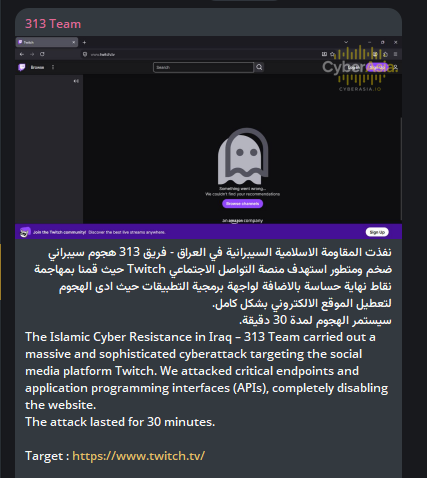
According to public claims published on the collective’s official Telegram broadcast channel, the attack directly targeted critical backend endpoints responsible for video metadata retrieval, authentication validation, and live chat synchronization. When the microservice architecture became saturated, the web client failed to render video player interfaces, displaying the iconic Twitch ghost graphic alongside the error message: “Something went wrong… We couldn’t find your recommendations.”
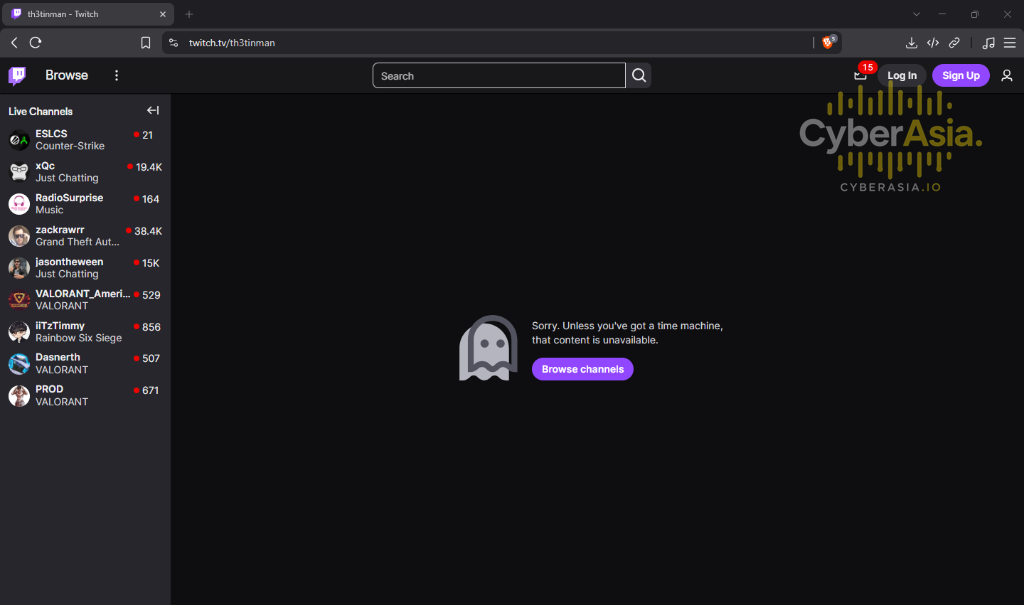
[TACTICAL INSIGHT] “Application-layer API stress floods bypass standard edge caching mechanisms by issuing computationally expensive dynamic queries. When microservices fail to scale rapidly enough, legitimate stream ingestion halts across entire geographical clusters.”
2. 313 Team Threat Profile: Ideological Motivation and TTPs
The 313 Team is an ideologically driven cyber collective originating from Iraq. Operating under the banner of regional resistance, the group routinely conducts disruptive cyber operations against Western technology platforms, government portals, and privacy infrastructure. Their operational playbook differs significantly from commercial cybercrime syndicates:
- High-Visibility Target Selection: Rather than targeting obscure corporate servers for monetary ransom, 313 Team prioritizes high-traffic consumer platforms like Twitch, ensuring instantaneous media coverage and community reaction.
- Pre-Announced Operational Windows: In accordance with standard hacktivist doctrine, the collective announced a predetermined 30-minute assault window, demonstrating their capability to cause temporary disruption without maintaining prolonged persistence.
- Immediate Telemetry Broadcasting: Proof-of-impact metrics, including check-host status checks and community error screenshots, were disseminated immediately across Telegram channels to validate the Twitch Down claim.
3. Technical Analysis: MITRE ATT&CK Mapping
Security analysts investigating the Twitch Down incident map the observed adversary techniques directly to the MITRE ATT&CK Framework:
- Network Denial of Service (
T1498): Adversaries coordinate distributed botnet nodes to deliver saturated traffic bursts against content delivery network (CDN) edge nodes. - Endpoint Denial of Service (
T1499): Attack payloads exploit application logic by sending rapid asynchronous GraphQL requests to exhaust backend memory buffers. - Direct Network Flooding (
T1498.001): High-volume HTTPS connection handshakes overwhelming perimeter TLS termination clusters. - Application Exploitation (
T1499.004): Crafting un-cached API calls that force relational database lockouts and worker thread exhaustion.
4. Mitigation Strategies: Defending Cloud-Scale Media APIs
To defend critical video streaming infrastructure against coordinated hacktivist surges, enterprise engineering teams must enforce rigorous layered controls aligned with CISA DDoS Mitigation Guidance:
- Dynamic API Rate Limiting: Enforce strict per-token and per-IP request throttling at the API gateway layer, automatically dropping client sessions that exceed normal browsing thresholds.
- Edge Web Application Firewall (WAF) Challenges: Deploy automated JS challenge rules and CAPTCHA verifications for incoming requests originating from known proxy nodes and commercial VPN IP blocks.
- GraphQL Query Cost Analysis: Implement query depth limits and computational cost analyzers on public GraphQL endpoints to reject overly complex nested data queries before execution.
- Threat Exposure Auditing: Organizations can assess their digital attack surface using the CyberAsia Cyber Risk Checker or securely transmit technical threat telemetry via CyberAsia Secure Drop.
Frequently Asked Questions (FAQ)
Here are the key technical questions surrounding the Twitch Down DDoS incident:
Q1: Was user account data or payment information compromised during the Twitch Down incident?
No. The attack was strictly a Layer 7 denial-of-service (DDoS) event targeting API availability. There is no evidence of data exfiltration, database breach, or credential theft.
Q2: Why did the 313 Team target Twitch rather than financial or government infrastructure?
Hacktivist groups prioritize public visibility and psychological resonance. Disrupting a global streaming platform generates immediate worldwide attention across social media and gaming communities.
Q3: How do Layer 7 API floods bypass cloud CDN protections?
Layer 7 attacks mimic legitimate HTTPS traffic and target dynamic, non-cached API routes. Standard volumetric filters permit the traffic through to backend microservices, causing processing bottlenecks unless specialized behavioral WAF rules are triggered.
Disclaimer: The information presented in this threat intelligence report is for educational and cybersecurity research purposes only. CyberAsia reports on cyber incidents to help organizations understand and defend against emerging threats. We do not provide hacking instructions, host stolen data, or endorse illegal activities.
> INTELLIGENCE_NOTICE
The report above detailing Twitch Down: 9,000 Critical Outage Reports Logged as 313 Team Strikes Core APIs is part of the CyberAsia public archive. For organizations requiring real-time attack telemetry, check-host latency records, and edge firewall mitigation strategies for ddos incidents, please refer to our Secure Drop or contact the research desk.