Defacement
~/ › Defacement › article
Defacement
“Khilafah Hackers” Deface 5 Israeli Websites, Cite Ties to Cyber Ummah Alliance
> By Clara | Aug 31, 2026 | 6 min read
A coordinated wave of cyber defacements surfaced across the weekend as Khilafah Hackers Deface 5 Israeli Websites, replacing commercial and municipal landing pages with pro-Palestinian ideological statements and religious emblems. The collective publicly tied the defacement operation to a broader coalition identifying as the Cyber Ummah Alliance, targeting exposed content management systems across the .co.il domain namespace.
What Happened
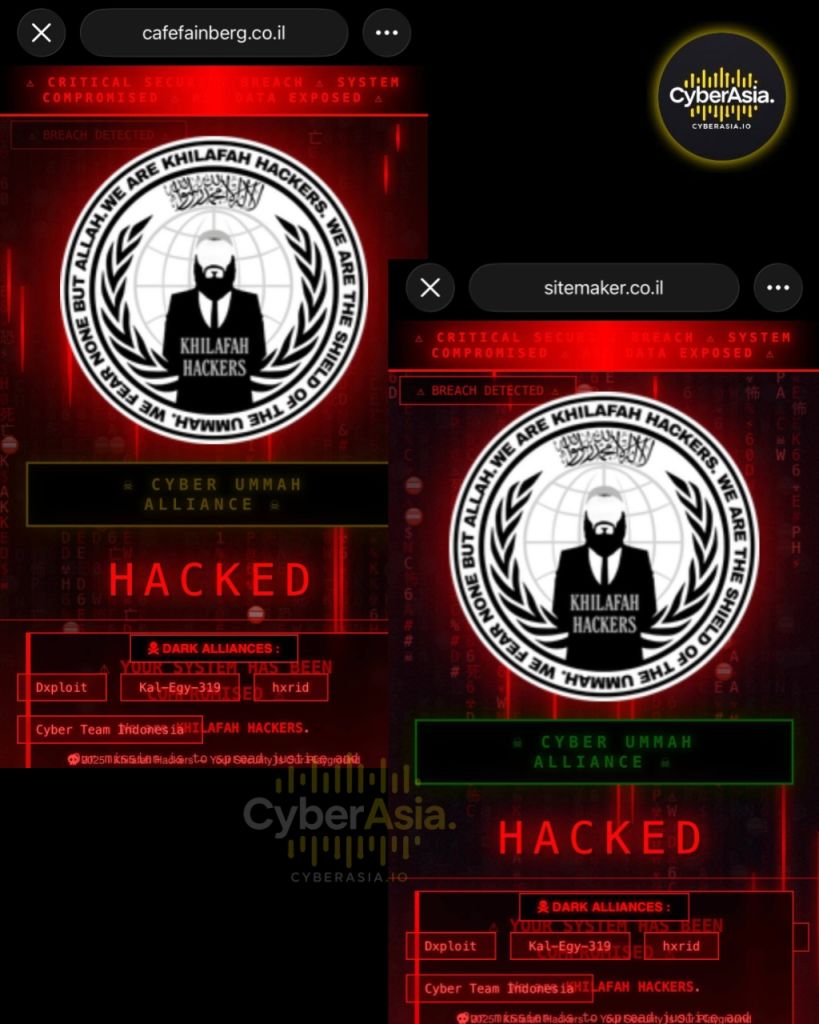
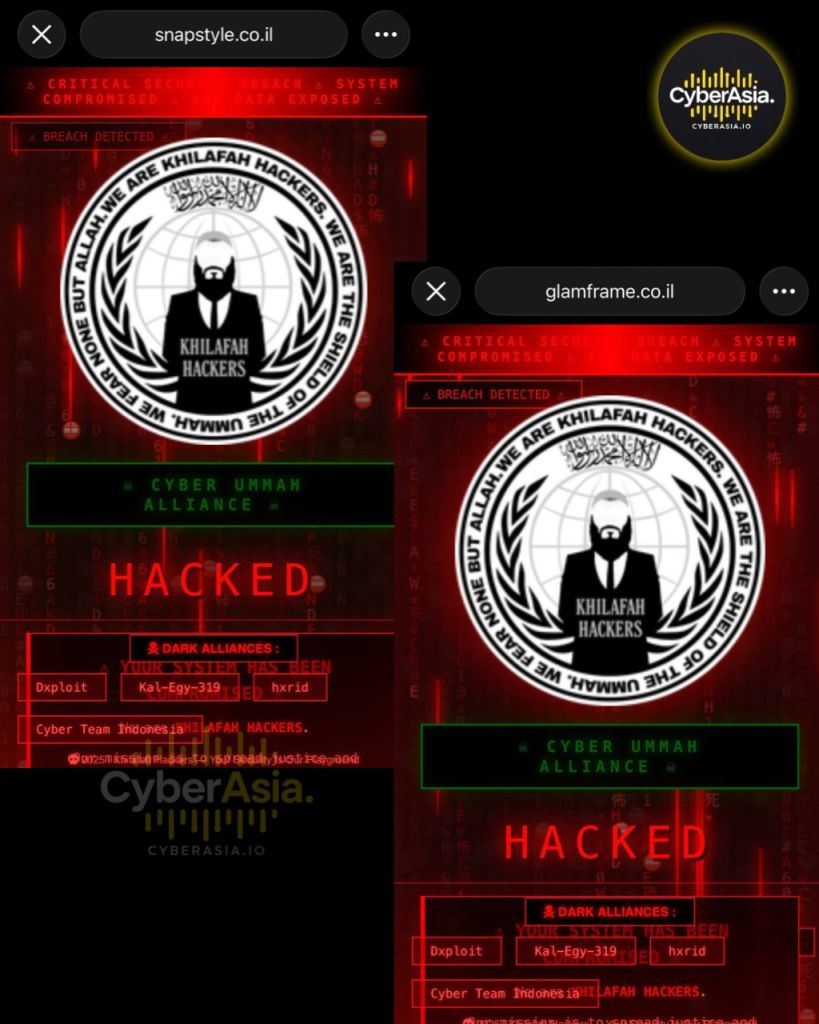
Based on screenshots reviewed and visually confirmed by the CyberAsia editorial team, the original homepages of 5 websites were replaced with a dark red defacement page featuring the word “HACKED” in large capital letters. At the center of each page sits a circular emblem depicting a bearded man in a suit, surrounded by the phrase “We Fear None But Allah, We Are Khilafah Hackers, We Are The Shield of The Ummah.” This visual style closely resembles branding used by several religiously motivated hacktivist collectives in recent years.
The defacement pages also display banners reading “Critical Security Breach,” “System Compromised,” and “Data Exposed” near the top of the screen, although no accompanying evidence of stolen data samples was published alongside the message. Beneath the main emblem, the name “Cyber Ummah Alliance” appears, apparently functioning as an umbrella label for several groups involved in the operation.
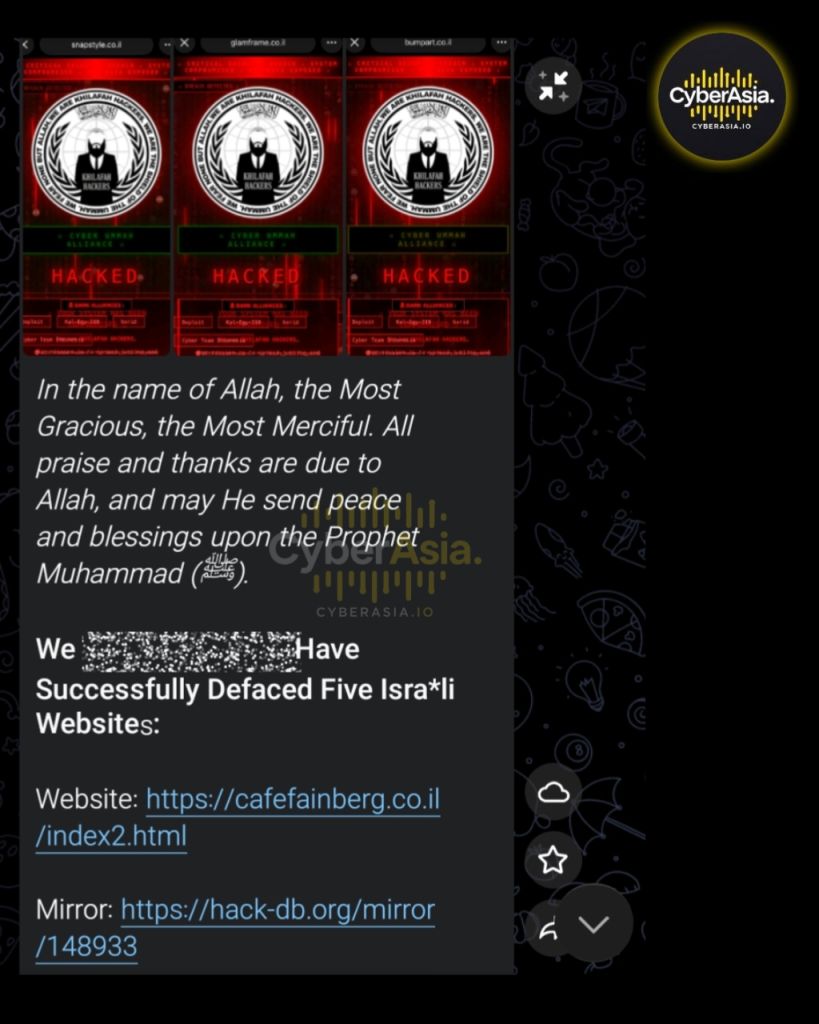
The message accompanying the defacement opens with a religious statement in English: “In the name of Allah, the Most Gracious, the Most Merciful. All praise and thanks are due to Allah, and may He send peace and blessings upon the Prophet Muhammad.” Following this opening, the message states that the group successfully altered 5 Israeli websites, complete with direct links to each affected site as well as backup mirror links hosted on a third-party archive site called hack-db.org.
Affected Websites
The 5 domains named in the defacement message are:
- cafefainberg.co.il
- sitemaker.co.il
- snapstyle.co.il
- glamframe.co.il
- bumpart.co.il
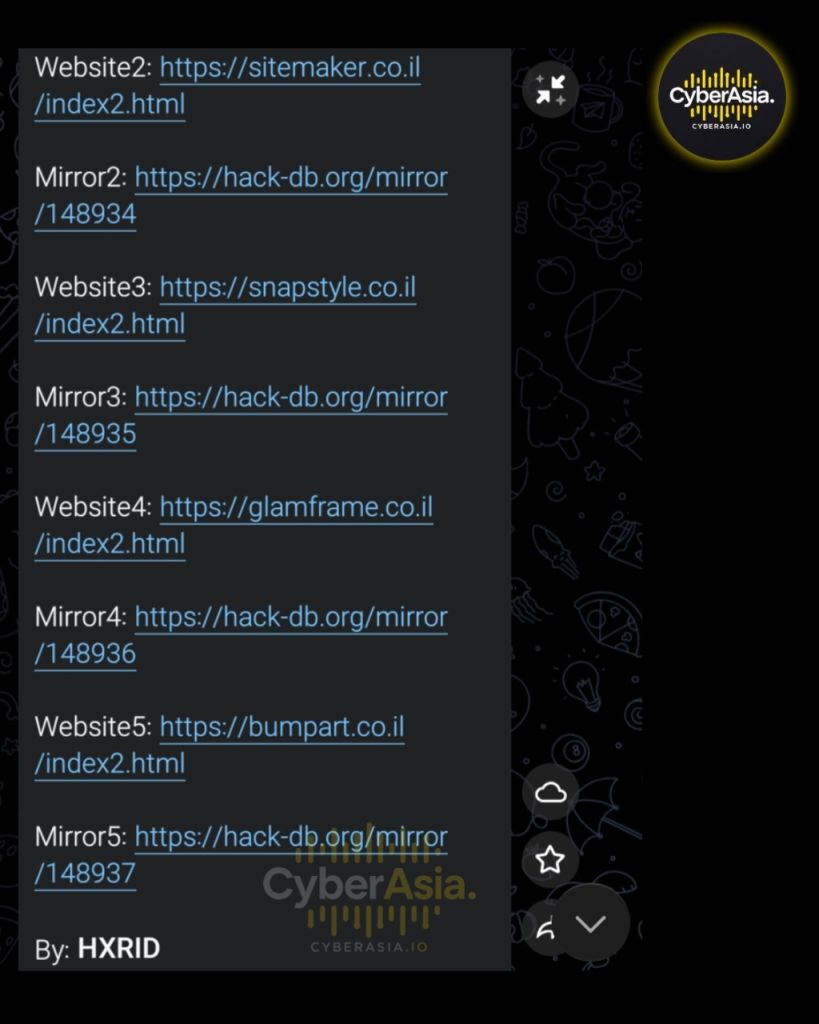
All 5 sites displayed an identical defacement layout and design, differing only in the domain name shown in the browser’s address bar. Based on their domain names, these websites appear to belong to small and medium-sized businesses, ranging from a cafe and web design service to a fashion boutique and accessories shop. There is no indication that any of these sites belong to critical infrastructure, government institutions, or major financial entities.
This pattern is consistent with common trends in politically motivated defacement campaigns, where operators often target sites with weaker security postures to maximize the number of affected targets in a short period, rather than pursuing entities with stronger cyber defenses.
Technical Details
So far, the message posted by Khilafah Hackers does not specify the exact technical method used to gain access to and alter these websites. There is no mention of a particular vulnerability, a flaw in a specific Content Management System (CMS), or an exploitation technique such as SQL injection or credential stuffing. The uniform defacement pattern across 5 different domains suggests the possibility of a shared access method, such as a common hosting management panel, weak administrator credentials, or a vulnerability in a widely used third-party plugin or template affecting smaller sites.
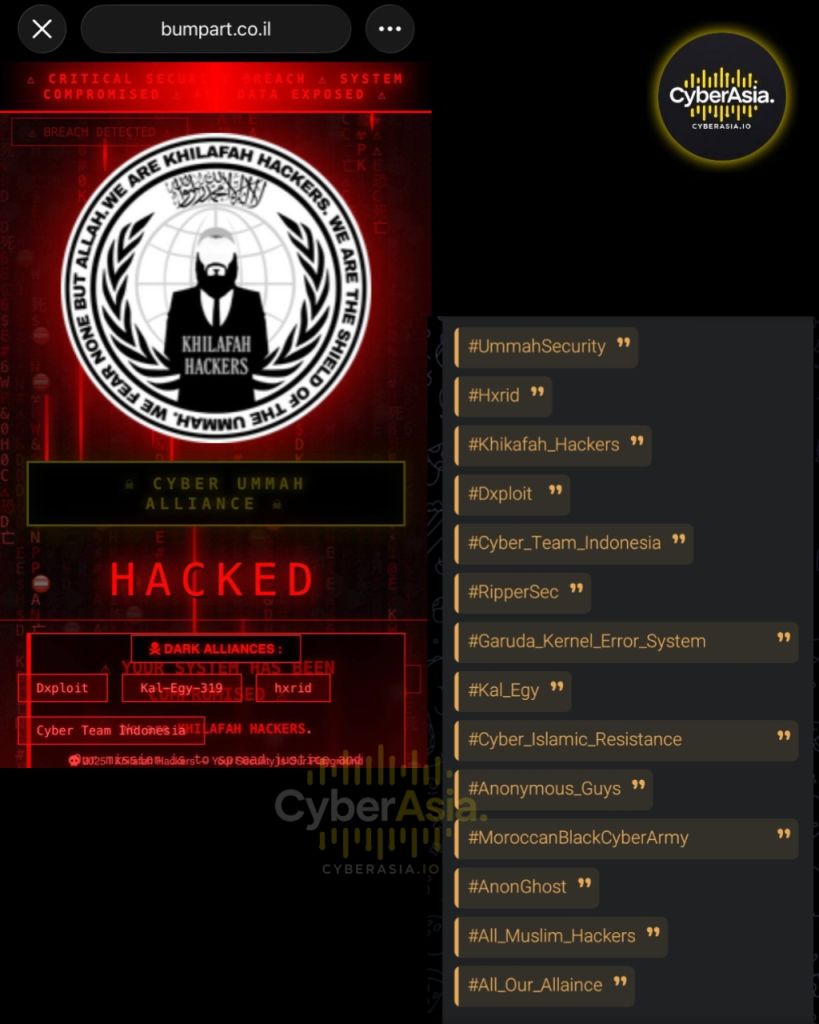
The defacement page also lists several names under a section labeled “Dark Alliances,” including Dxploit, Kal-Egy-319, and hxrid, and references involvement from an entity called Cyber Team Indonesia. At the bottom of the message, a signature reading “By: HXRID” appears, credited as the party responsible for publishing the results of the operation.
Additionally, one of the screenshots shows a list of hashtags used to promote the operation on social media, including #UmmahSecurity, #Hxrid, #Khilafah_Hackers, #Dxploit, #Cyber_Team_Indonesia, #RipperSec, #Garuda_Kernel_Error_System, #Kal_Egy, #Cyber_Islamic_Resistance, #Anonymous_Guys, #MoroccanBlackCyberArmy, #AnonGhost, #All_Muslim_Hackers, and #All_Our_Alliance. This collection of hashtags suggests the operation may be the result of collaboration across multiple hacktivist communities rather than the work of a single group acting alone.
Threat Actor Background
The names Khilafah Hackers and Cyber Ummah Alliance do not appear extensively in major threat intelligence databases as groups with a long operational history. However, the language patterns, visual branding, and religious framing used in the defacement message bear resemblance to pro-Palestinian hacktivist collectives that have been active in launching defacement campaigns against Israeli websites since regional tensions escalated.
The presence of Cyber Team Indonesia within the “Dark Alliances” list is also notable, given that similarly branded groups from Indonesia have historically been active participants in hacktivist movements targeting Israeli websites and other nations perceived as opposing broader Islamic solidarity causes. The mix of names referencing different regions, including an apparent reference to Egypt through the name Kal-Egy-319, reinforces the possibility that this operation involves a network of actors from multiple countries united under a shared banner.
Potential Impact
From a technical standpoint, website defacement falls into a category of attack that primarily damages a site’s reputation and visitor trust rather than resulting in large scale data theft. When a homepage is replaced with an attacker’s message, visitors attempting to access the site are immediately greeted with a “HACKED” page instead of the original content, which can undermine confidence in the platform’s security among both existing customers and prospective visitors.
Although the defacement banners include a “Data Exposed” label, no supporting evidence of actual leaked data samples appears in the available screenshots. It is therefore important for the affected site owners to conduct a thorough security audit to determine whether this incident was limited to a homepage alteration or also involved unauthorized access to backend databases or customer information.
Longer term consequences of this type of incident can include reduced search engine rankings if malicious content was temporarily indexed, possible suspension by hosting providers as a precaution, and additional costs associated with system recovery and strengthening security measures after the fact.
Response and Mitigation
As of this report, no official statement has been issued by the owners of the 5 affected websites. These sites appear to be operated by small to medium sized businesses that likely lack a dedicated internal security team capable of responding to such incidents quickly.
For website owners, particularly small and medium businesses, this incident serves as a reminder of the importance of basic digital security practices. These include regularly updating content management systems, using strong and unique passwords for administrative panels, enabling two factor authentication, restricting login access to specific IP addresses where feasible, and maintaining regular data backups to allow for rapid recovery in the event of a similar incident.
Monitoring server logs for suspicious activity and deploying a Web Application Firewall (WAF) can also help detect or prevent unauthorized access attempts before they escalate into a full homepage compromise.
Conclusion
The incident involving Khilafah Hackers and Cyber Ummah Alliance illustrates how political and religious motivations continue to drive hacktivist activity online, particularly campaigns targeting Israeli-registered websites amid unresolved regional tensions. While the scope of impact appears limited to homepage alterations, the pattern of cross-group collaboration reflected in the hashtag list and named entities suggests that these hacktivist networks continue to grow and remain interconnected.
For website owners around the world, this incident is a reminder that cyber threats do not always originate from financially motivated criminal groups. They can also come from ideologically driven actors who exploit digital security gaps to broadcast their message to a wider audience.
Disclaimer: CyberAsia is an independent Cyber Threat Intelligence (CTI) research organization. The information provided in this report is derived from public intelligence gathering, dark web monitoring, and threat actor claims. It is published strictly for educational purposes, defensive analysis, and public awareness. CyberAsia does not endorse, verify, or facilitate any cyberattacks or illegal activities.
> INTELLIGENCE_NOTICE
The report above detailing “Khilafah Hackers” Deface 5 Israeli Websites, Cite Ties to Cyber Ummah Alliance is part of the CyberAsia public archive. For organizations requiring real-time attack telemetry, check-host latency records, and edge firewall mitigation strategies for defacement incidents, please refer to our Secure Drop or contact the research desk.