 Data Breach & Leak
~/ › Data Breach & Leak › article
Data Breach & Leak
Cyber Team Indonesia Sadikun Data Leak: What Defenders Need to Know
> By Haider | Aug 07, 2026 | 3 min read
?? THREAT INTELLIGENCE ADVISORY:
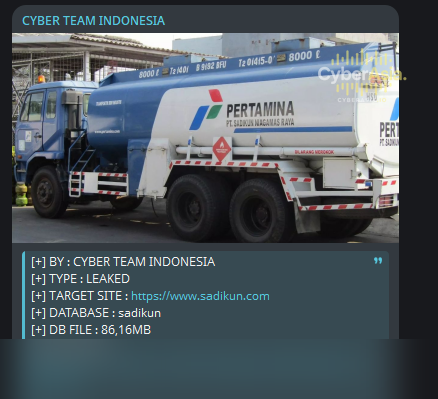
The Cyber Team Indonesia Sadikun Data Leak highlights a targeted data breach against PT. Sadikun Niagamas Raya, a major distributor for Pertamina. The threat actor group claims to have exfiltrated an 86.16MB database from the company’s systems.
This incident underscores the ongoing risk to supply chain and energy logistics providers in Southeast Asia. The unauthorized access to corporate databases poses significant risks regarding operational security and potentially exposes internal business records.
Context and Motivation
The hacktivist or threat actor group known as Cyber Team Indonesia posted a public claim announcing the compromise of the target site, sadikun.com. The leak was explicitly tagged as a “LEAKED” database and accompanied by visual elements including an image of a Pertamina PT. Sadikun Niagamas Raya tanker truck.
The actor provided a direct file sharing link (which has been blurred in our intelligence gathering to prevent distribution of stolen data) pointing to an archive named sadikun.com.zip, allegedly containing 86.16MB of stolen database records.
Technical Analysis: Data Leak
While the exact vector of compromise remains unverified, the nature of the leak suggests a successful exfiltration of backend database systems. The relatively small size of the database (86.16MB) typically indicates a structured SQL dump containing user records, administrative logs, or specific operational tables, rather than large-scale document repositories.
Observed / likely vectors:
1. SQL Injection (SQLi): A common vector for extracting backend databases from web applications.
2. Exposed Database Ports: Misconfigured database services exposed to the public internet.
3. Compromised Credentials: Unauthorized access gained through phished or reused administrative credentials.
Impact Assessment
The impact of the Cyber Team Indonesia Sadikun Data Leak is significant for the targeted entity. As a prominent distributor of fuels and chemicals, exposed databases could contain sensitive corporate client details, employee information, or internal logistics data. Furthermore, such breaches often serve as a stepping stone for subsequent social engineering or phishing attacks against partners.
Mitigation Recommendations
- Database Access Review: Ensure backend databases are strictly segregated from the public internet and accessible only via secured, internal networks (e.g., VPNs or strict IP whitelisting).
- Vulnerability Scanning: Regularly audit web applications for SQL injection vulnerabilities and implement Web Application Firewalls (WAF) to filter malicious input.
- Credential Auditing: Reset administrative credentials across web platforms and enforce multi-factor authentication (MFA) for all remote access points.
- Data Exposure Monitoring: Monitor dark web and clear web forums for the dissemination of the leaked archive to assess the full scope of the exposed data.
We will continue to monitor the situation. For related coverage, see CyberAsia threat intelligence updates.
> subscribe_to_intel
Get CyberAsia threat intelligence updates by email. Unsubscribe anytime. Privacy Policy.
> DISCLAIMER
The information provided in this article is for educational and threat intelligence purposes only. CyberAsia does not condone, promote, or encourage any illegal activities, including data breaches or unauthorized access to systems. The claims made by threat actors are unverified and reported strictly for awareness and defensive mitigation.
Mitigation & Prevention Strategies
Data breaches involving Personally Identifiable Information (PII) or sensitive corporate databases require immediate containment and long-term security overhauls:
- Database Hardening: Ensure databases (SQL, MongoDB, Elasticsearch) are never exposed directly to the public internet. Bind services to localhost or strict internal VPCs.
- Data Encryption: Implement robust encryption for data-at-rest. Even if threat actors exfiltrate database dumps, properly salted and hashed passwords minimize the blast radius.
- Credential Rotation: Following any suspected breach, force a global password reset for affected users and rotate API keys and service credentials immediately.
Disclaimer: CyberAsia is an independent Cyber Threat Intelligence (CTI) research organization. The information provided in this report is derived from public intelligence gathering, dark web monitoring, and threat actor claims. It is published strictly for educational purposes, defensive analysis, and public awareness. CyberAsia does not endorse, verify, or facilitate any cyberattacks or illegal activities.
> INTELLIGENCE_NOTICE
The report above detailing Cyber Team Indonesia Sadikun Data Leak: What Defenders Need to Know is part of the CyberAsia public archive. For organizations requiring real-time Indicators of Compromise (IoCs), YARA rules, and extended mitigation strategies for data breach & leak threats, please refer to our Secure Drop or contact the research desk.

> ABOUT_AUTHOR: Haider
> related_intel --suggest
Data Breach & Leak
 Data Breach & Leak
Data Breach: Cyber Team Indonesia Leaks Pemdes Butuh Citizen Records
> read Data Breach & Leak