 SCADA & IoT
~/ › SCADA & IoT › article
SCADA & IoT
Chat Control Protest: RipperSec Breach Italian SCADA System
> By Haider | Aug 12, 2026 | 5 min read
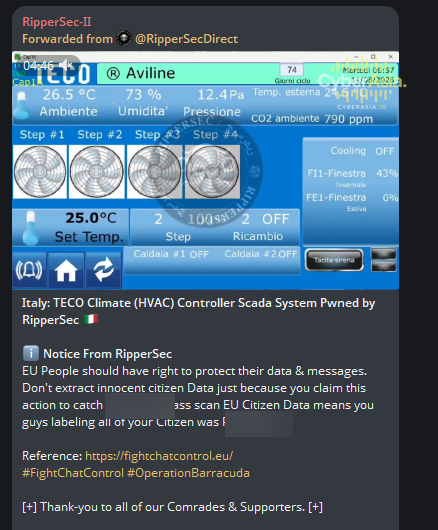
In a direct retaliation against the European Union’s proposed surveillance legislation, the hacktivist collective known as RipperSec has launched a highly disruptive chat control protest by compromising Operational Technology (OT) infrastructure in Italy. Operating under the banner of #OperationBarracuda, the threat actors successfully breached a TECO Climate (HVAC) SCADA controller, gaining full remote manipulation capabilities over the facility’s atmospheric and cooling systems.
The cyberattack highlights a dangerous escalation in hacktivist tactics, shifting from traditional Layer 7 DDoS disruption towards the kinetic manipulation of poorly secured industrial control systems (ICS). The group explicitly cited their opposition to the EU’s “Chat Control” mass surveillance framework, arguing that bulk scanning of citizen communications equates to labeling all citizens as criminals.
Technical Analysis: Exploiting the TECO HVAC HMI
Based on the telemetry and raw evidence published by the threat actors, the compromised system is an Aviline interface connected to a TECO Climate controller. The SCADA Human-Machine Interface (HMI) was likely exposed directly to the public internet via insecure remote access protocols or default misconfigurations on industrial ports (e.g., Modbus/TCP over port 502 or BACnet over port 47808) without adequate network segmentation.
The unauthorized access granted the attackers comprehensive control over critical physical parameters, including:
> COMPROMISED_SCADA_PARAMETERS
- Cooling Fan Arrays: Full manipulation of Steps #1 through #4 fans.
- Atmospheric Controls: Modification of Set Temp (25.0°C baseline).
- Boiler States: Access to Caldaia #1 and #2 (currently forced OFF).
- Alarm Suppression: Access to the “Tacita Sirena” (Silence Alarm) function, enabling stealthy prolonged disruption.
The Core Motive: EU Chat Control Protest
The incident serves as a stark digital chat control protest. RipperSec’s manifesto specifically references fightchatcontrol.eu, signaling their intent to weaponize critical infrastructure vulnerabilities to apply political pressure against EU legislators. By targeting Italian infrastructure, they are demonstrating that physical damage can and will be leveraged to defend digital privacy rights.
Mitigation & Defensive Posture
Facilities relying on industrial HVAC and SCADA controllers must immediately review their remote access architecture to prevent similar intrusions.
- Enforce OT/IT Air-Gapping. Ensure that SCADA systems, particularly environmental and HVAC controllers, are strictly isolated from corporate networks and the public internet using robust VLANs and firewalls in accordance with the Purdue Reference Architecture.
- Implement Secure Remote Access (SRA). If remote maintenance is required, mandate the use of zero-trust VPNs equipped with phishing-resistant Multi-Factor Authentication (MFA) and granular role-based access control.
- Deploy ICS-Specific DPI. Utilize Deep Packet Inspection (DPI) tailored for industrial protocols (Modbus, BACnet, DNP3) to detect anomalous command injections or unauthorized read/write requests to PLC holding registers.
- Audit Default Credentials. Immediately rotate all default vendor passwords on HMI panels and embedded web servers, as hacktivists frequently leverage Shodan/Censys to identify exposed administrative portals.
> THREAT_INTEL_DISCLAIMER
CyberAsia operates as an independent cyber threat intelligence (CTI) monitoring platform. The information provided above is derived from raw OSINT and dark web telemetry. It is published strictly for defensive awareness, security research, and mitigation purposes. CyberAsia does not endorse, support, or condone any illegal hacking activities or the political ideologies of the threat actors mentioned.
> DISCLAIMER
The information provided in this article is for educational and threat intelligence purposes only. CyberAsia does not condone, promote, or encourage any illegal activities, including data breaches or unauthorized access to systems. The claims made by threat actors are unverified and reported strictly for awareness and defensive mitigation.
OT vs IT Network Isolation & The Purdue Model
The breach of an Italian SCADA system underscores a fundamental failure in network architecture, specifically the lack of isolation between Information Technology (IT) and Operational Technology (OT) environments. According to industry-standard frameworks like the Purdue Enterprise Reference Architecture, critical SCADA systems must exist in highly restricted zones (Levels 0-3), completely segmented from the corporate IT network (Levels 4-5) and the public internet. When threat actors successfully pivot from an external entry point into the OT environment, it strongly indicates that these segmentation protocols were bypassed or entirely absent.
Implementing strict Demilitarized Zones (DMZs) and utilizing deep packet inspection (DPI) firewalls configured to understand industrial protocols like Modbus or DNP3 are mandatory defenses. Without these barriers, an attacker gaining access to an operator workstation can immediately issue malicious commands to physical PLCs, risking catastrophic equipment failure.
The Escalation of Ideological Hacktivism
The transition of hacktivist collectives from conducting superficial website defacements to actively targeting critical SCADA infrastructure marks a dangerous escalation in the cyber threat landscape. Groups like RipperSec are demonstrating advanced capabilities typically associated with state-sponsored entities. This evolution from nuisance attacks to kinetic disruptions indicates a paradigm shift where ideological protests pose a direct threat to public safety and national infrastructure stability.
> subscribe_to_intel
Join 5,000+ analysts. Get uncensored threat intelligence and breach alerts delivered directly to your inbox. Privacy Policy.
Mitigation & Prevention Strategies
Exploitation of vulnerabilities in critical infrastructure and edge devices requires immediate remediation to prevent catastrophic disruption:
- Patch Management: Apply vendor-supplied security patches or firmware updates immediately. For legacy systems, deploy virtual patching via network firewalls.
- Isolate OT Networks: SCADA and OT environments must be strictly isolated from corporate IT networks (the Purdue Model) to prevent spillover attacks.
- Continuous Monitoring: Deploy Endpoint Detection and Response (EDR) solutions and monitor network traffic for indicators of compromise (IoCs) associated with known exploits.
Disclaimer: CyberAsia is an independent Cyber Threat Intelligence (CTI) research organization. The information provided in this report is derived from public intelligence gathering, dark web monitoring, and threat actor claims. It is published strictly for educational purposes, defensive analysis, and public awareness. CyberAsia does not endorse, verify, or facilitate any cyberattacks or illegal activities.
> INTELLIGENCE_NOTICE
The report above detailing Chat Control Protest: RipperSec Breach Italian SCADA System is part of the CyberAsia public archive. For organizations requiring real-time Indicators of Compromise (IoCs), YARA rules, and extended mitigation strategies for scada & iot threats, please refer to our Secure Drop or contact the research desk.