 Data Breach & Leak
~/ › Data Breach & Leak › article
Data Breach & Leak
Indonesian Student Data Breach: Analyzing the SMPN 1 Yogyakarta Leak
> By Haider | Aug 09, 2026 | 4 min read
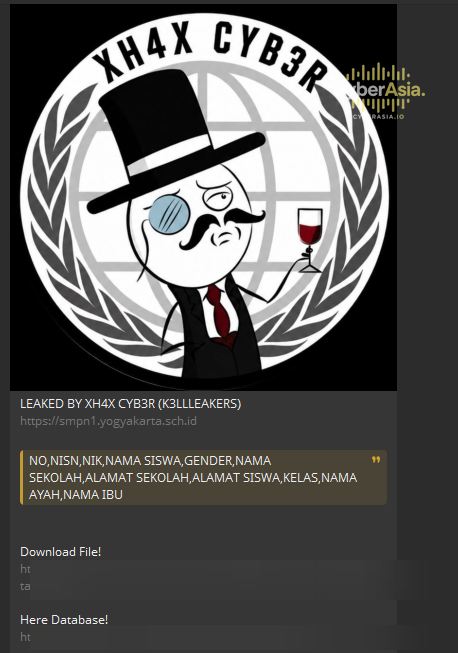
The education sector is facing a severe cybersecurity incident as threat intelligence analysts investigate a newly claimed Indonesian student data breach. A hacktivist or extortion group operating under the alias XH4X CYB3R has released a database purportedly belonging to SMP Negeri 1 Yogyakarta, exposing highly sensitive, personally identifiable information (PII) of minors and their families.
⚠️ THREAT INTELLIGENCE ADVISORY:
The threat actor “XH4X CYB3R” (also identifying as K3LLLEAKERS) has published a database leak allegedly extracted from SMPN 1 Yogyakarta. The exposed archive contains critical identity records including National Identity Numbers (NIK) and National Student Numbers (NISN). Authorities have yet to independently verify the authenticity of the payload.
Context Behind the Indonesian Student Data Breach
In a recent broadcast distributed across underground forums and Telegram channels, the actor XH4X CYB3R published a compressed archive hosted on MediaFire, alongside a direct forum thread on Batchforums. The threat actor explicitly targeted SMPN 1 Yogyakarta, a prominent junior high school, indicating a deliberate focus on the educational sector. Educational institutions in Indonesia frequently suffer from underfunded IT infrastructure and lack dedicated security operation centers (SOC), making them highly attractive, low-effort targets for data extortionists seeking to build their reputation.
Technical Analysis of the Exposed Database
An analysis of the database schema provided by the threat actor reveals a catastrophic exposure of relational PII, with independent verification confirming the dataset contains exactly 100,000 lines of data, representing 100,000 individual student records. The leaked data structure includes the following fields: NO, NISN (National Student Number), NIK (National Identity Number), NAMA SISWA (Student Name), GENDER, NAMA SEKOLAH (School Name), ALAMAT SEKOLAH (School Address), ALAMAT SISWA (Student Address), KELAS (Class), NAMA AYAH (Father’s Name), and NAMA IBU (Mother’s Name).
The inclusion of the mother’s name alongside the NIK is particularly dangerous. In the Indonesian financial system, the biological mother’s name serves as a primary security verification question for banking and credential recovery. The exfiltration of this exact combination of data points provides malicious actors with a complete identity package (Fullz) ready for immediate financial exploitation.
Impact Assessment: Minors at Risk
The severity of this incident is classified as High. The direct exposure of minors’ home addresses combined with parental identification creates severe physical and digital security risks. Cybercriminals routinely weaponize such precise demographic data to execute highly targeted social engineering attacks, sophisticated phishing campaigns directed at parents, or outright identity theft.
The leak permanently compromises the digital footprint of the affected students long before they enter the workforce, demonstrating the long-tail damage of localized school data breaches.
Mitigation Recommendations
School administrators and national education bodies must urgently address these systemic vulnerabilities. We recommend the following immediate security interventions:
- Parental Notification: SMPN 1 Yogyakarta must immediately alert all parents regarding the specific data points exposed, warning them against unsolicited calls or emails referencing their children’s NISN or NIK.
- Financial Monitoring: Parents should monitor their banking credentials and consider preemptively updating security verification questions, as the mother’s name is now compromised.
- Infrastructure Audit: The Ministry of Education, Culture, Research, and Technology (Kemdikbud) should mandate independent penetration testing for all regional school databases connected to the national system.
- Access Control: Implement strict principle-of-least-privilege (PoLP) policies for school administrators handling unencrypted PII.
CyberAsia tracks the evolving threat landscape targeting educational infrastructure. Read our latest Data Breach analysis for more updates on regional cyber incidents.
Reference: Ministry of Education, Culture, Research, and Technology (Kemdikbud).
> DISCLAIMER
The information provided in this article is for educational and threat intelligence purposes only. CyberAsia does not condone, promote, or encourage any illegal activities, including data breaches or unauthorized access to systems. The claims made by threat actors are unverified and reported strictly for awareness and defensive mitigation.
> subscribe_to_intel
Join 5,000+ analysts. Get uncensored threat intelligence and breach alerts delivered directly to your inbox. Privacy Policy.
Mitigation & Prevention Strategies
Data breaches involving Personally Identifiable Information (PII) or sensitive corporate databases require immediate containment and long-term security overhauls:
- Database Hardening: Ensure databases (SQL, MongoDB, Elasticsearch) are never exposed directly to the public internet. Bind services to localhost or strict internal VPCs.
- Data Encryption: Implement robust encryption for data-at-rest. Even if threat actors exfiltrate database dumps, properly salted and hashed passwords minimize the blast radius.
- Credential Rotation: Following any suspected breach, force a global password reset for affected users and rotate API keys and service credentials immediately.
Disclaimer: CyberAsia is an independent Cyber Threat Intelligence (CTI) research organization. The information provided in this report is derived from public intelligence gathering, dark web monitoring, and threat actor claims. It is published strictly for educational purposes, defensive analysis, and public awareness. CyberAsia does not endorse, verify, or facilitate any cyberattacks or illegal activities.
> INTELLIGENCE_NOTICE
The report above detailing Indonesian Student Data Breach: Analyzing the SMPN 1 Yogyakarta Leak is part of the CyberAsia public archive. For organizations requiring real-time Indicators of Compromise (IoCs), YARA rules, and extended mitigation strategies for data breach & leak threats, please refer to our Secure Drop or contact the research desk.

> ABOUT_AUTHOR: Haider
> related_intel --suggest
Data Breach & Leak
 Data Breach & Leak
Data Breach: Cyber Team Indonesia Leaks Pemdes Butuh Citizen Records
> read Data Breach & Leak