 Data Breach & Leak
~/ › Data Breach & Leak › article
Data Breach & Leak
KPU Database Leak: Analyzing Cyber Team Indonesia’s 377MB Claim
> By Haider | Aug 09, 2026 | 4 min read
The integrity of Indonesia’s electoral infrastructure is once again under scrutiny as cybersecurity analysts evaluate claims of a new KPU database leak. a hacktivist syndicate has stepped forward, alleging unauthorized access to internal commission records and distributing the purportedly stolen data across public file-sharing networks.
⚠️ THREAT INTELLIGENCE ADVISORY:
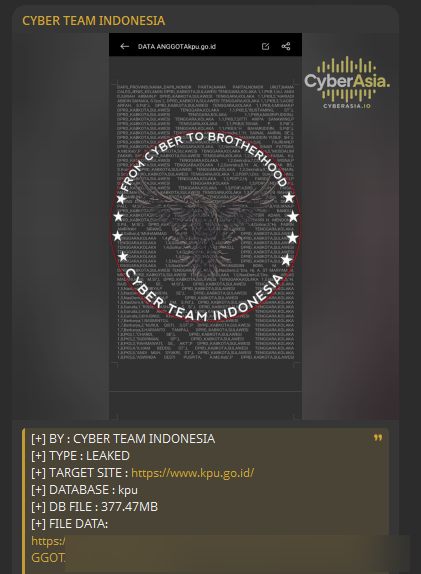
The hacktivist group “Cyber Team Indonesia” claims to have breached the General Elections Commission (KPU) website, leaking a 377MB file allegedly containing “Member Data” (Data Anggota).
Context and Motivation
In a recent Telegram broadcast, the hacktivist collective known as Cyber Team Indonesia published screenshots and a MediaFire link pointing to a file named “DATA ANGGOTAkpu.go.id.doc”. The group, which typically engages in politically motivated website defacements, distributed denial-of-service (DDoS) attacks, and CCTV system takeovers, appears to be pivoting toward data extortion or hack-and-leak operations.
The targeting of the General Elections Commission (KPU) is a recurring theme in Indonesian cyberspace. Given the highly sensitive nature of election data, threat actors frequently target the KPU to project power, undermine public trust, or capitalize on domestic political tensions. However, Cyber Team Indonesia’s historical tactics suggest ideological or nationalist motivations rather than purely financial ones.
Technical Analysis of the KPU Database Leak
Unlike the massive 2023 breach by the threat actor “Jimbo”, which exposed over 200 million national voter records and required extensive intervention by the National Cyber and Crypto Agency (BSSN), this current KPU database leak is notably smaller in scope. The leaked archive is 377.47MB, a fraction of a full national voter registry.
The filename, “DATA ANGGOTA” (Member Data), strongly implies that the dataset contains internal administrative records. This could include personally identifiable information (PII) of KPU staff, regional election committee members (KPUD), or logistical personnel rather than the general voting public. Threat intelligence analysts are currently investigating the provenance of the data to determine if this is a fresh breach resulting from a novel vulnerability (such as a compromised internal portal) or merely recycled data from previous security incidents packaged to look new.
Impact Assessment
The immediate severity of this incident is classified as Medium pending verification. While a 377MB breach does not represent a systemic collapse of the national voting infrastructure, the exposure of internal committee members poses significant privacy and operational risks. If the data contains contact details, home addresses, or identification numbers of election officials, these individuals become prime targets for targeted phishing (spear-phishing), social engineering, or physical intimidation.
Repeated claims of data leaks, regardless of their authenticity, erode public confidence in the KPU’s digital resilience. Threat actors often leverage the mere perception of a breach to amplify disinformation campaigns.
Mitigation Recommendations
Organizations managing critical national infrastructure must operate under the assumption of continuous targeting. Defenders and election security personnel should consider the following immediate actions:
- Credential Auditing: Mandate immediate password resets and enforce multi-factor authentication (MFA) for all internal KPU staff and regional committee members accessing administrative portals.
- Data Provenance Verification: Incident response teams must cross-reference the leaked 377MB dataset against known past breaches to establish if a novel exfiltration vector exists within the current network perimeter.
- Phishing Awareness: Issue internal advisories to all personnel regarding the heightened risk of targeted social engineering attacks leveraging the exposed “Data Anggota.”
- Perimeter Hardening: Review Web Application Firewall (WAF) logs and endpoint detection telemetry for anomalous exfiltration patterns originating from unauthorized external IP addresses.
CyberAsia continues to monitor hacktivist activities targeting critical infrastructure. For related coverage on regional threats, consult our Data Breach intelligence updates.
Reference: Ministry of Communication and Informatics (Kominfo).
> DISCLAIMER
The information provided in this article is for educational and threat intelligence purposes only. CyberAsia does not condone, promote, or encourage any illegal activities, including data breaches or unauthorized access to systems. The claims made by threat actors are unverified and reported strictly for awareness and defensive mitigation.
> subscribe_to_intel
Join 5,000+ analysts. Get uncensored threat intelligence and breach alerts delivered directly to your inbox. Privacy Policy.
Mitigation & Prevention Strategies
Data breaches involving Personally Identifiable Information (PII) or sensitive corporate databases require immediate containment and long-term security overhauls:
- Database Hardening: Ensure databases (SQL, MongoDB, Elasticsearch) are never exposed directly to the public internet. Bind services to localhost or strict internal VPCs.
- Data Encryption: Implement robust encryption for data-at-rest. Even if threat actors exfiltrate database dumps, properly salted and hashed passwords minimize the blast radius.
- Credential Rotation: Following any suspected breach, force a global password reset for affected users and rotate API keys and service credentials immediately.
Disclaimer: CyberAsia is an independent Cyber Threat Intelligence (CTI) research organization. The information provided in this report is derived from public intelligence gathering, dark web monitoring, and threat actor claims. It is published strictly for educational purposes, defensive analysis, and public awareness. CyberAsia does not endorse, verify, or facilitate any cyberattacks or illegal activities.
> INTELLIGENCE_NOTICE
The report above detailing KPU Database Leak: Analyzing Cyber Team Indonesia’s 377MB Claim is part of the CyberAsia public archive. For organizations requiring real-time Indicators of Compromise (IoCs), YARA rules, and extended mitigation strategies for data breach & leak threats, please refer to our Secure Drop or contact the research desk.

> ABOUT_AUTHOR: Haider
> related_intel --suggest
Data Breach & Leak
 Data Breach & Leak
Data Breach: Cyber Team Indonesia Leaks Pemdes Butuh Citizen Records
> read Data Breach & Leak