 Data Breach & Leak
~/ › Data Breach & Leak › article
Data Breach & Leak
XH4X CYB3R Mahkamah Agung Data Leak: Critical Privacy Alert for e-Court Users
> By Haider | Aug 08, 2026 | 5 min read
?? THREAT INTELLIGENCE ADVISORY:
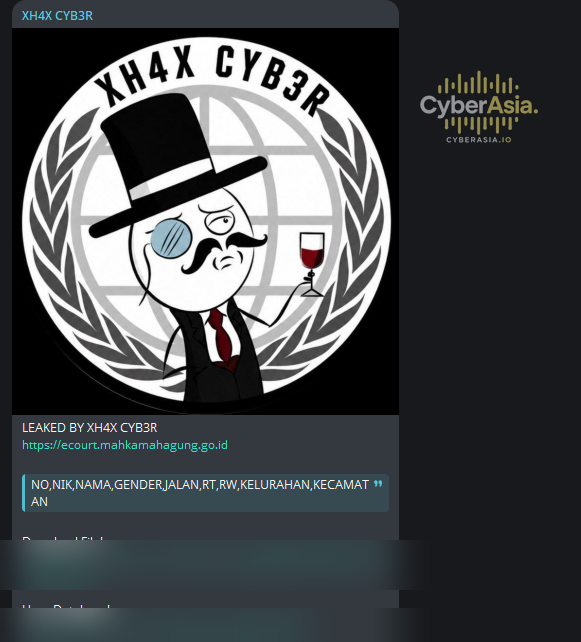
The XH4X CYB3R Mahkamah Agung Data Leak highlights a targeted data breach against Indonesia’s Supreme Court e-court system (ecourt.mahkamahagung.go.id). The threat actor group claims to have exfiltrated a CSV database containing extensive Personally Identifiable Information (PII) from the portal.
This incident underscores the ongoing risk to government and judicial digital infrastructure in Southeast Asia. The unauthorized access to legal and civil databases poses significant risks regarding citizen privacy and operational security. As governments accelerate digital transformation, the attack surface expands, often leaving legacy backend systems exposed to modern enumeration and exfiltration techniques.
Context and Actor Motivation
The threat actor known as XH4X CYB3R posted a public claim announcing the compromise of the target site. The leak was explicitly tagged with the actor’s insignia and accompanied by a sample of the data structure. Historically, threat actors targeting Indonesian government portals are driven by a mix of hacktivism, clout-chasing within underground forums, and financial motivation through the sale of bulk PII.
The actor provided direct file-sharing links (which have been blurred in our intelligence gathering to prevent the distribution of stolen data) pointing to a file named MAHKAMAH_AGUNG.csv. The provided sample headers confirm the presence of highly sensitive demographic data. This includes NIK (National Identity Number), Full Name (NAMA), Gender, and highly detailed Residential Addresses (JALAN, RT, RW, KELURAHAN, KECAMATAN). The structured nature of this CSV suggests an automated dump of a specific user registration table rather than a scattered collection of documents.
Technical Analysis of the XH4X CYB3R Mahkamah Agung Data Leak
While the exact vector of compromise remains unverified by the Mahkamah Agung or BSSN (National Cyber and Crypto Agency), the nature of the XH4X CYB3R Mahkamah Agung Data Leak suggests a successful exfiltration of backend database systems tied to the e-court’s user registration or civil case files. The extraction of structured CSV data typically indicates a direct database dump or an insecure API endpoint exploitation that allows unauthorized querying of the database.
Observed / likely attack vectors include:
1. SQL Injection (SQLi): A common vector for extracting backend databases from government web applications. If the e-court portal fails to properly sanitize user inputs in search fields or login portals, attackers can inject malicious SQL payloads to dump entire tables.
2. Insecure Direct Object References (IDOR): Flaws in the e-court API that might allow unauthorized downloading of user records. If access controls are not strictly enforced on API endpoints, an attacker can enumerate through user IDs and scrape the resulting PII into a CSV format.
3. Compromised Administrative Credentials: Unauthorized access gained through phished or reused portal credentials belonging to court administrators or IT personnel, providing the actor with legitimate but unauthorized access to export tools.
4. Unpatched Vulnerabilities: Exploitation of known CVEs in the underlying web framework (such as outdated versions of PHP, Laravel, or whatever the portal utilizes) that grant remote code execution (RCE) and subsequent database access.
Broader Impact Assessment and Risks
The impact of the XH4X CYB3R Mahkamah Agung Data Leak is severe due to the critical nature of the exposed PII. The leakage of NIK (National Identity Numbers) combined with full residential addresses provides malicious actors with the exact dataset required for devastating downstream attacks.
Threat actors frequently weaponize this data for identity theft, opening fraudulent financial accounts, or bypassing knowledge-based authentication (KBA) mechanisms. Furthermore, this data can be utilized for highly targeted social engineering and spear-phishing campaigns against Indonesian citizens, court officials, and legal professionals. The judicial context of the e-court system further elevates the sensitivity of the breach, as litigants and lawyers expect strict confidentiality regarding their interactions with the Supreme Court.
Mitigation Recommendations for Defenders
- Database Access Review and Segmentation: Ensure backend databases are strictly segregated from the public internet and accessible only via secured, internal networks (such as Zero Trust Network Access or VPNs with strict IP whitelisting).
- Vulnerability Scanning and WAF Implementation: Regularly audit the e-court application for SQL injection and IDOR vulnerabilities. Implement a robust Web Application Firewall (WAF) to filter malicious input and block abnormal data extraction patterns.
- API Security and Rate Limiting: Enforce strict rate-limiting, token-based authentication (OAuth 2.0), and authorization checks on all endpoints returning user demographic data to prevent automated scraping.
- Data Exposure Monitoring: Monitor dark web and clear web forums for the dissemination of the leaked CSV archive to assess the full scope of the exposed data and notify affected individuals proactively.
- Enforce Multi-Factor Authentication (MFA): Mandate MFA for all administrative and elevated access accounts to mitigate the risk of credential compromise.
We will continue to monitor the situation as more details emerge. For related coverage, see our CyberAsia threat intelligence updates.
Reference: CISA Guidance on Securing Public-Facing Systems.
> DISCLAIMER
The information provided in this article is for educational and threat intelligence purposes only. CyberAsia does not condone, promote, or encourage any illegal activities, including data breaches or unauthorized access to systems. The claims made by threat actors are unverified and reported strictly for awareness and defensive mitigation.
> subscribe_to_intel
Get CyberAsia threat intelligence updates by email. Unsubscribe anytime. Privacy Policy.
Mitigation & Prevention Strategies
Data breaches involving Personally Identifiable Information (PII) or sensitive corporate databases require immediate containment and long-term security overhauls:
- Database Hardening: Ensure databases (SQL, MongoDB, Elasticsearch) are never exposed directly to the public internet. Bind services to localhost or strict internal VPCs.
- Data Encryption: Implement robust encryption for data-at-rest. Even if threat actors exfiltrate database dumps, properly salted and hashed passwords minimize the blast radius.
- Credential Rotation: Following any suspected breach, force a global password reset for affected users and rotate API keys and service credentials immediately.
Disclaimer: CyberAsia is an independent Cyber Threat Intelligence (CTI) research organization. The information provided in this report is derived from public intelligence gathering, dark web monitoring, and threat actor claims. It is published strictly for educational purposes, defensive analysis, and public awareness. CyberAsia does not endorse, verify, or facilitate any cyberattacks or illegal activities.
> INTELLIGENCE_NOTICE
The report above detailing XH4X CYB3R Mahkamah Agung Data Leak: Critical Privacy Alert for e-Court Users is part of the CyberAsia public archive. For organizations requiring real-time Indicators of Compromise (IoCs), YARA rules, and extended mitigation strategies for data breach & leak threats, please refer to our Secure Drop or contact the research desk.

> ABOUT_AUTHOR: Haider
> related_intel --suggest
Data Breach & Leak
 Data Breach & Leak
Data Breach: Cyber Team Indonesia Leaks Pemdes Butuh Citizen Records
> read Data Breach & Leak