 data leak
Data Leak: Hacktivist XH4X CYB3R Exposes 34 SIPD Palembang Accounts
> By Haider | Aug 08, 2026 | 4 min read
?? THREAT INTELLIGENCE ADVISORY:
The pro-hacktivist group XH4X CYB3R has claimed responsibility for a data leak involving the Sistem Informasi Pemerintahan Daerah (SIPD) of Palembang. However, technical analysis reveals the breach is severely limited in scope, exposing only a handful of administrative or user records rather than a massive systemic compromise.
Operating under the #OpIndo campaign banner, the threat actor released a file allegedly extracted from the regional government system. While hacktivist groups often exaggerate their claims to sow panic, our investigation confirms that this specific incident involves exactly 34 SIPD Palembang accounts. Despite the small number, the leaked information still poses targeted privacy risks to the affected individuals.
What Was Actually Leaked?
The threat actor distributed the stolen data via a public Mediafire link (https://www.mediafire.com/file/.../SIPD.PALEMBANG.sql/file). The file itself is an SQL database dump, which suggests the attackers likely found an exposed database backup or exploited a minor SQL injection (SQLi) flaw on a neglected endpoint.
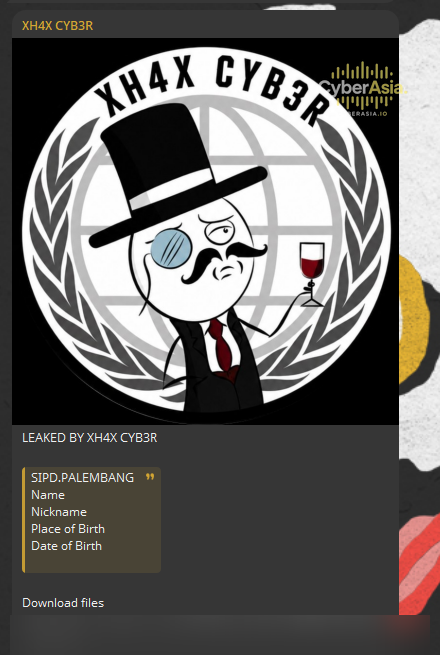
Based on the screenshot evidence provided by XH4X CYB3R, the SQL file exposes the following Personally Identifiable Information (PII) fields for the 34 SIPD Palembang accounts:
Fortunately, highly critical data such as passwords, National Identification Numbers (NIK), or financial details do not appear to be included in this specific dump.
Hacktivism and “Clout-Chasing”
This incident is a textbook example of modern hacktivist “clout-chasing.” By successfully extracting a small SIPD.PALEMBANG.sql file, XH4X CYB3R attempts to project an image of omnipotence, framing a minor exposure as a major victory against Indonesian government infrastructure. This tactic is heavily utilized within the #OpIndo campaign to maintain momentum and attract new followers without requiring highly sophisticated zero-day exploits.
Defender Takeaways: Sealing the Cracks
While the scope of this leak is minimal, exposing 34 SIPD Palembang accounts indicates that basic security hygiene on government portals needs tightening. IT administrators overseeing regional SIPD systems should prioritize the following:
- Audit Database Backups: Ensure that `.sql`, `.bak`, or `.json` database backups are never stored in web-accessible directories.
- Sanitize Error Outputs: Prevent the application from leaking database structure or syntax errors, which threat actors use to map out SQL injection points.
- Enforce Least Privilege: Limit database user permissions so that even if an SQL injection vulnerability exists, the attacker cannot dump the entire schema.
For more updates on the #OpIndo campaign and debunked threat actor claims, visit the CyberAsia Threat Intelligence Hub.
> DISCLAIMER
The information provided in this article is for educational and threat intelligence purposes only. CyberAsia does not condone, promote, or encourage any illegal activities, including data breaches or unauthorized access to systems. The claims made by threat actors are reported strictly for awareness and defensive mitigation.
> subscribe_to_intel
Get CyberAsia threat intelligence updates by email. Unsubscribe anytime. Privacy Policy.
Mitigation & Prevention Strategies
Data breaches involving Personally Identifiable Information (PII) or sensitive corporate databases require immediate containment and long-term security overhauls:
- Database Hardening: Ensure databases (SQL, MongoDB, Elasticsearch) are never exposed directly to the public internet. Bind services to localhost or strict internal VPCs.
- Data Encryption: Implement robust encryption for data-at-rest. Even if threat actors exfiltrate database dumps, properly salted and hashed passwords minimize the blast radius.
- Credential Rotation: Following any suspected breach, force a global password reset for affected users and rotate API keys and service credentials immediately.
Strategic Defense Matrix and Incident Hardening
Operational intelligence analysis of this data leak campaign indicates that the threat actors frequently exploit configuration oversights, unpatched external-facing gateways, and weak credential management policies across targeted organizations. Enterprise security operations centers (SOC) and defensive engineering teams must deploy layered perimeter safeguards to detect and neutralize similar threat vectors before lateral movement occurs.
- Continuous Asset and Perimeter Auditing: Maintain real-time inventory of all public-facing services, verifying SSL/TLS certificates and eliminating unauthenticated administrative interfaces following CISA Defensive Guidelines.
- Behavioral Anomaly and Zero-Trust Telemetry: Enforce strict hardware-backed multi-factor authentication (MFA) across all remote access nodes and implement endpoint detection and response (EDR) telemetry mapped to the MITRE ATT&CK Framework.
- Threat Intelligence Integration: Security teams are encouraged to correlate emerging indicators of compromise (IoCs) and evaluate network vulnerability profiles using our Cyber Risk Checker or submit anonymous confidential threat data via CyberAsia Secure Drop.
Disclaimer: The information presented in this threat intelligence report is for educational and cybersecurity research purposes only. CyberAsia reports on cyber incidents to help organizations understand and defend against emerging threats. We do not provide hacking instructions, host stolen data, or endorse illegal activities.
> INTELLIGENCE_NOTICE
The report above detailing Data Leak: Hacktivist XH4X CYB3R Exposes 34 SIPD Palembang Accounts is part of the CyberAsia public archive. For organizations requiring breach validation schemas, credential exposure auditing, and PII containment protocols for data leak events, please refer to our Secure Drop or contact the research desk.

> ABOUT_AUTHOR: Haider
> related_intel --suggest
data leak
 data leak
Anonymous Switzerland Warns Efadah: 40 GB Data Sale Looms
> read data leak