 SCADA & IoT
~/ › SCADA & IoT › article
SCADA & IoT
NoName05716 Romanian CCTV Exposure: IoT Privacy Risks
> By Haider | Aug 07, 2026 | 4 min read
⚠️ THREAT INTELLIGENCE ADVISORY:
The NoName05716 Romanian CCTV Exposure highlights a concerning privacy breach at a social infrastructure facility. Pro-Russian hacktivists claim to have gained real-time access to multiple surveillance cameras due to weak security configurations.
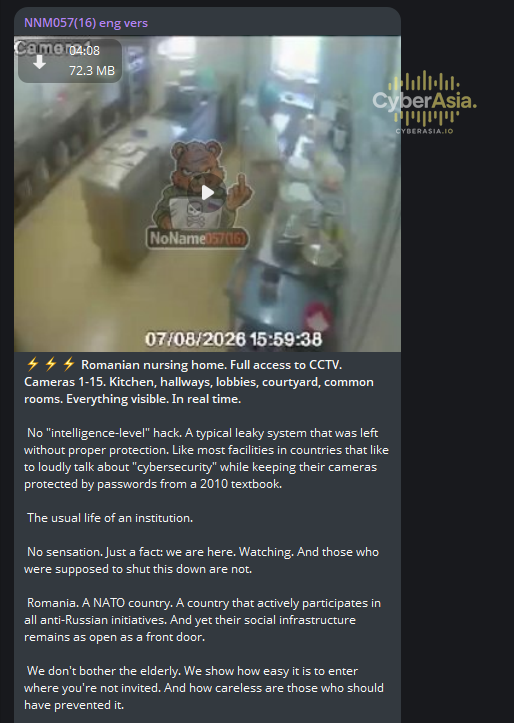
This incident underscores a recurring vulnerability in physical security deployments: internet-exposed IoT devices protected by default or easily guessable credentials. While not a sophisticated intrusion, the privacy implications for vulnerable populations remain significant.
> TABLE_OF_CONTENTS [toggle]
Context and Motivation
On August 7, 2026, the pro-Russian hacktivist group NoName057(16) posted a statement claiming full access to a closed-circuit television (CCTV) system at a Romanian nursing home. The threat actor shared visual evidence allegedly showing real-time feeds from 15 cameras, covering kitchens, hallways, lobbies, courtyards, and common rooms.
The group explicitly framed this activity as politically motivated, citing Romania’s membership in NATO and its support for anti-Russian initiatives. The message mocked the target’s security posture, stating that the systems were protected by “passwords from a 2010 textbook” and emphasizing how easily social infrastructure could be infiltrated.
Technical Analysis: IoT Vulnerabilities
Despite the political rhetoric, the NoName05716 Romanian CCTV Exposure does not appear to involve advanced persistent threat (APT) capabilities. The attackers themselves described the target as a “typical leaky system.”
Observed / likely vectors:
1. Weak Credentials: The primary vector is almost certainly the use of default, factory-set, or easily brute-forced passwords on the camera web interfaces or DVR/NVR systems.
2. Internet Exposure: The CCTV management interface was likely exposed directly to the public internet without an intermediary VPN or IP whitelisting, making it discoverable via scanning engines like Shodan or Censys.
Impact Assessment
The severity of this incident is assessed as low to medium. There is no indication that critical network segments, sensitive databases, or financial systems were compromised. However, the unauthorized surveillance of a nursing home constitutes a severe privacy violation for the residents and staff, demonstrating the opportunistic nature of current hacktivist operations to generate propaganda.
Mitigation Recommendations
- Change Default Passwords: Ensure all IP cameras and recording equipment use strong, unique passwords immediately upon deployment.
- Disable Public Exposure: Place CCTV management interfaces behind a Virtual Private Network (VPN) and disable remote access features like UPnP or P2P cloud connectivity if not strictly required.
- Segment IoT Devices: Isolate surveillance equipment on a dedicated VLAN, preventing lateral movement to or from the primary corporate network.
- Update Firmware: Regularly check for and apply security patches provided by the camera manufacturer to address known exploits.
We will continue to monitor the situation. For related coverage, see CyberAsia threat intelligence updates.
Reference: CISA Guidance on Securing IoT Devices.
Strategic Threat Landscape & Operational Technology (OT) Vulnerabilities
The escalation of this specific cyber incident reflects a broader, systemic shift in the global threat landscape regarding the targeting of Operational Technology (OT) and critical infrastructure. Threat intelligence analysts continuously observe that the tactics, techniques, and procedures (TTPs) deployed here represent a severe escalation in cyber-physical risks.
In recent months, the rapid digitization of industrial environments—often referred to as Industry 4.0—has inadvertently expanded the attack surface of once-isolated SCADA systems and Industrial Control Systems (ICS). The convergence of IT and OT networks has allowed threat actors to pivot from compromised corporate environments directly into environments controlling physical processes, power grids, and manufacturing lines.
Furthermore, the exploitation of unpatched IoT devices, exposed HMIs (Human-Machine Interfaces), and legacy protocols lacking native encryption has become a preferred vector for both financially motivated syndicates and state-aligned disruption teams. These intrusions are often designed to inflict maximum operational downtime and societal impact.
Defensive Evolution & The Purdue Enterprise Reference Architecture
From a defensive standpoint, applying traditional IT security models to OT environments is fundamentally flawed. Organizations must urgently adopt and strictly enforce the Purdue Enterprise Reference Architecture (PERA), ensuring rigorous network segmentation and the implementation of industrial DMZs.
To combat this evolving threat matrix, the deployment of passive, ICS-specific Deep Packet Inspection (DPI) is critical for identifying anomalous lateral movement without disrupting fragile legacy equipment. Proactive threat hunting, continuous vulnerability management, and strict access controls are the most effective strategies for maintaining organizational resilience against cyber-physical adversaries.
> subscribe_to_intel
Join 5,000+ analysts. Get uncensored threat intelligence and breach alerts delivered directly to your inbox. Privacy Policy.
Mitigation & Prevention Strategies
Exploitation of vulnerabilities in critical infrastructure and edge devices requires immediate remediation to prevent catastrophic disruption:
- Patch Management: Apply vendor-supplied security patches or firmware updates immediately. For legacy systems, deploy virtual patching via network firewalls.
- Isolate OT Networks: SCADA and OT environments must be strictly isolated from corporate IT networks (the Purdue Model) to prevent spillover attacks.
- Continuous Monitoring: Deploy Endpoint Detection and Response (EDR) solutions and monitor network traffic for indicators of compromise (IoCs) associated with known exploits.
>
Disclaimer: CyberAsia is an independent Cyber Threat Intelligence (CTI) research organization. The information provided in this report is derived from public intelligence gathering, dark web monitoring, and threat actor claims. It is published strictly for educational purposes, defensive analysis, and public awareness. CyberAsia does not endorse, verify, or facilitate any cyberattacks or illegal activities.
> INTELLIGENCE_NOTICE
The report above detailing NoName05716 Romanian CCTV Exposure: IoT Privacy Risks is part of the CyberAsia public archive. For organizations requiring real-time Indicators of Compromise (IoCs), YARA rules, and extended mitigation strategies for scada & iot threats, please refer to our Secure Drop or contact the research desk.

> ABOUT_AUTHOR: Haider
> related_intel --suggest
SCADA & IoT
 SCADA & IoT
BMS Cyberattack: Disrupt0r Hacks Quinquela Plaza SCADA
> read SCADA & IoT