 SCADA & IoT
~/ › SCADA & IoT › article
SCADA & IoT
NoName057(16) Smart Home Hack: 1 Bizarre IoT Security Breach
> By Haider | Aug 04, 2026 | 5 min read
The cyber threat landscape is increasingly expanding beyond traditional targets, as illustrated by the recent NoName057(16) Smart Home Hack. In a highly unusual digital intrusion, the hacktivist collective known as NoName057(16) claimed to have breached the control system of an ordinary residential property in Spain. Rather than targeting enterprise or critical infrastructure, the attackers compromised a smart home interface controlling household blinds, lights, heating, and the boiler.
Our threat intelligence analysts view this incident as a critical case study of the vulnerabilities present in consumer Internet of Things (IoT) deployments. When hacktivists pivot to targeting individual smart homes, it highlights a broader security issue: the rapid adoption of home automation often outpaces the implementation of necessary network protections.
Table of Contents
- The Context of the Targeting
- Technical Reality: Unsecured IoT Interfaces
- The Privacy Implications of Exposed Systems
- Essential Mitigation Measures for Homeowners
The Context of the NoName057(16) Smart Home Hack
Historically, hacktivist collectives focus their operations on high-profile geopolitical targets, such as large corporations, financial institutions, or government portals. However, the NoName057(16) Smart Home Hack took a different approach by targeting a private residence in Spain. The group detailed this operation in their Telegram channel, noting their access to the home’s automated “blinds, lights, heating, and boiler” systems.
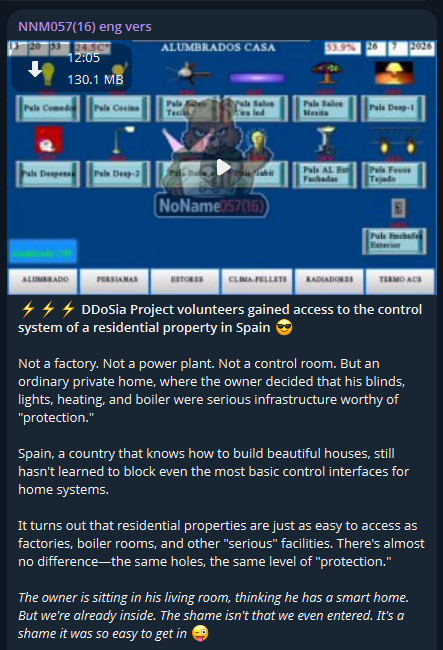
By executing the NoName057(16) Smart Home Hack, the group demonstrated that residential properties are frequently just as exposed as larger facilities. Their statement highlighted a common reality in the IoT space: many modern homes possess the same level of digital exposure as commercial buildings, yet they often lack enterprise-grade protection. This incident serves to draw attention to the widespread issue of misconfigured consumer devices connected to the public internet.
Technical Reality: Unsecured IoT Interfaces
From a technical standpoint, the execution of this breach highlights the risks of exposed administrative panels. The attackers did not necessarily require complex zero-day exploits to gain access. Instead, incidents like this frequently involve utilizing network search engines like Shodan to locate exposed, unsecured web panels.
Many smart home automation systems are installed without placing the management interface behind a proper firewall or virtual private network (VPN). If a smart home dashboard is port-forwarded directly to the public internet with default or weak passwords, unauthorized individuals can easily gain administrative control. In this scenario, the attackers were able to locate an exposed IP address, access the unprotected web interface, and capture screenshots of the control panel to verify their claims.
The Privacy Implications of Exposed Systems
The NoName057(16) Smart Home Hack brings significant privacy implications to the forefront. An exposed smart home hub grants an unauthorized user visibility into a resident’s daily routines. Observers can determine when a house is occupied based on lighting and heating schedules, which presents a significant privacy concern.
Furthermore, if a smart home system is integrated with security cameras, intercoms, or smart locks, the risks increase substantially. The aggregation of seemingly harmless data points—like when the boiler is activated or when the living room blinds are drawn—allows unauthorized actors to understand the behavioral patterns of the household. This incident serves as a crucial reminder: the convenience of remote home automation must be balanced with foundational network security.
Essential Mitigation Measures for Homeowners
Securing a smart home does not necessarily require expensive, enterprise-grade security appliances. Homeowners and local installers can adopt standard network hygiene to prevent falling victim to incidents similar to the NoName057(16) Smart Home Hack.
We recommend the following defensive measures, which align with global cybersecurity best practices (CISA) for consumer IoT:
- Do Not Expose Interfaces: Avoid port-forwarding your smart home management dashboard directly to the open internet.
- Utilize VPNs: If remote access is required, configure a secure Virtual Private Network (VPN) to access your home network safely.
- Change Default Passwords: Immediately update all default administrator credentials provided by the manufacturer or installer to strong, unique passwords.
- Network Segmentation: Where possible, place all IoT devices on a dedicated, isolated guest network separate from primary personal devices.
- Regular Updates: Continuously update the firmware of your smart home hubs and devices to patch publicly known vulnerabilities.
- Enable Multi-Factor Authentication (MFA): Whenever supported by the smart home platform, enable MFA to add an additional layer of security beyond just a standard password.
The unauthorized access of a residential heating and lighting system illustrates a shift in digital targeting. As interconnected devices become more common in private residences, it is vital that security standards evolve accordingly. The growing interconnectedness of our daily lives brings immense convenience, but it also broadens the potential attack surface. Cybersecurity is no longer solely the responsibility of large corporations; it begins at the front door of every modern home. By implementing basic access controls, homeowners can significantly enhance their privacy and secure their properties against opportunistic digital intrusions.
For more analyses of digital vulnerabilities and cybersecurity trends, explore our ongoing coverage of recent cyber incidents.
Mitigation & Prevention Strategies
Exploitation of vulnerabilities in critical infrastructure and edge devices requires immediate remediation to prevent catastrophic disruption:
- Patch Management: Apply vendor-supplied security patches or firmware updates immediately. For legacy systems, deploy virtual patching via network firewalls.
- Isolate OT Networks: SCADA and OT environments must be strictly isolated from corporate IT networks (the Purdue Model) to prevent spillover attacks.
- Continuous Monitoring: Deploy Endpoint Detection and Response (EDR) solutions and monitor network traffic for indicators of compromise (IoCs) associated with known exploits.
Disclaimer: CyberAsia is an independent Cyber Threat Intelligence (CTI) research organization. The information provided in this report is derived from public intelligence gathering, dark web monitoring, and threat actor claims. It is published strictly for educational purposes, defensive analysis, and public awareness. CyberAsia does not endorse, verify, or facilitate any cyberattacks or illegal activities.
> INTELLIGENCE_NOTICE
The report above detailing NoName057(16) Smart Home Hack: 1 Bizarre IoT Security Breach is part of the CyberAsia public archive. For organizations requiring real-time Indicators of Compromise (IoCs), YARA rules, and extended mitigation strategies for scada & iot threats, please refer to our Secure Drop or contact the research desk.

> ABOUT_AUTHOR: Haider
> related_intel --suggest
SCADA & IoT
 SCADA & IoT
BMS Cyberattack: Disrupt0r Hacks Quinquela Plaza SCADA
> read SCADA & IoT