 SCADA & IoT
~/ › SCADA & IoT › article
SCADA & IoT
RipperSec’s #FightChatControl Hits Ireland: Fuel Management OT Breach
> By Haider | Aug 10, 2026 | 4 min read
The hacktivist group known as RipperSec recently published evidence of a successful intrusion into an Operational Technology (OT) system in Ireland. Specifically, the group targeted an OPW Fuel Management System, an industrial control platform used to monitor and manage bulk fuel inventories. The attack is politically motivated and falls under the banner of #FightChatControl and #OperationBarracuda.
According to the official statement released on their Telegram channel, RipperSec executed this cyberattack as a direct protest against the European Union’s proposed legislation for mass scanning of citizen communications (often referred to as Chat Control). The threat actors argued that enforcing mass surveillance to catch predators inherently treats all innocent citizens as suspects. They directed their supporters to fightchatcontrol.eu for further context on the privacy movement.
Technical Analysis (TTPs)
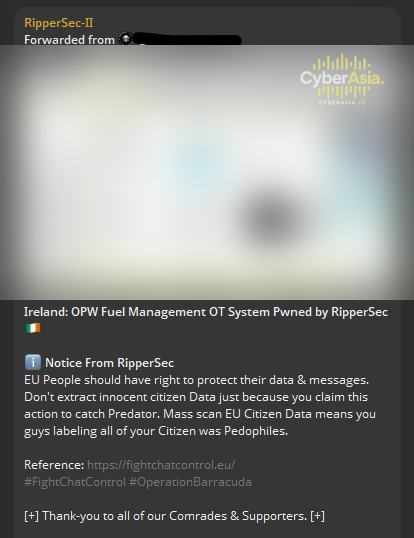
Based on the exposed graphic evidence, RipperSec successfully compromised an embedded Graphical User Interface (GUI) belonging to an OPW Fuel Management System. The dashboard provides comprehensive telemetry and direct control over physical tank assets.
The compromised interface displays real-time data for “Tank 2”, which contains Kerosene. At the time of the breach, the system reported a total capacity of 54,800 liters, with a net product volume of 11,164.34 liters. The attacker gained access to critical readouts including gross volume, product height, temperature, and density unit metrics. More alarmingly, the HMI dashboard features active controls such as “Send All” and “Settings” menus, indicating that the threat actor did not just have read-only access but possessed the capability to manipulate the physical environment.
The system’s local IP address (192.168.1.xxx) was visible on the dashboard. The breach likely occurred because the OT asset was improperly exposed to the public internet without adequate VPN tunneling or authentication layers.
Impact Assessment
Unauthorized access to a bulk fuel management system poses severe operational and safety risks. If threat actors manipulate the tank settings, alter temperature thresholds, or spoof inventory levels, it could lead to large-scale fuel theft, undetected leaks, or supply chain disruption.
This incident highlights a recurring vulnerability within the critical infrastructure sector where industrial control panels are left accessible online with default credentials or outdated firmware.
Mitigation Recommendations
- Isolate OT Networks: Immediately remove all Human-Machine Interfaces (HMI) and SCADA systems from public internet exposure. They must be placed behind robust industrial firewalls.
- Implement Secure Access: Remote telemetry monitoring must strictly require a Virtual Private Network (VPN) connection fortified with Multi-Factor Authentication (MFA).
- Audit Firmware: Verify that all OPW Fuel Management Systems are running the latest vendor-approved security patches to close known exploitation vectors.
Strategic Threat Landscape & Operational Technology (OT) Vulnerabilities
The escalation of this specific cyber incident reflects a broader, systemic shift in the global threat landscape regarding the targeting of Operational Technology (OT) and critical infrastructure. Threat intelligence analysts continuously observe that the tactics, techniques, and procedures (TTPs) deployed here represent a severe escalation in cyber-physical risks.
In recent months, the rapid digitization of industrial environments—often referred to as Industry 4.0—has inadvertently expanded the attack surface of once-isolated SCADA systems and Industrial Control Systems (ICS). The convergence of IT and OT networks has allowed threat actors to pivot from compromised corporate environments directly into environments controlling physical processes, power grids, and manufacturing lines.
Furthermore, the exploitation of unpatched IoT devices, exposed HMIs (Human-Machine Interfaces), and legacy protocols lacking native encryption has become a preferred vector for both financially motivated syndicates and state-aligned disruption teams. These intrusions are often designed to inflict maximum operational downtime and societal impact.
Defensive Evolution & The Purdue Enterprise Reference Architecture
From a defensive standpoint, applying traditional IT security models to OT environments is fundamentally flawed. Organizations must urgently adopt and strictly enforce the Purdue Enterprise Reference Architecture (PERA), ensuring rigorous network segmentation and the implementation of industrial DMZs.
To combat this evolving threat matrix, the deployment of passive, ICS-specific Deep Packet Inspection (DPI) is critical for identifying anomalous lateral movement without disrupting fragile legacy equipment. Proactive threat hunting, continuous vulnerability management, and strict access controls are the most effective strategies for maintaining organizational resilience against cyber-physical adversaries.
> DISCLAIMER
The information provided in this article is for educational and threat intelligence purposes only. CyberAsia does not condone, promote, or encourage any illegal activities, including data breaches or unauthorized access to systems. The claims made by threat actors are unverified and reported strictly for awareness and defensive mitigation.
> subscribe_to_intel
Join 5,000+ analysts. Get uncensored threat intelligence and breach alerts delivered directly to your inbox. Privacy Policy.
Mitigation & Prevention Strategies
Exploitation of vulnerabilities in critical infrastructure and edge devices requires immediate remediation to prevent catastrophic disruption:
- Patch Management: Apply vendor-supplied security patches or firmware updates immediately. For legacy systems, deploy virtual patching via network firewalls.
- Isolate OT Networks: SCADA and OT environments must be strictly isolated from corporate IT networks (the Purdue Model) to prevent spillover attacks.
- Continuous Monitoring: Deploy Endpoint Detection and Response (EDR) solutions and monitor network traffic for indicators of compromise (IoCs) associated with known exploits.
Disclaimer: CyberAsia is an independent Cyber Threat Intelligence (CTI) research organization. The information provided in this report is derived from public intelligence gathering, dark web monitoring, and threat actor claims. It is published strictly for educational purposes, defensive analysis, and public awareness. CyberAsia does not endorse, verify, or facilitate any cyberattacks or illegal activities.
> INTELLIGENCE_NOTICE
The report above detailing RipperSec’s #FightChatControl Hits Ireland: Fuel Management OT Breach is part of the CyberAsia public archive. For organizations requiring real-time Indicators of Compromise (IoCs), YARA rules, and extended mitigation strategies for scada & iot threats, please refer to our Secure Drop or contact the research desk.

> ABOUT_AUTHOR: Haider
> related_intel --suggest
SCADA & IoT
 SCADA & IoT
BMS Cyberattack: Disrupt0r Hacks Quinquela Plaza SCADA
> read SCADA & IoT