 SCADA & IoT
~/ › SCADA & IoT › article
SCADA & IoT
Unsecured HMI Exposes South Korean Hydroponic Farm to Remote Hackers
> By Haider | Aug 09, 2026 | 4 min read
Smart agriculture promises unprecedented efficiency, but for one South Korean hydroponic farm, it delivered a stark lesson in operational technology (OT) risk. Security researchers and threat actors alike are increasingly scanning the internet for low-hanging fruit, and unsecured industrial control systems (ICS) remain a prime target.
⚠️ THREAT INTELLIGENCE ADVISORY:
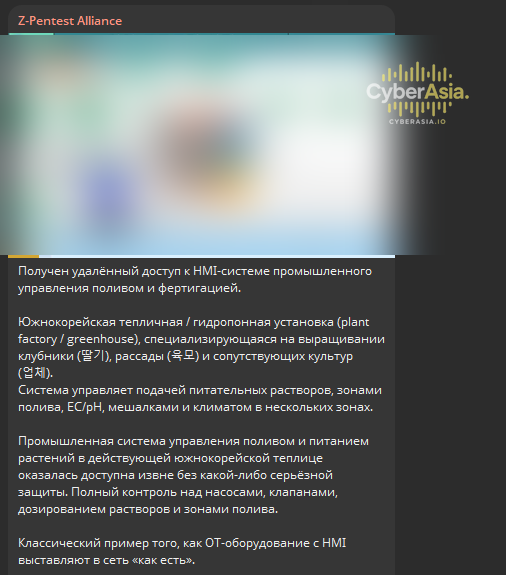
Hacktivist collective Z-Pentest Alliance has demonstrated unauthorized remote access to an actively operating agricultural HMI, exposing a South Korean hydroponic farm’s critical irrigation, fertigation, and climate controls to the open internet.
Context and Motivation
The pro-Russian hacktivist group known as Z-Pentest Alliance recently published evidence of a successful intrusion into an agricultural control system. Based on the exposed interface, the target is a South Korean hydroponic farm specializing in strawberries and related crops. While the group is typically known for ideologically motivated cyberattacks targeting entities aligned with Western interests, this specific incident appears to highlight stark opportunism rather than a targeted political sabotage campaign.
Threat actors often demonstrate their technical capabilities by exploiting severely misconfigured systems left accessible to the public web. By infiltrating a South Korean hydroponic farm, the group signals that no sector, no matter how niche or geographically distant, is immune to automated scanning and exploitation when basic security hygiene is neglected.
Technical Analysis (TTPs)
Unlike sophisticated Advanced Persistent Threat (APT) campaigns that rely on zero-day vulnerabilities or complex phishing chains, this breach is a classic example of severe operational negligence. The target is a Human-Machine Interface (HMI) governing industrial irrigation and fertigation.
According to the group’s claims, the industrial system was exposed to the external network “as is,” without a Virtual Private Network (VPN), strong authentication, or any serious perimeter defense. This lack of basic network segmentation allowed external actors to gain total administrative control over critical physical processes. Attackers frequently use IoT search engines like Shodan to scan the IPv4 address space for default ports associated with OT environments, such as Modbus port 502 or unsecured web panels operating on ports 80 and 443.
Once the panel was discovered, the threat actors were able to bypass (or entirely skip) login mechanisms, granting them the ability to manipulate pumps, valves, solution dosing (EC/pH levels), and multi-zone climate regulation with a single click. This type of exposure usually stems from misconfigured port forwarding on edge routers during the initial vendor installation process.
Impact Assessment
While a compromised South Korean hydroponic farm may not pose a national security crisis, the operational and financial impact on the facility itself is catastrophic. Hydroponic farming, particularly for high-yield, sensitive crops like strawberries, relies on precise environmental parameters. An attacker with unrestricted access to dosing systems and irrigation valves could easily destroy an entire crop cycle in a matter of hours.
By maliciously altering pH levels, flooding greenhouses, dispensing toxic amounts of fertilizers, or disabling climate control mechanisms during extreme weather, attackers can cause irreversible physical damage. This incident serves as a stark microcosm of the broader vulnerability landscape plaguing Operational Technology (OT) and Internet of Things (IoT) deployments globally, where the physical safety of operations is tethered to insecure digital networks.
Mitigation Recommendations
To prevent similar compromises, facility operators and OT administrators must implement immediate defensive measures and adopt a zero-trust mindset for industrial systems:
- Remove Direct Exposure: Never expose HMI panels, Programmable Logic Controllers (PLCs), or SCADA systems directly to the public internet. Ensure these systems sit behind a strictly configured, industry-standard firewall.
- Implement Secure Remote Access: Require a secure Virtual Private Network (VPN) combined with Multi-Factor Authentication (MFA) for any remote administrative or vendor access to OT environments.
- Network Segmentation: Isolate agricultural control systems from corporate IT networks and guest Wi-Fi to limit lateral movement in the event of a broader network breach. Utilize the Purdue Enterprise Reference Architecture model to structure these boundaries.
- Change Default Credentials: Immediately audit all connected IoT and industrial devices to ensure default or hardcoded vendor passwords have been replaced with strong, unique credentials.
CyberAsia will continue to monitor hacktivist activity and OT vulnerabilities targeting critical and commercial infrastructure worldwide. For more insights on securing ICS environments, explore our vulnerability intelligence archives.
> DISCLAIMER
The information provided in this article is for educational and threat intelligence purposes only. CyberAsia does not condone, promote, or encourage any illegal activities, including data breaches or unauthorized access to systems. The claims made by threat actors are unverified and reported strictly for awareness and defensive mitigation.
> subscribe_to_intel
Join 5,000+ analysts. Get uncensored threat intelligence and breach alerts delivered directly to your inbox. Privacy Policy.
Mitigation & Prevention Strategies
Exploitation of vulnerabilities in critical infrastructure and edge devices requires immediate remediation to prevent catastrophic disruption:
- Patch Management: Apply vendor-supplied security patches or firmware updates immediately. For legacy systems, deploy virtual patching via network firewalls.
- Isolate OT Networks: SCADA and OT environments must be strictly isolated from corporate IT networks (the Purdue Model) to prevent spillover attacks.
- Continuous Monitoring: Deploy Endpoint Detection and Response (EDR) solutions and monitor network traffic for indicators of compromise (IoCs) associated with known exploits.
Disclaimer: CyberAsia is an independent Cyber Threat Intelligence (CTI) research organization. The information provided in this report is derived from public intelligence gathering, dark web monitoring, and threat actor claims. It is published strictly for educational purposes, defensive analysis, and public awareness. CyberAsia does not endorse, verify, or facilitate any cyberattacks or illegal activities.
> INTELLIGENCE_NOTICE
The report above detailing Unsecured HMI Exposes South Korean Hydroponic Farm to Remote Hackers is part of the CyberAsia public archive. For organizations requiring real-time Indicators of Compromise (IoCs), YARA rules, and extended mitigation strategies for scada & iot threats, please refer to our Secure Drop or contact the research desk.

> ABOUT_AUTHOR: Haider
> related_intel --suggest
SCADA & IoT
 SCADA & IoT
BMS Cyberattack: Disrupt0r Hacks Quinquela Plaza SCADA
> read SCADA & IoT