 ddos
ddos
ddos
QX-CYBER DDoS Disrupts Thai Weather Agency: 503 Errors
> By Clara | Oct 17, 2026 | 6 min read
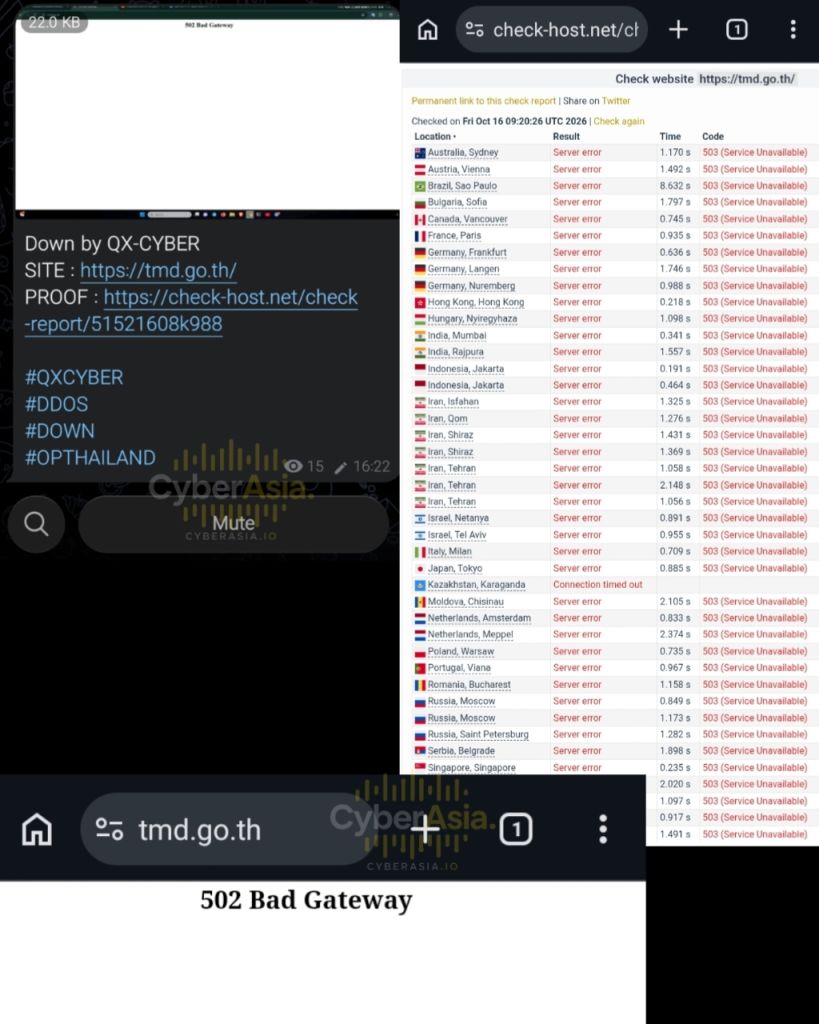
The public website of the Thai Meteorological Department, tmd.go.th, returned HTTP 503 errors from at least 41 monitoring locations on Friday, October 16, 2026, following a QX-CYBER DDoS attack announced under the #OpThailand tag. A separate browser capture posted with the announcement shows the site serving a bare 502 Bad Gateway page. The evidence covers website availability only. Nothing in it shows whether forecasting or warning systems were affected.
QX-CYBER DDoS Attack on tmd.go.th: What the Evidence Shows
The group’s post names the target as https://tmd.go.th/, links to a check-host.net report and ends with four hashtags: #QXCYBER, #DDOS, #DOWN and #OPTHAILAND. The report is stamped Friday, October 16, 2026, at 09:20:26 UTC. That timestamp gives analysts a fixed point to compare against the agency’s own server logs.
Two screenshots sit beside the post. One shows a desktop browser window with nothing but the words 502 Bad Gateway on a white page. The other is a mobile Chrome tab opened on tmd.go.th, displaying the same error in bold black type.
Neither capture carries a visible timestamp, so the images alone cannot show how long the disruption lasted.
How the Outage Looked From Around the World
Check-host sends a request to a URL from dozens of probe servers and records the HTTP status each one receives. In this run, 41 of the 42 visible locations returned 503 Service Unavailable. Only Karaganda in Kazakhstan differed, reporting a connection timeout with no HTTP code at all.
The spread is wide. Probes in Sydney, Vancouver, Sao Paulo, Frankfurt, Mumbai, Tokyo, Moscow and Tehran all received the same answer. Jakarta, Hong Kong and Singapore returned errors in under half a second, while Sao Paulo needed 8.632 seconds and Meppel in the Netherlands took 2.374 seconds.
That mix of fast and slow failures is often seen when a front-end proxy is under heavy load. Some requests are rejected immediately, and others wait in a queue before giving up. A 502 in the browser captures and a 503 from the probes fit the same picture, because both codes can come from a gateway that cannot get a usable response from the origin server.
Without access to the agency’s logs, the exact vector behind the QX-CYBER DDoS attack stays unknown. It could be a Layer 7 HTTP flood or something else entirely.
Who Is QX-CYBER and Why #OpThailand Matters
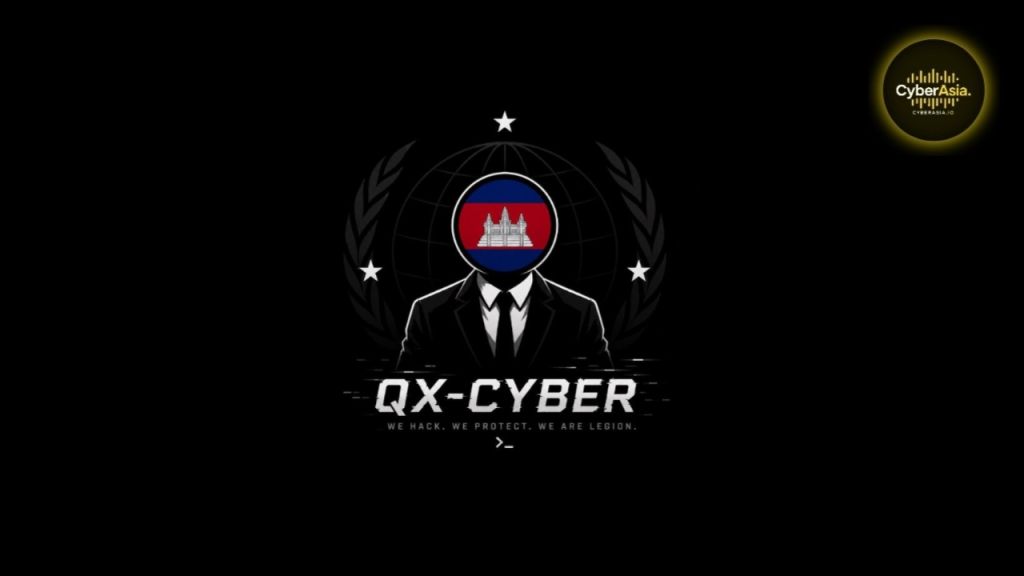
The group’s logo shows a faceless figure in a suit whose head is replaced by the Cambodian flag, with the Angkor Wat temple at its center. The tagline reads “We hack. We protect. We are legion.” No other background on the group came with the evidence, and we could not locate public research profiling QX-CYBER specifically at the time of writing.
The #OpThailand tag points to a wider pattern. Group-IB researchers counted 139 cyberattacks linked to 19 hacktivist groups between July 24 and August 7, 2025, during the border conflict between Cambodia and Thailand. Eleven of those groups sided with Cambodia and eight with Thailand. Most of the attacks, 103 in total, were DDoS.
A ceasefire was agreed on July 28, 2025, yet other OSINT reporting has documented Cambodia-linked groups continuing to target Thai institutions afterward. Whether QX-CYBER belongs to that ecosystem is not established by the evidence at hand. Its choice of target and hashtag are consistent with it, though.
Why a Weather Agency Makes a Visible Target
The Thai Meteorological Department is the national agency for weather forecasts, climate monitoring and warnings. It joined the World Meteorological Organization in 1949 and is listed in the WMO register as Thailand’s alerting authority, with public forecast and alert feeds published through its website.
For a hacktivist, a government site with that profile is attractive for a simple reason. Downtime is easy to prove with a free public tool and easy to screenshot.
Read more cybersecurity news from CyberAsia at https://cyberasia.io/articles/
The real impact depends on architecture. If forecasts and alert feeds run through the same web front end, residents and partner agencies could be locked out during bad weather. If they are served separately, the outage hits a landing page and little else. The posted evidence does not settle which case applies.
What Admins Can Do During a Layer 7 Flood
Teams running public government portals can reduce exposure with a few practical steps:
- Place the site behind a CDN or DDoS mitigation service and keep the origin IP address private.
- Cache forecast pages and static assets at the edge so repeat requests never reach the origin.
- Apply per-IP and per-session rate limits, and challenge traffic with unusual request patterns.
- Alert on spikes of 502 and 503 responses, and report incidents to the national CERT.
FAQ
Q1 : Did the QX-CYBER DDoS attack expose any data from the Thai Meteorological Department?
Nothing in the posted material points to data theft. The evidence shows availability errors only, with no leaked files, credentials or database screenshots. A DDoS attack floods a service with traffic and does not by itself give anyone access to stored data.
Q2 : Does a 503 error mean the QX-CYBER DDoS attack succeeded?
It means the server could not handle requests at the moment of the check. It does not show how long the outage lasted, and a mitigation provider can also return 503 while it filters traffic. Server and CDN logs are the only reliable source for duration.
Q3 : Are weather forecasts and storm warnings affected?
The screenshots only test the public website. Forecast production and observation networks normally run on separate systems, but how results reach the public depends on the agency’s setup. Anyone needing urgent weather information can check the department’s official channels or local disaster authorities until the site recovers.
Q4 : Why would a group using the Cambodian flag target a Thai agency?
The post gives no stated motive. The logo uses the Cambodian flag, and the #OpThailand tag matches the campaign style seen since the 2025 border conflict. That context is suggestive, but it is not proof of intent.
Q5 : What should an admin check first when a site starts returning 503 errors?
Confirm whether the origin server or the proxy layer is failing, then turn on rate limiting and edge caching. Contact the hosting or mitigation provider early and preserve all logs for investigation. Sharing indicators with the national CERT helps other agencies prepare.
Editorial Notice
This article is published for educational and cyber security research purposes only. CyberAsia.io reports on publicly available information and does not endorse or support attacks against any organization. Readers should never attempt to access, disrupt or test systems without explicit authorization. Details may be updated as more information becomes available.
Disclaimer: The information presented in this threat intelligence report is for educational and cybersecurity research purposes only. CyberAsia reports on cyber incidents to help organizations understand and defend against emerging threats. We do not provide hacking instructions, host stolen data, or endorse illegal activities.
> INTELLIGENCE_NOTICE
The report above detailing QX-CYBER DDoS Disrupts Thai Weather Agency: 503 Errors is part of the CyberAsia public archive. For organizations requiring real-time attack telemetry, check-host latency records, and edge firewall mitigation strategies for ddos incidents, please refer to our Secure Drop or contact the research desk.