🔴 [LATEST] IRAN DEPLOYS 2 CYBER FRONTS: HANDALA TARGETS ISRAEL, CYBERAV3NGERS TARGETS US    ◆    🔴 [LATEST] PARAGUAY'S MITIC SERVER DOWN FOR 24 HOURS, THEGARUDAEYE IN SPOTLIGHT    ◆    🔴 [LATEST] THEHATMAN SELLS 3.6 MILLION AZURE EMPLOYEE RECORDS FROM FORTUNE 500 COMPANIES    ◆    🔴 [LATEST] 24 HOURS OF DIGITAL BLACKOUT: THEGARUDAEYE SILENCES PARAGUAY'S CULTURE MINISTRY PORTAL IN THE NAME OF PALESTINE    ◆    🔴 [LATEST] WHERE HAS DRAGONFORCE MALAYSIA GONE? THE SILENCE OF SOUTHEAST ASIA'S PREMIER HACKTIVISTS

~/ddosarticle

ddos

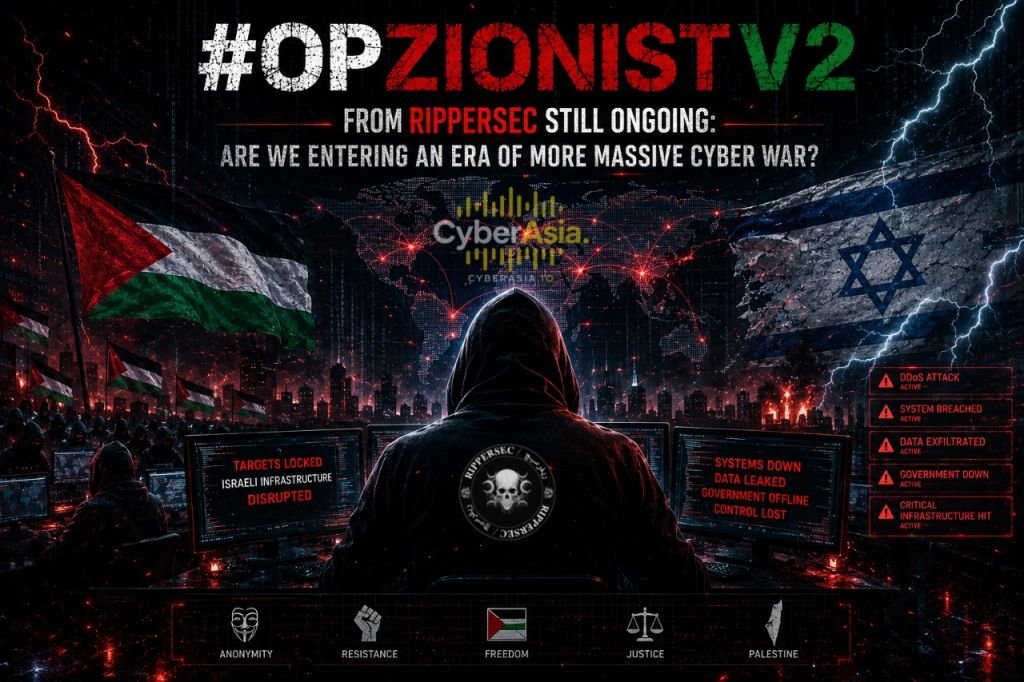
#OpZionistV2 from RipperSec still Ongoing: Are We Entering an Era of More Massive Cyber War?

> By Clara | Aug 08, 2026 | 8 min read

#OpZionistV2 from RipperSec still Ongoing: Are We Entering an Era of More Massive Cyber War? - CyberAsia Threat Intel Evidence

#OpZionistV2: RipperSec Continues DDoS Campaign Against Israeli-Linked Entities | CyberAsia.io

:root{
–bg:#0a0a0a;
–bg-panel:#111111;
–yellow:#f5d90a;
–yellow-dim:#8a7d0a;
–text:#d8d8d8;
–text-dim:#8a8a8a;
–line:#2a2a2a;
–red:#ff4d4d;
–green:#3ddc84;
}
*{box-sizing:border-box;margin:0;padding:0;}
body{
background:var(–bg);
color:var(–text);
font-family:’Space Grotesk’,sans-serif;
line-height:1.7;
padding-bottom:80px;
}
::selection{background:var(–yellow);color:#000;}

.statusbar{
font-family:’JetBrains Mono’,monospace;
font-size:12px;
color:var(–text-dim);
border-bottom:1px solid var(–line);
padding:10px 24px;
display:flex;
justify-content:space-between;
letter-spacing:0.5px;
}
.statusbar .dot{color:var(–green);margin-right:6px;}
.statusbar .blink{animation:blink 1.4s steps(2) infinite;}
@keyframes blink{50%{opacity:0;}}

.wrap{max-width:760px;margin:0 auto;padding:0 24px;}

header{padding-top:40px;}
.kicker{
font-family:’JetBrains Mono’,monospace;
font-size:12px;
color:var(–red);
letter-spacing:2px;
text-transform:uppercase;
display:flex;
align-items:center;
gap:8px;
margin-bottom:18px;
}
.kicker::before{content:”[“;color:var(–text-dim);}
.kicker::after{content:”]”;color:var(–text-dim);}

h1{
font-family:’Space Grotesk’,sans-serif;
font-weight:700;
font-size:clamp(28px,5vw,44px);
line-height:1.15;
color:#fff;
margin-bottom:18px;
letter-spacing:-0.5px;
}
.dek{
font-size:17px;
color:var(–text-dim);
font-weight:400;
margin-bottom:24px;
max-width:62ch;
}
.byline{
font-family:’JetBrains Mono’,monospace;
font-size:12px;
color:var(–text-dim);
border-top:1px solid var(–line);
border-bottom:1px solid var(–line);
padding:12px 0;
margin-bottom:34px;
display:flex;
flex-wrap:wrap;
gap:4px 16px;
}
.byline span{color:var(–yellow);}

.meta-grid{
display:grid;
grid-template-columns:repeat(auto-fit,minmax(140px,1fr));
gap:1px;
background:var(–line);
border:1px solid var(–line);
margin-bottom:36px;
}
.meta-cell{
background:var(–bg-panel);
padding:14px 16px;
}
.meta-cell .label{
font-family:’JetBrains Mono’,monospace;
font-size:10px;
letter-spacing:1.5px;
text-transform:uppercase;
color:var(–text-dim);
margin-bottom:6px;
}
.meta-cell .value{
font-family:’JetBrains Mono’,monospace;
font-size:14px;
font-weight:700;
color:var(–yellow);
}
.meta-cell .value.low{color:var(–green);}
.meta-cell .value.active{color:var(–red);}

article p{
font-size:16px;
color:var(–text);
margin-bottom:20px;
}
article p strong{color:#fff;}

h2{
font-family:’JetBrains Mono’,monospace;
font-size:15px;
font-weight:700;
color:var(–yellow);
letter-spacing:1px;
text-transform:uppercase;
margin-top:44px;
margin-bottom:16px;
padding-bottom:10px;
border-bottom:1px solid var(–line);
display:flex;
align-items:center;
gap:10px;
}
h2::before{
content:”▸”;
color:var(–yellow-dim);
}

.quote-block{
font-family:’JetBrains Mono’,monospace;
font-size:14px;
color:var(–yellow);
background:var(–bg-panel);
border-left:3px solid var(–yellow);
padding:16px 20px;
margin:24px 0;
}
.quote-block .tag{
display:block;
color:var(–text-dim);
font-size:11px;
margin-bottom:8px;
letter-spacing:1px;
}

.tool-tag{
display:inline-block;
font-family:’JetBrains Mono’,monospace;
font-size:12px;
color:#000;
background:var(–yellow);
padding:2px 8px;
border-radius:2px;
font-weight:700;
}

.callout{
border:1px solid var(–line);
background:var(–bg-panel);
padding:20px 22px;
margin:32px 0;
}
.callout .callout-title{
font-family:’JetBrains Mono’,monospace;
font-size:12px;
color:var(–red);
letter-spacing:1.5px;
text-transform:uppercase;
margin-bottom:10px;
}
.callout p{font-size:14px;color:var(–text-dim);margin-bottom:0;}

footer.tagbar{
margin-top:50px;
padding-top:24px;
border-top:1px solid var(–line);
display:flex;
flex-wrap:wrap;
gap:8px;
}
.tag-pill{
font-family:’JetBrains Mono’,monospace;
font-size:11px;
color:var(–text-dim);
border:1px solid var(–line);
padding:5px 12px;
letter-spacing:0.5px;
}

.end-marker{
text-align:center;
font-family:’JetBrains Mono’,monospace;
color:var(–yellow-dim);
font-size:12px;
margin-top:40px;
letter-spacing:2px;
}

@media(max-width:480px){
.byline{flex-direction:column;gap:4px;}
}

The pro-Palestinian hacktivist group has released fresh claims of attacks against the Israel Export Institute using the MegaMedusa toolkit , no evidence yet of data leaks or compromise of critical infrastructure.

Attack Type
L7 DDoS

Toolkit
MegaMedusa

Primary Target
Export Institute

Websites & Servers
Down

Data Exfiltration
Not Detected

Campaign Trend
Escalating

As of August 5, 2026, the #OpZionistV2 campaign by the pro-Palestinian hacktivist group RipperSec shows no signs of slowing down. The group has released new claims of distributed denial-of-service (DDoS) activity targeting Israeli-linked organizations, including the Israel Export Institute and related entities. These operations align with a broader pattern of coordinated hacktivist efforts that have intensified since late 2025.
#OpZionistV2 from RipperSec still Ongoing: Are We Entering an Era of More Massive Cyber War? - CyberAsia Threat Intel Evidence
> TABLE_OF_CONTENTS [toggle]

What’s Happening

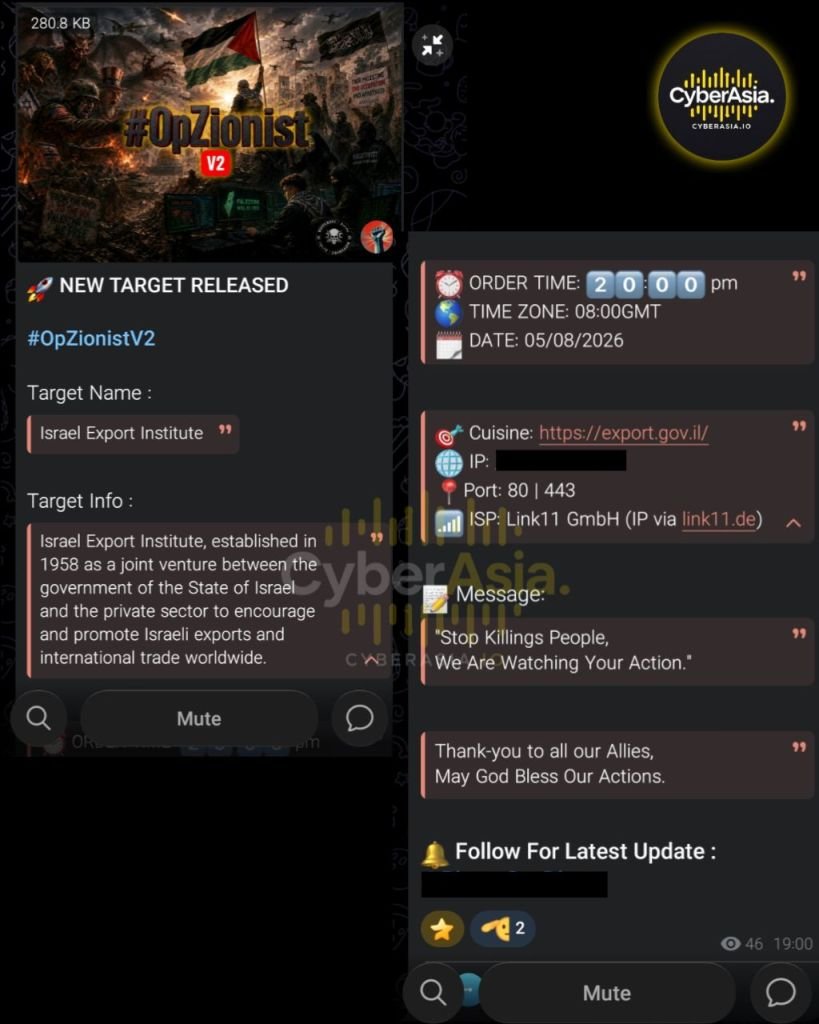
RipperSec, a pro-Palestinian hacktivist group active since June 2023, has publicly announced continued operations under the #OpZionistV2 banner. The latest releases reference the Israel Export Institute (export.gov.il), a government-private partnership established in 1958 to promote Israeli exports worldwide.

Group Statement
Stop Killings People, We Are Watching Your Action.

The message was accompanied by thanks to allied groups and invocations of divine blessings, part of the campaign’s broader political messaging.

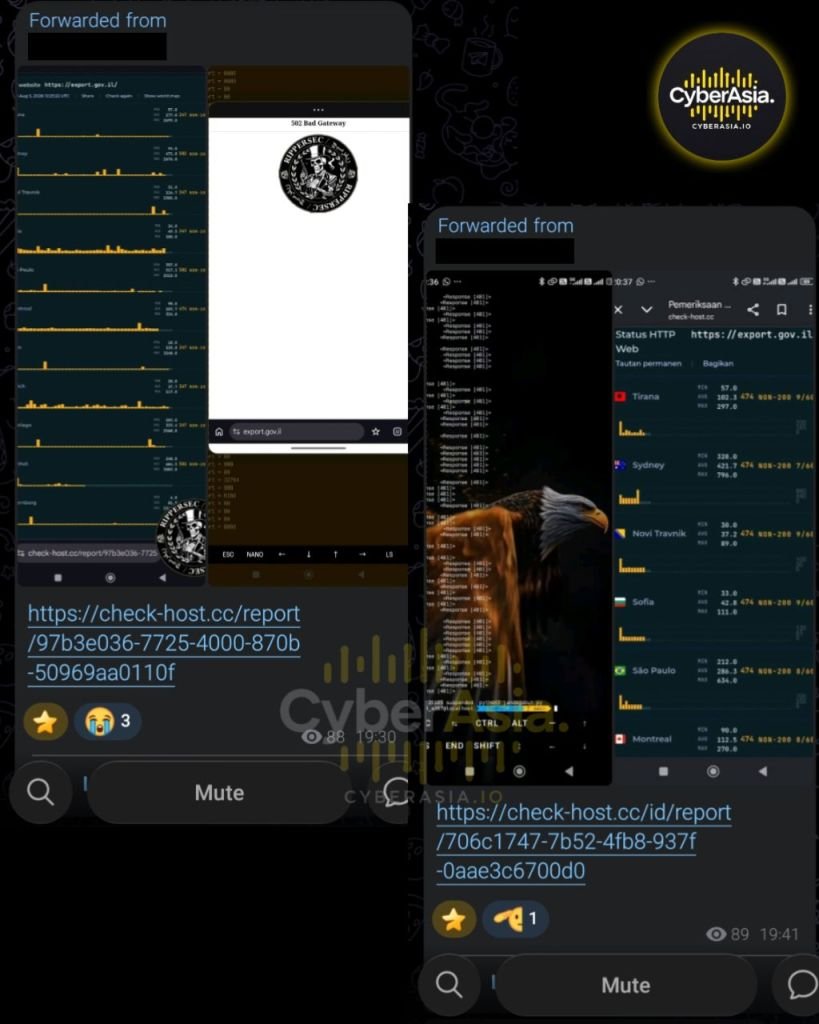
Technical indicators point to the use of MegaMedusa , a private Node.js-based web DDoS toolkit designed for application-layer floods relayed through proxies. The tool is not publicly available and is circulated privately among affiliated operators, allowing for high-volume HTTP/HTTPS attacks with randomization to bypass basic filters. No evidence of destructive malware or data exfiltration has surfaced in the campaign to date.
#OpZionistV2 from RipperSec still Ongoing: Are We Entering an Era of More Massive Cyber War? - CyberAsia Threat Intel Evidence

Who Is Affected

The primary targets fall outside critical infrastructure sectors. Israeli export promotion websites and similar public-facing platforms are the focus. Previous phases of #OpZionistV2 and allied operations have hit government bodies, defense-related entities, and organizations perceived as aligned with Israeli interests. The campaign’s reach has expanded to include diaspora and international entities supporting Israel, such as certain foundations and advocacy groups.

Technical Details

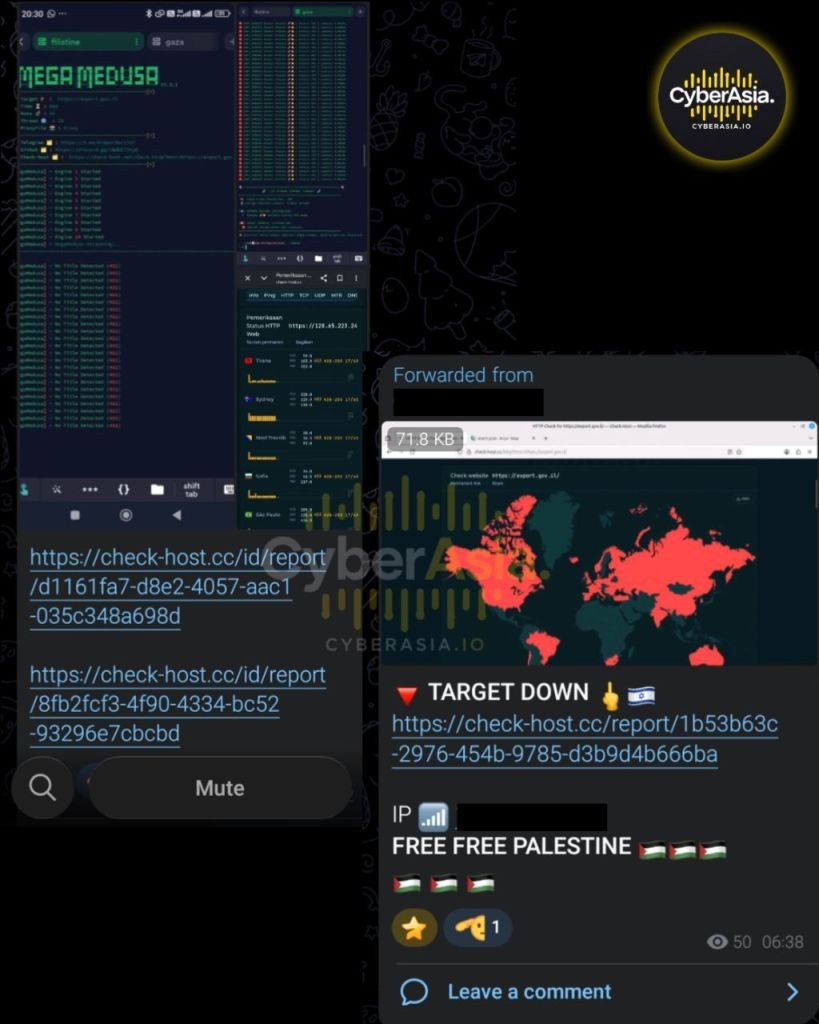
MegaMedusa operates by generating traffic spikes against web servers, often exploiting open proxy chains or CDN bypass techniques. The group maintains a Telegram channel for rapid claim dissemination and coordination with other hacktivist collectives. Reports from monitoring services like check-host.cc show repeated entries for the campaign, though success metrics remain unconfirmed independently. The toolkit’s closed, privately circulated nature makes it harder for researchers to study and mitigate its behavior compared to publicly available tools.
#OpZionistV2 from RipperSec still Ongoing: Are We Entering an Era of More Massive Cyber War? - CyberAsia Threat Intel Evidence

Background and Actors

RipperSec operates with a clear ideological focus on pro-Palestinian causes and opposition to perceived Israeli and Western policies. The group has coordinated with dozens of other hacktivist teams, including those aligned under broader coalitions such as the Cyber Islamic Resistance Axis. Some analyses note links to state-aligned efforts, though RipperSec itself maintains a decentralized, hacktivist model rather than direct state sponsorship. Its operations have spanned multiple continents, with notable activity against targets in the Middle East, Europe, and Asia.

Potential Impact

Current claims center on temporary service disruption rather than permanent compromise or data leaks. Export and government websites are not considered critical infrastructure, so real-world effects are limited to access issues and reputational noise. However, the sheer volume of such operations contributes to defensive overload and public anxiety. If the campaign expands to include data leaks or targeted infrastructure, the impact could grow significantly.
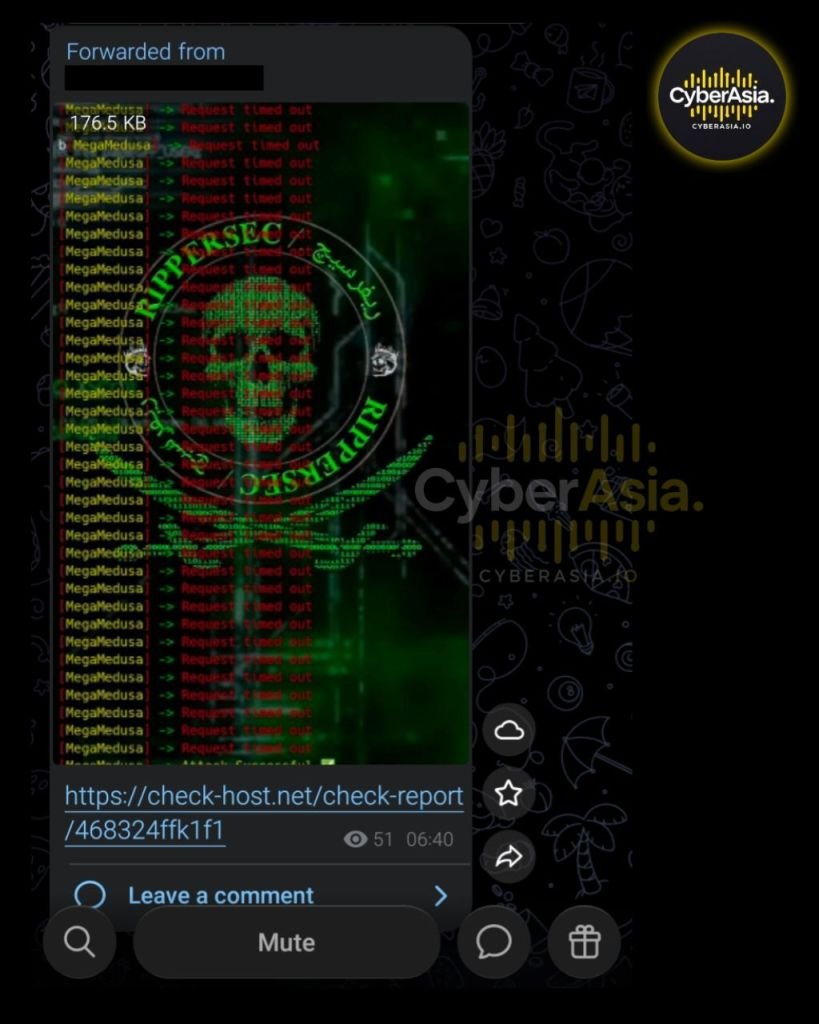
#OpZionistV2 from RipperSec still Ongoing: Are We Entering an Era of More Massive Cyber War? - CyberAsia Threat Intel Evidence

Current Response and Mitigation

Israeli authorities and technology providers have not issued specific statements regarding these claims. General DDoS mitigation relies on rate limiting, CDN scrubbing, and proxy blocking. Threat intelligence feeds have proven effective in reducing the effectiveness of MegaMedusa by identifying and isolating proxy infrastructure, despite the toolkit’s limited public exposure.

Is a More Massive Cyber War Emerging?

The #OpZionistV2 campaign represents one chapter in a larger trend of politically motivated hacktivism. Coordinated waves involving multiple groups have become more common, especially in regions tied to geopolitical tensions. However, these operations remain largely at the level of disruptive claims rather than sustained, destructive campaigns backed by advanced persistent threats or state resources. True “massive” cyber escalation , characterized by widespread infrastructure compromise, destructive payloads, and integration with kinetic operations , has not been observed in this specific theater.

RipperSec’s activities continue to serve primarily as information operations and symbolic pressure. The group’s decentralized structure limits its ability to conduct large-scale, sophisticated attacks. While the frequency and geographic spread of hacktivist claims are rising, the evolution toward a full-scale cyber war requires additional factors such as advanced tooling, state-level funding, and targeting of critical infrastructure.

Conclusion

#OpZionistV2 from RipperSec remains active and ongoing, reflecting the persistent nature of hacktivist campaigns in the current geopolitical climate. Organizations in export, government, and international trade should maintain vigilance against politically motivated DDoS operations. Proactive monitoring of Telegram channels, rapid blocking of proxy infrastructure, and shared threat intelligence remain the most effective defenses.

The cyber landscape continues to evolve, but this particular campaign underscores the importance of resilience against disruptive rather than destructive threats. As monitoring intensifies, the question of whether we are entering a more massive cyber era will depend on whether these politically aligned actors can transition from claims to truly impactful, sustained operations. The situation remains fluid, with details still developing. Security teams are advised to stay informed through reliable threat intelligence sources.


#RipperSec
#OpZionistV2
#DDoS
#MegaMedusa
#Hacktivism
#Israel
> DISCLAIMER

The information provided in this article is for educational and threat intelligence purposes only. CyberAsia does not condone, promote, or encourage any illegal activities, including data breaches or unauthorized access to systems. The claims made by threat actors are unverified and reported strictly for awareness and defensive mitigation.


> subscribe_to_intel

Join 5,000+ analysts. Get uncensored threat intelligence and breach alerts delivered directly to your inbox. Privacy Policy.

> establish_connection:
[X/Twitter]
[Telegram]

Mitigation & Prevention Strategies

To defend against advanced Layer 7 and volumetric DDoS attacks observed in these campaigns, organizations should implement the following defensive postures:

  • Edge Protection: Deploy robust Web Application Firewalls (WAF) and Anti-DDoS solutions configured to challenge anomalous request rates (e.g., CAPTCHA or JS challenges) before they hit origin servers.
  • Geographic Rate Limiting: If the threat actor originates from or utilizes botnets concentrated in specific regions, enforce geo-blocking rules for non-essential traffic.
  • Infrastructure Scaling: Ensure load balancers and auto-scaling groups are optimized to absorb sudden traffic spikes while maintaining core service availability.

> INTELLIGENCE_NOTICE

The report above detailing #OpZionistV2 from RipperSec still Ongoing: Are We Entering an Era of More Massive Cyber War? is part of the CyberAsia public archive. For organizations requiring real-time Indicators of Compromise (IoCs), YARA rules, and extended mitigation strategies for ddos threats, please refer to our Secure Drop or contact the research desk.

> ABOUT_AUTHOR: Clara

Senior Threat Intelligence Analyst and former Cyber Policy Consultant focusing on geopolitical cyber warfare and data privacy.

> related_intel --suggest