 hacktivism
~/ › hacktivism › article
hacktivism
Babayo Eror System Claims Defacement of Indonesian Government Websites
> By Haider | Aug 06, 2026 | 3 min read
The hacktivist collective known as Babayo Eror System has purportedly breached and defaced multiple Indonesian regional government websites. The targeted domains primarily include village and regency portals such as batukali.jepara.go.id, gumiwang-banjarnegara.desa.id, and blingoh.jepara.go.id.
The threat actors publicly announced their campaign via their Telegram channel, providing direct links to the compromised sites as evidence of their intrusion.

Upon accessing the affected pages, visitors are greeted with a politically charged defacement manifesto rather than the standard government content. The injected imagery features protesters holding signs with slogans such as “BADAN BESAR OTAK KOSONG” and “OK GAS OK GAS INDONESIA CEMAS”.
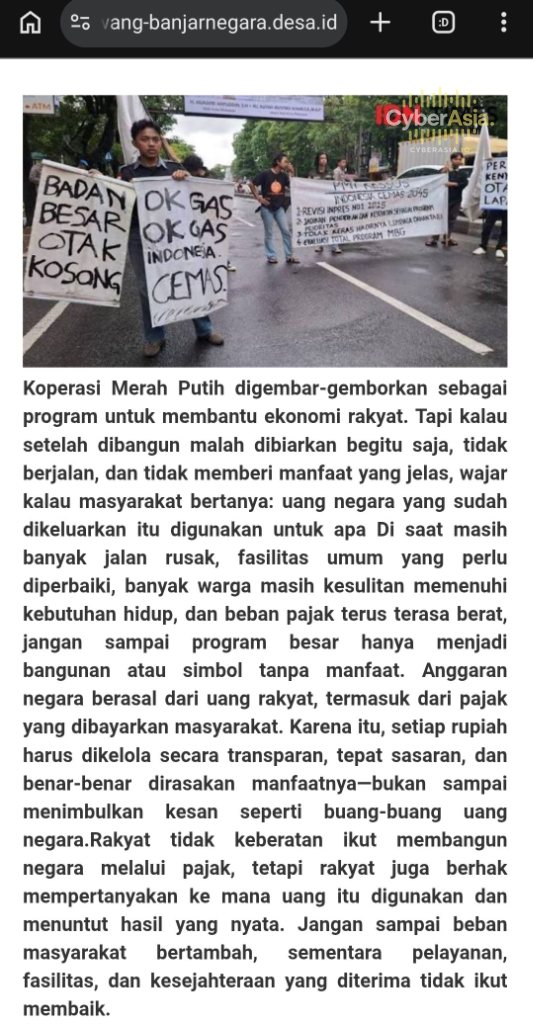
The accompanying text heavily critiques state economic policies, specifically targeting the “Koperasi Merah Putih” program. The manifesto questions the allocation of national budget and taxpayer funds, arguing that the public has not experienced tangible benefits despite significant government expenditure. This aligns with the typical modus operandi of Babayo Eror System, which often leverages opportunistic website compromises to broadcast socio-economic grievances and anti-establishment narratives.
Actionable Defense: Defacement Mitigation Strategies
To prevent opportunistic defacements on municipal and regional web portals, administrators should implement the following fundamental controls:
> THREAT_INTELLIGENCE_DATA
- CMS Hardening and Patching: Ensure that the core Content Management System (CMS), such as WordPress or Joomla, along with all active plugins and themes, are updated to their latest versions to close known exploitation vectors.
- Access Control and Authentication: Enforce strong, unique passwords and mandatory Multi-Factor Authentication (MFA) for all administrative accounts. Restrict access to backend login portals to trusted internal IP addresses only.
- File Integrity Monitoring (FIM): Deploy FIM solutions to automatically detect and alert administrators to unauthorized modifications of core web files, enabling rapid incident response before the defacement is widely publicized.
Disclaimer: The information presented in this threat intelligence report is for educational and cybersecurity research purposes only. CyberAsia reports on cyber incidents to help organizations understand and defend against emerging threats. We do not provide hacking instructions, host stolen data, or endorse illegal activities.
Mitigation & Prevention Strategies
Exploitation of vulnerabilities in critical infrastructure and edge devices requires immediate remediation to prevent catastrophic disruption:
- Patch Management: Apply vendor-supplied security patches or firmware updates immediately. For legacy systems, deploy virtual patching via network firewalls.
- Isolate OT Networks: SCADA and OT environments must be strictly isolated from corporate IT networks (the Purdue Model) to prevent spillover attacks.
- Continuous Monitoring: Deploy Endpoint Detection and Response (EDR) solutions and monitor network traffic for indicators of compromise (IoCs) associated with known exploits.
Strategic Threat Landscape & Layer 7 Disruption Analysis
The escalation of this specific cyber incident reflects a broader, systemic shift in the global threat landscape regarding distributed denial-of-service (DDoS) methodologies. Threat intelligence analysts continuously observe that the tactics, techniques, and procedures (TTPs) deployed here are rapidly becoming the standard operational blueprint for regionally aligned hacktivist collectives seeking high-visibility disruption.
In recent months, there has been a documented pivot away from traditional volumetric attacks (Layer 3/4) towards highly sophisticated Layer 7 application-layer disruptions. These attacks bypass traditional scrubbing centers by mimicking legitimate user behavior, exhausting server resources through complex database queries or API abuse. This evolution enables attackers to cripple critical infrastructure and governmental portals with significantly smaller botnets.
In addition, the convergence of geopolitical tensions and cyber operations has transformed DDoS from a mere nuisance into an instrument of international policy disagreement. Hacktivist syndicates now leverage decentralized proxy networks and compromised IoT devices to launch these campaigns anonymously, targeting organizations based on ideological alignment rather than financial gain.
Defensive Evolution & Proactive Mitigation
From a defensive standpoint, legacy perimeter security models and basic rate-limiting are no longer sufficient. Organizations must urgently transition to adopting advanced, AI-driven Web Application Firewalls (WAFs) capable of behavioral analysis and bot mitigation.
To combat this evolving threat matrix, continuous monitoring of web traffic baselines and the deployment of elastic, cloud-based infrastructure are critical. In addition, the integration of automated Threat Intelligence Platforms (TIPs) allows organizations to proactively block malicious IPs and known proxy exit nodes before an attack reaches critical mass.
> INTELLIGENCE_NOTICE
The report above detailing Babayo Eror System Claims Defacement of Indonesian Government Websites is part of the CyberAsia public archive. For organizations requiring real-time Indicators of Compromise (IoCs), YARA rules, and extended mitigation strategies for hacktivism threats, please refer to our Secure Drop or contact the research desk.