 hacktivism
~/ › hacktivism › article
hacktivism
Where Has DragonForce Malaysia Gone? The Silence of Southeast Asia’s Premier Hacktivists
> By Haider | Aug 18, 2026 | 5 min read
The sudden silence across Southeast Asia’s hacktivist underground raises a critical intelligence question: where has DragonForce Malaysia gone after dominating regional cyber operations for years? The collective, once celebrated across dark web channels and social media for orchestrated campaigns including #OpsBedil, #OpsPatuk, and #OpsIsrael, has largely retreated from public-facing ideological warfare. While their once-vibrant community forum and high-profile defacements have vanished from active cyber warfare rosters, threat intelligence telemetry reveals a profound transformation: an evolution marked by law enforcement pressure, the official decommissioning of their primary forum, explicit denials of ransomware affiliations, and a strategic pivot toward commercial cybersecurity education.
> TABLE_OF_CONTENTS [toggle]
- > The Rise and Zenith of DragonForce Malaysia
- > Official Decommission: DragonForce Malaysia Shuts Down dragonforce.io Forum
- > From Geopolitical Hacktivism to Cybersecurity Training & Courses
- > The Ransomware Entity: A Separate Syndicate and Public Denials
- > CTI Insights: The Evolution of Southeast Asian Hacktivism
- > Mitigation and Defensive Architecture
The Rise and Zenith of DragonForce Malaysia
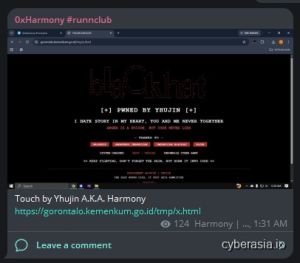
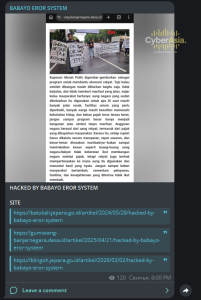
Formed as an ideologically motivated collective operating from Malaysia and coordinating with pan-Islamic hacktivist cells across Indonesia, Pakistan, and the Middle East, DragonForce Malaysia established a formidable digital footprint between 2021 and 2023. Operating through their dedicated forum portal and encrypted Telegram networks, the group orchestrated massive distributed denial-of-service (DDoS) campaigns, SQL injection intrusions, and web defacements targeting governmental and corporate assets in Israel, India, and across ASEAN.
At its peak, the collective possessed the rare ability to mobilize thousands of volunteer cyber partisans, script kiddies, and coordinated threat actors tracked in our CyberAsia Threat Actors Directory. Their campaigns were characterized by high-volume, multi-vector disruptions aimed at generating media resonance and raising global awareness for geopolitical causes, particularly the Palestinian struggle. However, following escalating regional geopolitical shifts and intensified international intelligence tracking, the group’s offensive operations ground to a halt.
Official Decommission: DragonForce Malaysia Shuts Down dragonforce.io Forum
In a decisive move confirming the end of their open web era, DragonForce Malaysia Headquarters issued an official press release formally announcing the permanent decommission and complete shutdown of their flagship forum portal, dragonforce.io, effective by late February to March 2026. The announcement marks the conclusion of one of the longest-running public community hubs in Southeast Asian hacktivism history.
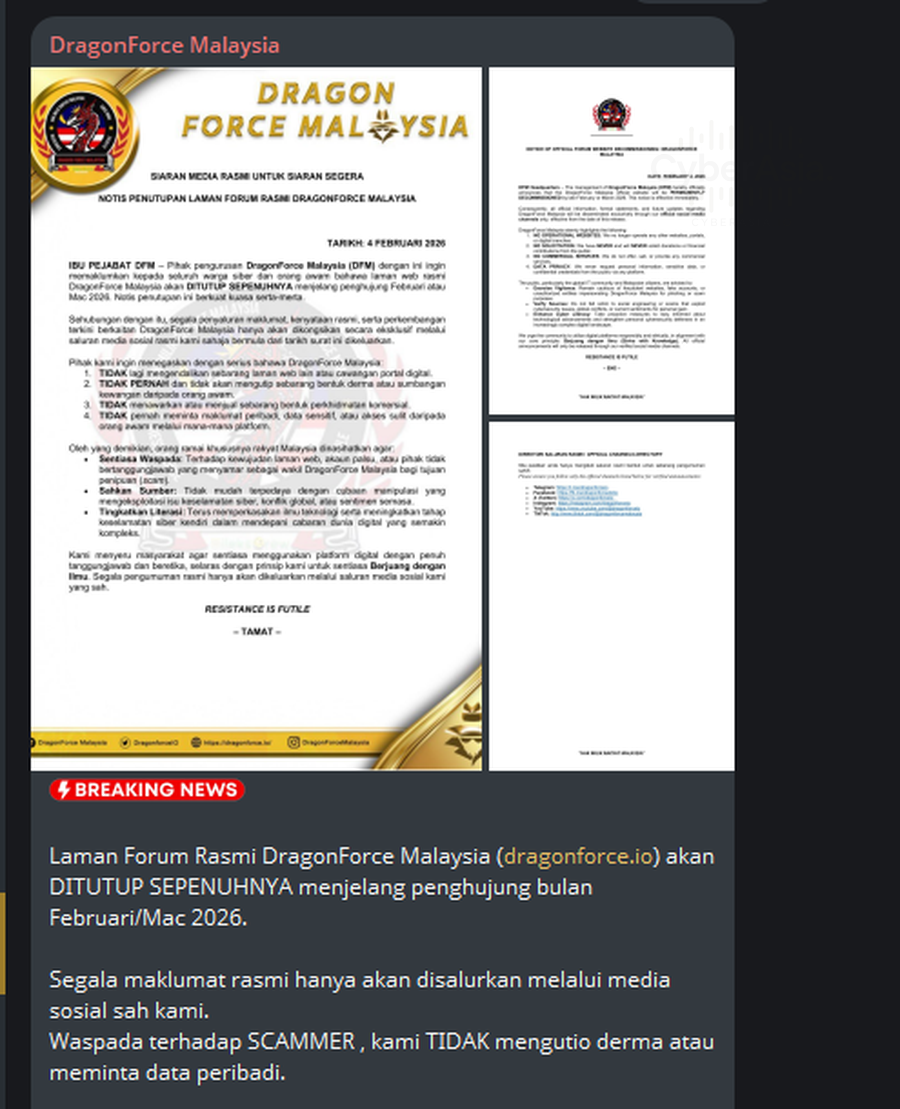
In the official communique, leadership outlined four strict operational mandates to prevent public exploitation and unauthorized impersonation:
- 1. No Operational Websites: DragonForce Malaysia explicitly ceased operating any digital forums, mirrors, or digital portal branches.
- 2. Zero Financial Solicitation: The collective affirmed it has never solicited and will never accept public donations, crowdfunding, or monetary contributions.
- 3. No Commercial Services: The group does not sell, broker, or offer commercial penetration testing, cyber attack services, or paid access.
- 4. Zero Data Collection: The management reiterated it never requests confidential credentials, private citizen data, or sensitive personal information.
From Geopolitical Hacktivism to Cybersecurity Training & Courses
Perhaps the most noticeable operational shift observed across DragonForce Malaysia’s authenticated communication feeds is their transition away from aggressive ideological hacktivism toward promoting domestic cybersecurity education, defensive training, and professional upskilling.
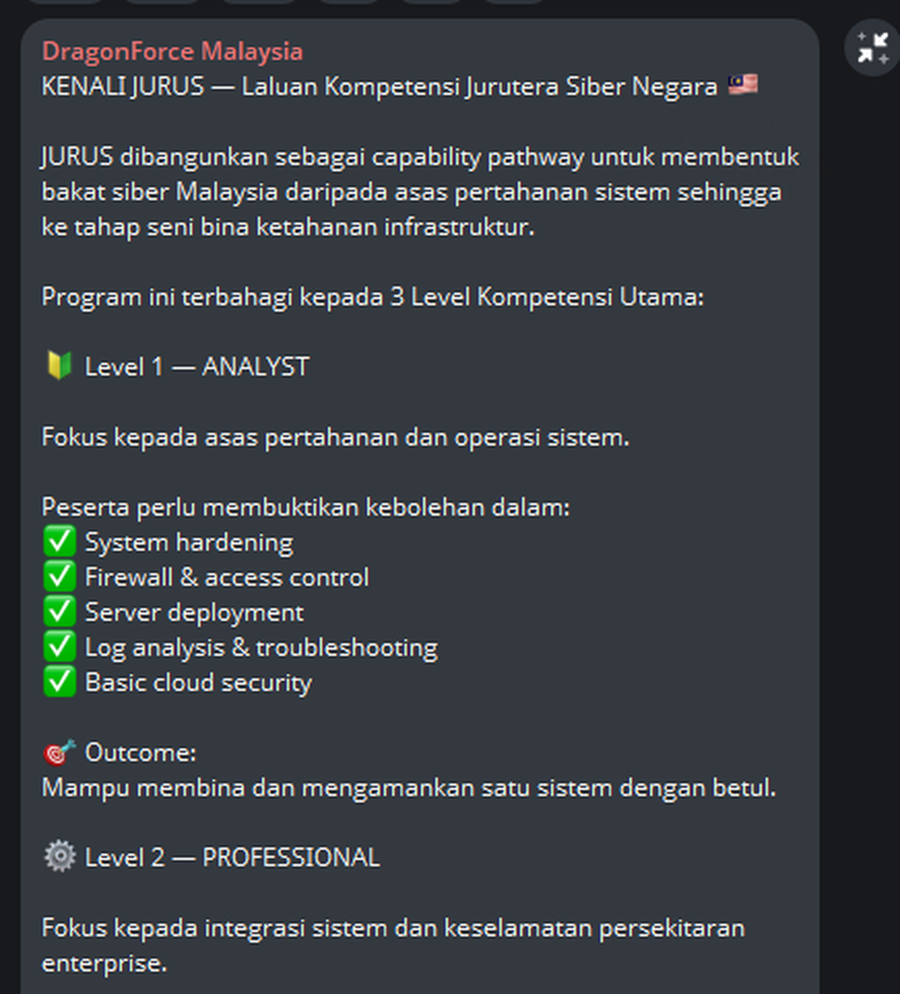
During their zenith, the collective’s channels served as real-time staging grounds for geopolitical cyber warfare, broadcasting target lists, defacement mirrors, and solidarity calls for Palestine. Today, the group’s official broadcasts are dominated by curriculum frameworks such as JURUS (Laluan Kompetensi Jurutera Siber Negara)—a structured capability pathway designed to train Malaysian cyber talent across three competency tiers: Analyst (System Hardening & Cloud Security), Professional (Enterprise Integration), and Specialist.
This pivot reflects a well-documented trajectory within post-hacktivist ecosystems: as legal scrutiny intensifies and core founders mature, technical communities frequently rebrand into defensive advocacy, digital literacy initiatives, and structured technical training to channel youth curiosity away from illicit cyber sabotage.
> THREAT_ACTOR_DOSSIER // ARCHIVAL_TRACKING
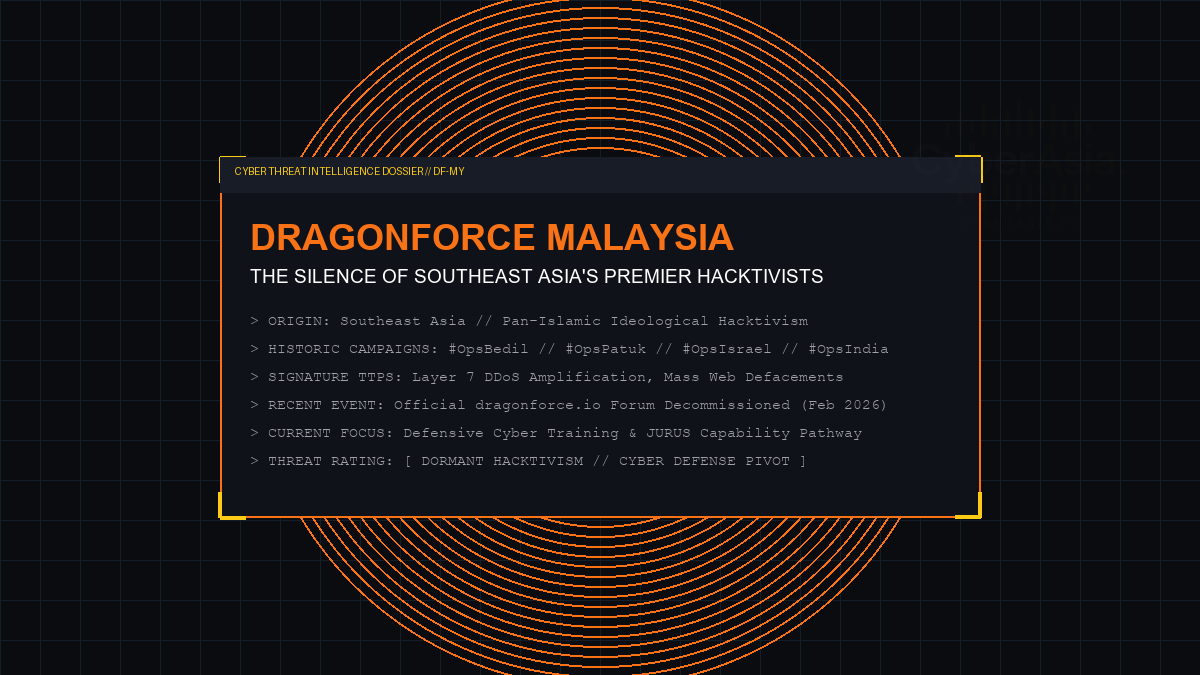
- Threat Actor: DragonForce Malaysia (DragonForceIO / DF-MY).
- Historical Focus: Geopolitical Hacktivism, #OpsBedil, #OpsIsrael Solidarity Campaigns.
- Current Operational Focus: Cybersecurity Education (JURUS Framework), Digital Literacy.
- Infrastructure Status: Official Forum (dragonforce.io) Permanently Decommissioned.
- Assessed Threat Level: 🟠 Moderate / Low (Shifted from Offensive Ops to Defensive Training).
The Ransomware Entity: A Separate Syndicate and Public Denials
In recent years, widespread confusion emerged across international cybersecurity media following the rise of a ruthless, profit-driven enterprise known as DragonForce Ransomware. Operating as a commercial Ransomware-as-a-Service (RaaS) cartel across Russian-speaking dark web forums like RAMP, this extortion syndicate deploys double-extortion lockers targeting global critical infrastructure, manufacturing, and healthcare sectors as monitored by CISA Cyber Threat Intelligence.
Crucially, threat intelligence forensics and verified underground communications confirm that the ransomware group is an entirely separate entity with no operational or organizational connection to the original Malaysian hacktivists. Senior representatives and operators of DragonForce Malaysia previously issued explicit, formal public denials, categorically rejecting any affiliation with financial ransomware operations or extortion cartels. Instead, the ransomware syndicate appropriated the established ‘DragonForce’ moniker to immediately gain brand recognition, induce panic in victim negotiations, and exploit historical digital notoriety.
CTI Insights: The Evolution of Southeast Asian Hacktivism
The trajectory of DragonForce Malaysia serves as a blueprint for understanding the lifecycle of grassroots cyber collectives. Unlike state-sponsored Advanced Persistent Threat (APT) groups that operate under sustained institutional backing, public hacktivist collectives rarely sustain prolonged visibility without facing severe operational attrition.
As documented in our intelligence archives, contemporary regional cyber warfare has shifted away from mass-participatory website defacements toward covert data brokerage, API exploitation, and targeted extortion, similar to dynamics seen during recent dark web forum disputes. While the official community forum has shut its doors and offensive campaigns have subsided, the educational initiatives led by its remnants represent an effort to redirect technical energy toward lawful defensive capability.
Mitigation and Defensive Architecture
For Enterprise & Critical Infrastructure Defense:
- Defend Against Automated Web Probing: Ensure web application firewalls (WAF) enforce strict rate-limiting and signature inspection to neutralize legacy exploit payloads commonly reused by hacktivist spin-off groups.
- Deploy Robust DDoS Mitigation: Maintain automated Layer 4 and Layer 7 anti-DDoS scrubbing services to protect public-facing digital portals from sudden politically motivated traffic surges.
For System Administrators & Public Users:
- Regularly patch Content Management Systems (CMS) and public plugins against known CVEs that serve as low-hanging fruit for mass defacement scripts.
- Enforce Multi-Factor Authentication (MFA) across all administrative control panels to prevent opportunistic credential stuffing attacks.
- Verify announcements strictly via authenticated social media channels and ignore fraudulent donation solicitations claiming to represent regional hacktivist collectives.
> DISCLAIMER
The information compiled in this report is provided strictly for educational, threat intelligence, and defensive awareness purposes. CyberAsia documents cyber threat actors and historical cyber operations based on open-source intelligence and does not condone unauthorized access to computer systems.
Notice: This intelligence brief forms part of CyberAsia’s historical threat actor retrospective. Verified researchers may request extended IoCs via our Secure Drop portal.
> INTELLIGENCE_NOTICE
The report above detailing Where Has DragonForce Malaysia Gone? The Silence of Southeast Asia’s Premier Hacktivists is part of the CyberAsia public archive. For organizations requiring real-time Indicators of Compromise (IoCs), YARA rules, and extended mitigation strategies for hacktivism threats, please refer to our Secure Drop or contact the research desk.