 ransomware
~/ › ransomware › article
ransomware
From Hacktivism to Ransomware: FEMBOYSec Breaches Landers
> By Haider | Aug 17, 2026 | 5 min read
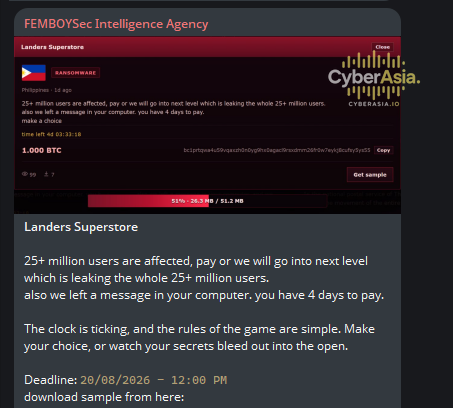
A high-profile cyber extortion campaign has escalated in the Philippines as FEMBOYSec breaches Landers Superstore’s internal infrastructure. According to intelligence alerts published on their dark web forum, this ransomware operation has allegedly compromised the personal data of over 25 million registered users. In a public ultimatum, the threat actors have demanded a 1 BTC ransom, warning that failure to comply within four days will result in the total public release of the compromised database.
> TABLE_OF_CONTENTS [toggle]
- > Technical Analysis and Initial Access Vectors
- > The “Batch-1” Extortion Strategy
- > Data Structure Analysis: The “landers.data” File
- > Actor Evolution: From Hacktivism to Financial Extortion
- > FEMBOYSec Breaches Landers: Target Infrastructure & Verification Status
- > Critical Infrastructure Impact in Southeast Asia
- > Mitigation and Prevention Strategies
Technical Analysis and Initial Access Vectors
While the exact initial access vector remains undisclosed by the victims, forensic analysis of similar FEMBOYSec operations suggests a heavy reliance on exploiting unpatched edge devices or utilizing compromised credentials acquired from Initial Access Brokers (IABs). Once inside the perimeter, the threat actors rapidly escalate privileges, disabling endpoint detection systems before exfiltrating high-value database tables containing customer Personally Identifiable Information (PII).
In this specific incident, the actors claim to have left a digital ransom note directly on the administrative terminals of the target, a classic hallmark of double-extortion ransomware operations. The payload utilized appears designed not just for data encryption, but specifically optimized for rapid, stealthy data extraction to leverage for maximum psychological pressure during negotiations.
The “Batch-1” Extortion Strategy
Threat intelligence researchers actively monitoring the leak site have identified that FEMBOYSec categorized this initial data dump as “Batch-1”. This labeling is a calculated psychological warfare tactic frequently employed by modern ransomware cartels. By threatening sequential dumps (such as a potential Batch-2 or Batch-3), threat actors attempt to apply sustained, escalating pressure on the victim’s Incident Response (IR) and Public Relations teams. The goal is to force the organization into paying the 1 BTC ransom before the countdown expires by demonstrating that the attackers still hold undisclosed, highly sensitive leverage.
Data Structure Analysis: The “landers.data” File
Preliminary analysis of the exposed dataset, explicitly labeled Philippine_customers_&_citizens_data, reveals a highly structured database architecture. Within this dump, researchers have identified specific file naming conventions, notably landers.data, which directly correlates to membership registration structures. The leaked tables allegedly contain verified email addresses, mobile phone numbers, hashed passwords, and physical residential addresses.
Because Landers operates as a membership-based superstore with extensive home delivery logistics, the exposure of physical addresses poses a severe secondary risk. Threat actors or opportunistic scammers can weaponize this hyper-localized data to launch highly convincing social engineering attacks, physical mail fraud, or targeted spear-phishing campaigns tailored to specific Philippine demographics.
Actor Evolution: From Hacktivism to Financial Extortion
The operational profile of the FEMBOYSec collective is highly erratic and challenges traditional threat modeling paradigms. Historical telemetry reveals that this group originally gained notoriety through ideologically motivated hacktivism, specifically launching aggressive disruption campaigns against digital infrastructure associated with the ISIS terrorist network. These early operations suggested a vigilante-style motivation.
However, their ideological consistency is notoriously unstable. In a highly unusual incident earlier this year, the collective launched an explicit adult content portal on their primary forum, only to abruptly delete the entire page within 24 hours. Intercepted communications indicated the operators experienced extreme “guilt” over the content, showcasing a volatile and unpredictable internal leadership structure. This recent pivot away from ideological disruption and toward pure financial extortion signifies a dangerous operational maturity. It indicates they are now actively seeking monetization of their network intrusion capabilities.
FEMBOYSec Breaches Landers: Target Infrastructure & Verification Status
> COMPROMISED_DATA_RECORDS
- Victim Entity: Landers Superstore (Philippines).
- Actor Claim Volume: 25,000,000 user records.
- Observed Dataset: Approximately 13,000,000 unique records.
- Extortion Demand: 1.000 BTC.
- Deadline: 20/08/2026 – 12:00 PM.
There is a notable discrepancy in the data volume. While the initial extortion note claims the exposure of 25 million records, independent CTI analysts mapping the “Batch-1” dataset estimate the actual verifiable unique records at approximately 13 million. Inflating data volumes is a common tactic among extortion groups aiming to maximize media panic and force faster negotiations.
As of this publication, Landers Superstore has not officially confirmed the breach. This radio silence aligns closely with standard corporate Incident Response playbooks. Victim organizations typically delay public acknowledgment while internal forensic teams scramble to secure logs, patch entry points, and verify the authenticity of the leaked data. Premature confirmation often leads to unnecessary market volatility and legal liabilities.
Critical Infrastructure Impact in Southeast Asia
While a retail superstore is not traditionally classified as critical national infrastructure, the systemic impact of compromising up to 25 million citizens cannot be understated. In environments where consumers frequently reuse credentials across multiple platforms, a localized breach of this magnitude acts as a catalyst for widespread account takeovers across the banking, government, and healthcare sectors across the Philippines.
This incident also highlights the severe regulatory and reputational friction that organizations face during a double-extortion event. The countdown timer creates immense psychological pressure, forcing the victim organization to simultaneously manage incident response forensics, public relations crises, and legal compliance reporting under intense public scrutiny.
Mitigation and Prevention Strategies
For the affected organization / IT Teams:
- Enforce Zero-Trust Architecture: Immediate implementation of rigorous network micro-segmentation is required to prevent lateral movement. Initial access brokers often exploit flat networks to pivot from a compromised workstation to critical databases.
- Deploy Behavioral EDR: Traditional signature-based antivirus is ineffective against custom extortion payloads. Endpoint Detection and Response (EDR) agents configured for behavioral anomaly detection must be deployed across all administrative assets.
- Mandate Phishing-Resistant MFA: All remote access gateways, VPNs, and administrative portals must be secured with hardware-backed Multi-Factor Authentication to neutralize stolen credential reuse.
- Isolate Immutable Backups: Organizations must maintain offline, immutable data backups that are completely disconnected from the primary Active Directory environment, ensuring recovery operations cannot be sabotaged by threat actors.
For residents and the public:
- Immediately reset passwords for any accounts associated with the breached entity, especially if those passwords are reused on personal banking or email accounts.
- Monitor personal financial statements for unauthorized transactions and consider placing a temporary freeze on your credit profile to prevent identity theft.
- Remain highly vigilant against unsolicited emails or SMS messages claiming to be from the affected organization, as threat actors frequently use leaked data to launch highly targeted phishing attacks targeting home delivery logistics.
> DISCLAIMER
The information provided in this article is for educational and threat intelligence purposes only. CyberAsia does not condone, promote, or encourage any illegal activities, including data breaches or unauthorized access to systems. The claims made by threat actors are unverified and reported strictly for awareness and defensive mitigation.
Notice: This intelligence report forms part of the CyberAsia incident archive. Security researchers or incident responders requiring extended Indicators of Compromise (IoCs) or YARA rules associated with this actor profile are encouraged to contact our research desk via the Secure Drop portal.
> INTELLIGENCE_NOTICE
The report above detailing From Hacktivism to Ransomware: FEMBOYSec Breaches Landers is part of the CyberAsia public archive. For organizations requiring real-time Indicators of Compromise (IoCs), YARA rules, and extended mitigation strategies for ransomware threats, please refer to our Secure Drop or contact the research desk.

> ABOUT_AUTHOR: Haider
> related_intel --suggest
ransomware
 ransomware
Lazarus Group Deploys Troy Backdoor via Fake Recruiters
> read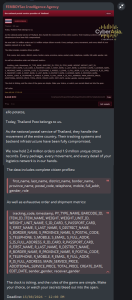 ransomware