 Threat Intelligence
~/ › Threat Intelligence › article
Threat Intelligence
Infrastructure Destruction Squad Sells Saudi Access for $2000: Dark Web Scam or Real Threat?
> By Haider | Aug 04, 2026 | 5 min read
A relatively obscure threat actor operating under the moniker Infrastructure Destruction Squad has recently published claims on their Telegram channel, asserting a full network compromise of a major Saudi Arabian government entity. According to the threat actor, they successfully gathered extensive intelligence regarding the internal network topology, mapped interconnections between various government sectors, and implanted a persistent, well-secured backdoor designed to automatically reconnect and conceal all operational traces. However, threat intelligence analysts are raising significant red flags, suggesting this operation bears the hallmarks of a dark web scam rather than a legitimate Initial Access Broker (IAB) sale.

> TABLE_OF_CONTENTS [toggle]
- > The Red Flags of the Infrastructure Destruction Squad Claim
- > A History of Sabotage and Client Betrayal
- > The Surreal Psychology of the Administrator
- > Recommendations for Threat Intelligence Teams
- - Mitigation & Prevention Strategies
- > Strategic Threat Landscape & Cyber-Physical Convergence (2026)
- - The Evolution of Defense Evasion & Zero-Trust Architecture
The Red Flags of the Infrastructure Destruction Squad Claim
The most glaring anomaly in the Infrastructure Destruction Squad‘s post is the asking price. The group is offering this purportedly high-value, persistent access to a sovereign government network for a mere $2,000. In the legitimate dark web IAB economy, confirmed administrative access to a national government entity-especially in the geopolitically critical Middle East region-commands prices starting in the tens of thousands of dollars, often negotiated privately with top-tier ransomware cartels. A public, flat-rate offering of $2,000 for “enormous value” strongly indicates a low-effort attempt to defraud aspiring cybercriminals.
In addition, the group failed to provide any standard cryptographic proof of compromise. Legitimate IABs traditionally release redacted directory trees, Active Directory domain controller screenshots, or small samples of internal network traffic to verify their claims to potential buyers. The complete absence of such evidence in this listing significantly undermines its credibility.
A History of Sabotage and Client Betrayal
Beyond the lack of technical proof, the operational history of the Infrastructure Destruction Squad administrator makes any transaction highly toxic. Security researchers monitoring the group’s past activities note a documented pattern of the administrator actively sabotaging their own clients. In previous instances where buyers reportedly purchased tools or access, the administrator allegedly backdoored the delivered assets to double-extort the buyer or intentionally leaked the buyer’s operational details to rival forums. Engaging with a threat actor known for burning their own clientele violates the foundational (albeit illicit) trust mechanics of dark web commerce.
The Surreal Psychology of the Administrator
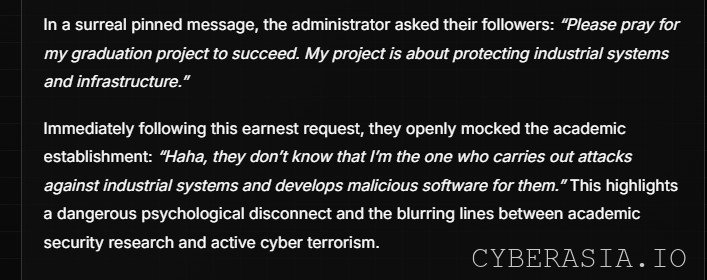
Perhaps the most bizarre element of this threat actor’s profile is the stark psychological disconnect evident in their recent communications. In a surreal pinned message on their channel, the administrator earnestly asked followers to “pray for my graduation project to succeed,” revealing that the project was about “protecting industrial systems and infrastructure.” Immediately following this academic plea, the administrator openly mocked their professors, stating: “Haha, they don’t know that I’m the one who carries out attacks against industrial systems and develops malicious software for them.”
This behavior points to a dangerous blurring of lines between academic security research and active cyber extremism. However, from a threat intelligence perspective, it also suggests an immature, ego-driven operator rather than a disciplined Advanced Persistent Threat (APT). Professional state-sponsored groups or highly skilled cybercrime syndicates do not broadcast their academic schedules or boast about deceiving their professors on public Telegram channels.
Recommendations for Threat Intelligence Teams
While the specific Saudi government claim by the Infrastructure Destruction Squad is likely a scam, defenders must remain vigilant. The proliferation of low-tier actors attempting to masquerade as elite IABs creates significant “noise” in intelligence feeds. Organizations should continue to monitor these channels but apply rigorous verification frameworks before escalating alerts. According to best practices outlined by institutions like Mandiant Threat Intelligence, prioritizing indicators of compromise (IoCs) derived from actual incident response engagements remains vastly superior to reacting to unverified, ego-driven boasts on social media platforms.
Mitigation & Prevention Strategies
Exploitation of vulnerabilities in critical infrastructure and edge devices requires immediate remediation to prevent catastrophic disruption:
- Patch Management: Apply vendor-supplied security patches or firmware updates immediately. For legacy systems, deploy virtual patching via network firewalls.
- Isolate OT Networks: SCADA and OT environments must be strictly isolated from corporate IT networks (the Purdue Model) to prevent spillover attacks.
- Continuous Monitoring: Deploy Endpoint Detection and Response (EDR) solutions and monitor network traffic for indicators of compromise (IoCs) associated with known exploits.
Strategic Threat Landscape & Cyber-Physical Convergence (2026)
The escalation of this specific cyber incident reflects a broader, systemic shift in the global threat landscape. Threat intelligence analysts continuously observe that the tactics, techniques, and procedures (TTPs) deployed here are rapidly becoming the standard operational blueprint for both sophisticated syndicates and regionally aligned collectives.
In recent months, the proliferation of dark web marketplaces has drastically reduced the barrier to entry for executing complex intrusions. Adversaries are increasingly purchasing pre-compromised credentials or exploiting unpatched edge devices, enabling highly aggressive, scalable operations against critical infrastructure, governmental networks, and the private sector across Asia and Europe.
In addition, the convergence of geopolitical tensions and cyber operations has blurred the lines between traditional cybercrime and strategic disruption. We are witnessing a significant pivot towards sophisticated data exfiltration campaigns and infrastructure sabotage designed to inflict maximum reputational and operational damage.
The Evolution of Defense Evasion & Zero-Trust Architecture
From a defensive standpoint, traditional perimeter security models are no longer sufficient to mitigate these advanced threats. The rapid exploitation of zero-day vulnerabilities in enterprise appliances demonstrates that edge devices themselves have become primary targets.
To combat this evolving threat matrix, organizations must urgently transition to a strict Zero-Trust Architecture (ZTA). This requires continuous authentication, rigorous network micro-segmentation, and the deployment of behavior-based Endpoint Detection and Response (EDR) agents across all assets, including legacy environments.
In addition, the integration of automated Threat Intelligence Platforms (TIPs) is critical for identifying malicious indicators of compromise (IoCs) before lateral movement can occur. As the volume and velocity of these cyber campaigns increase, proactive threat hunting remains the most effective strategy for maintaining resilience.
> INTELLIGENCE_NOTICE
The report above detailing Infrastructure Destruction Squad Sells Saudi Access for $2000: Dark Web Scam or Real Threat? is part of the CyberAsia public archive. For organizations requiring real-time Indicators of Compromise (IoCs), YARA rules, and extended mitigation strategies for threat intelligence threats, please refer to our Secure Drop or contact the research desk.

> ABOUT_AUTHOR: Haider
> related_intel --suggest
Threat Intelligence
 Threat Intelligence
BreachForums Admin: HasanBroker was a Predator? Dark Web Forum Wars Explode
> read Threat Intelligence