 ddos
ddos
ddos
24 Hours of Digital Blackout: TheGarudaEye Silences Paraguay’s Culture Ministry Portal in the Name of Palestine
> By Clara | Aug 18, 2026 | 6 min read
The hacktivist group TheGarudaEye has extended its reach into South America, taking down the official portal of the Secretaría Nacional de Cultura (SNC), the body overseeing Paraguay’s national culture affairs, via the site cultura.gov.py. The group labeled the incident internally as “GLOBAL CYBER ATTACK #0127,” marking the latest entry in a campaign tagged #OpParaguay and #OpBoP that has been running since mid-August 2026.

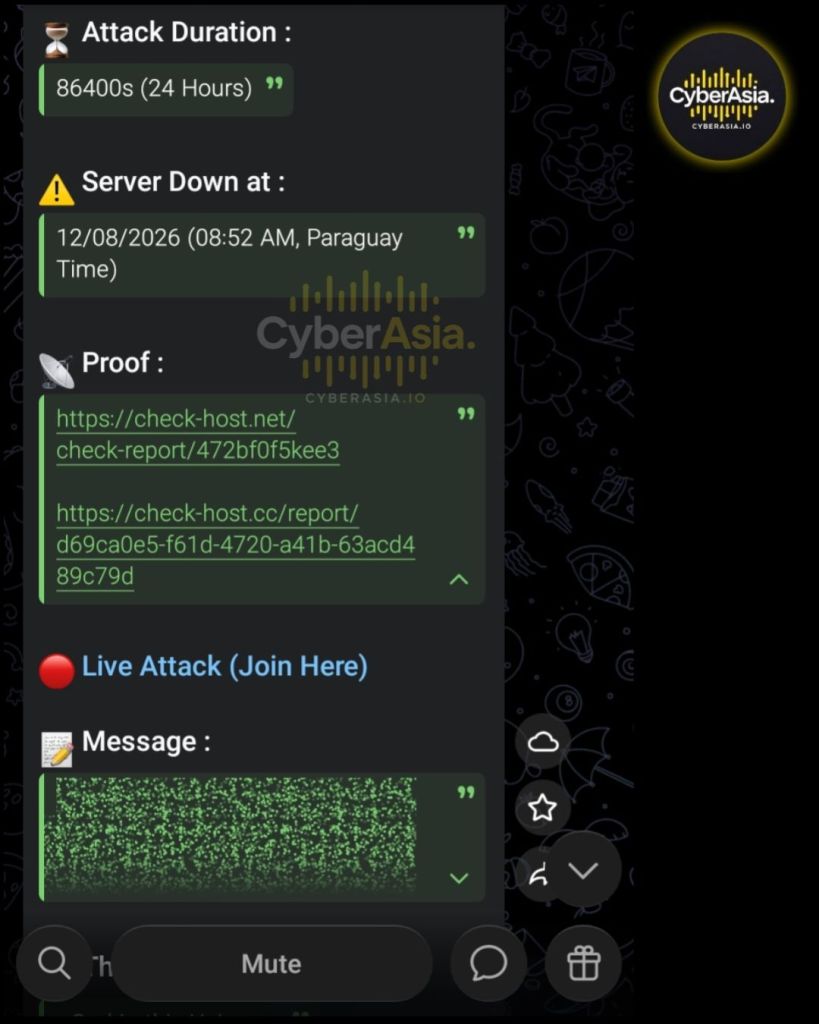
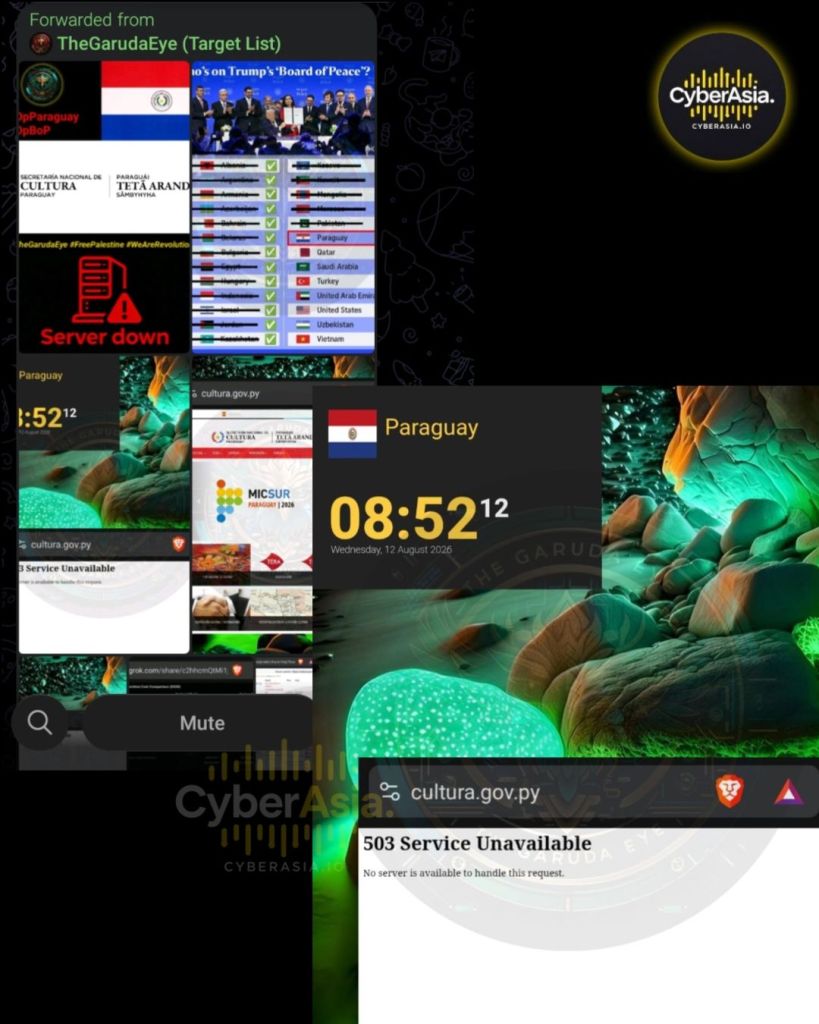
According to TheGarudaEye’s official Telegram channel, the cultura.gov.py server went down on August 12, 2026 at 08:52 local Paraguay time. Screenshots shared by the group show a “503 Service Unavailable” error message with the note “No server is available to handle this request,” which appeared when users attempted to access the portal through a browser. The error page was captured alongside a digital clock displaying the exact time and date of the incident, a documentation format TheGarudaEye has consistently used to release attack evidence in previous operations.
> TABLE_OF_CONTENTS [toggle]
Attack Duration and Technical Evidence
In its official release, TheGarudaEye listed the attack duration as 86,400 seconds, or a full 24 hours, indicating an operation planned as sustained service disruption rather than a brief test. As part of the group’s standard documentation practice, two third-party verification links were included: reports from check-host.net and check-host.cc, tools widely used by the security community to monitor a domain’s availability from multiple network points simultaneously.
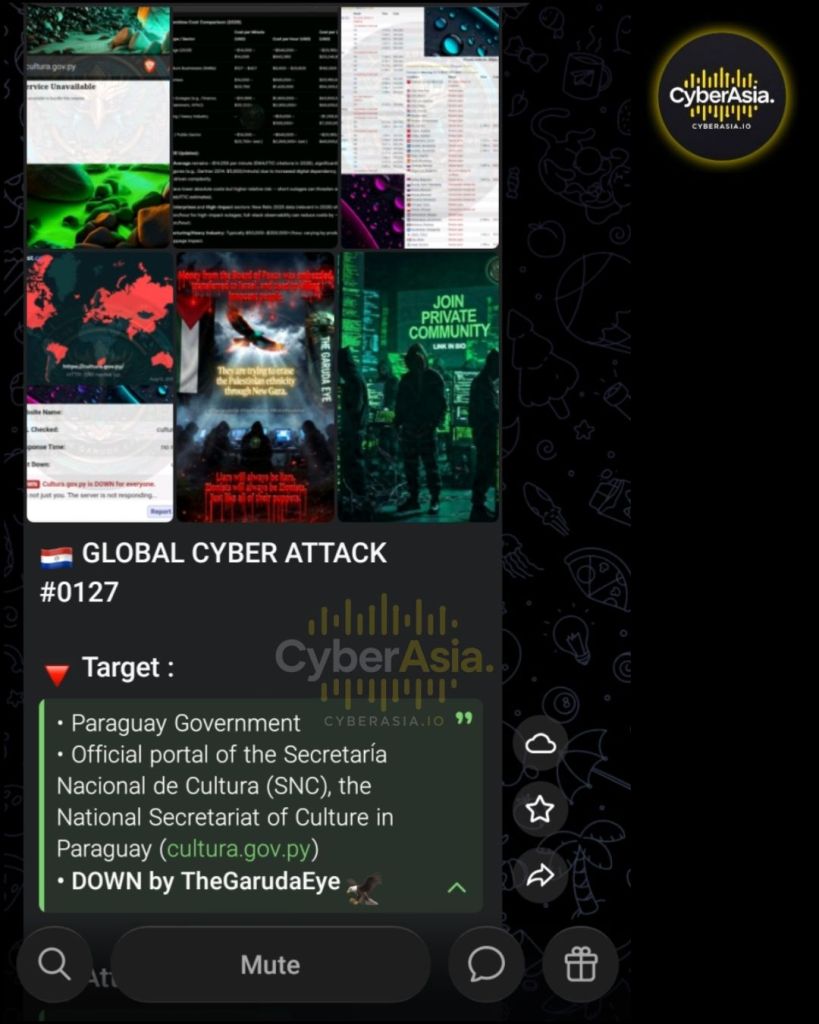
The cultura.gov.py portal serves as the SNC’s official information channel, including for promoting national cultural agendas such as MICSUR Paraguay 2026, a regional South American creative industries forum scheduled to take place in the country. With the portal down, public access to official event information and government cultural services was disrupted for the duration of the attack.
Political Narrative: The “Board of Peace” and the Gaza Issue
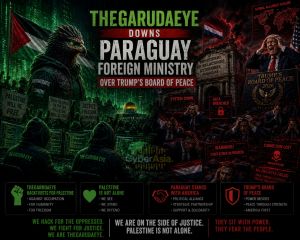
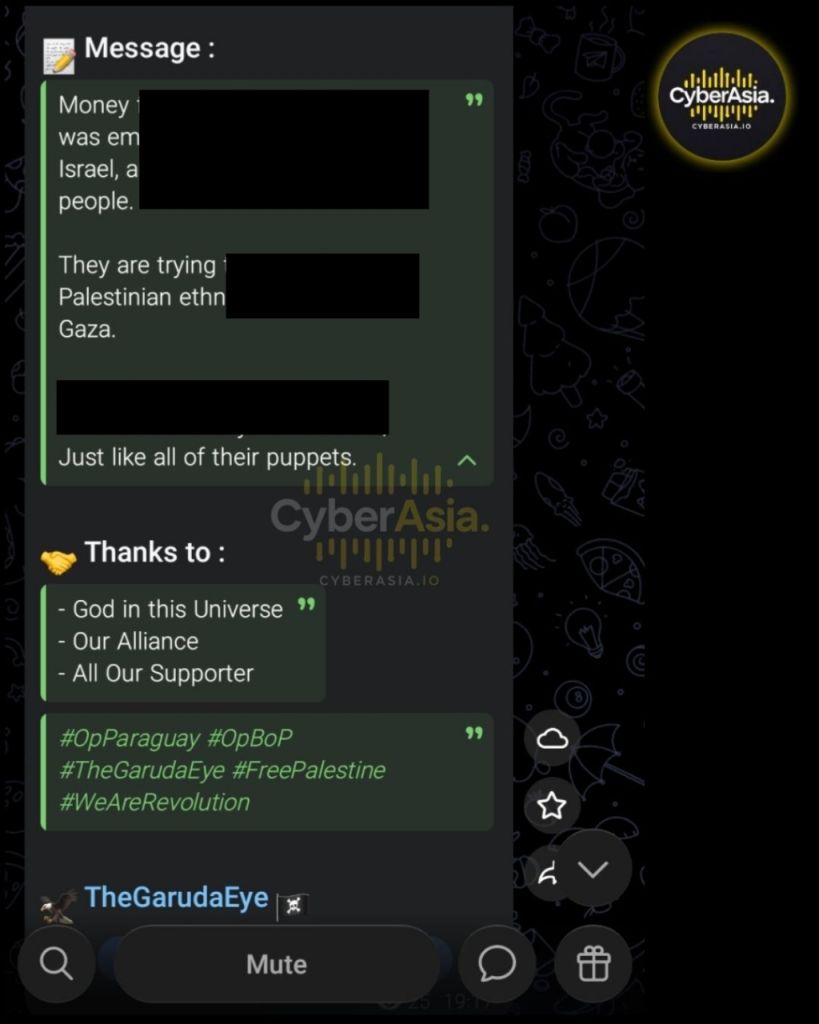
What sets this attack apart from a routine defacement or DDoS incident is the explicit political narrative TheGarudaEye attached to its propaganda message. The group tied its action to allegations that funds it says originated from the “Board of Peace” forum were misused, and accused certain parties of contributing to the deteriorating humanitarian situation in Gaza. TheGarudaEye framed the attack on cultura.gov.py as a symbolic protest against nations it views as supporting that initiative, as well as a statement of solidarity with the Palestinian people.
The “Board of Peace” referenced by the group points to an international forum involving several heads of state and world leaders, including former U.S. President Donald Trump. According to a target-list screenshot published by TheGarudaEye, the forum’s participant list includes a number of countries the group considers affiliated with or supportive of the initiative. That list marks each country with a checkmark, including Paraguay, which appears to form the basis of the group’s rationale for selecting its cyber targets.
TheGarudaEye closed its release with rhetoric reaffirming its opposition to parties it views as supporting Israeli policy in Gaza, while also thanking its alliance and supporters, a closing format the group has consistently used in prior releases.
The #OpParaguay and #OpBoP Operational Pattern
The #OpParaguay and #OpBoP hashtags attached to this release indicate that the attack on cultura.gov.py is not an isolated incident but part of a broader cyber campaign targeting Paraguayan entities the group views as connected to the “Board of Peace” narrative. This pattern is consistent with the operational style of other geopolitically motivated hacktivist groups in the region, which frequently link a country’s domestic targets to Middle East issues — particularly the Israeli-Palestinian conflict — as justification for attacks.
Additional hashtags such as #TheGarudaEye, #FreePalestine, and #WeAreRevolution accompany every release from the group, reinforcing its identity and ideological affiliation. The group also actively promotes a private community channel via a link in its bio, a common strategy among hacktivist groups to expand their support base while building a closed communication channel with core members.
Technical Analysis: Likely Attack Vector
Based on the disclosed attack pattern — including a 24-hour duration and server-failure indications in the form of a “503 Service Unavailable” response — the characteristics are consistent with a medium-to-large-scale distributed denial-of-service (DDoS) attack that overwhelms a target’s server infrastructure with request volumes exceeding its service capacity. An HTTP 503 status code typically appears when a web server is unable to process incoming requests due to overload, whether from limited backend capacity or automated defense mechanisms redirecting traffic to prevent total system failure.
Government portals in developing nations such as Paraguay often rely on hosting infrastructure with limited capacity and minimal protective layers against large-scale network- or application-layer attacks. This makes official government domains relatively easy targets for hacktivist groups with access to commercial booter or stresser infrastructure — a trend repeatedly observed in similar hacktivist operations across Southeast Asia and beyond.
Broader Context: Geopolitically Motivated Hacktivism
The attack on cultura.gov.py adds to a growing list of incidents in which hacktivist groups link a country’s domestic affairs to geopolitical conflicts unfolding elsewhere. This pattern has previously been observed in operations by groups such as RipperSec and The Comrade’s Group, which have consistently targeted entities perceived as affiliated with Israel or supportive of Israeli policy in the Middle East, operating under the #OpZionistV2 campaign banner.
TheGarudaEye appears to be adopting a similar strategy but with a different geographic focus, targeting Latin America through a narrative of those nations’ involvement in the “Board of Peace” forum. This strategy illustrates how contemporary hacktivist groups are increasingly adept at leveraging global geopolitical issues to lend ideological legitimacy to their cyber actions, expanding their target scope from entities directly affiliated with Israel to third countries viewed as indirectly involved.
Impact and Implications for Paraguay
The downtime of cultura.gov.py directly affected the accessibility of digital public services from Paraguay’s Culture Ministry, including official information on national cultural agendas and the promotion of international events such as MICSUR Paraguay 2026. While the impact on internal data or backend government systems has not been fully established, this kind of public service disruption still carries potential reputational and operational costs for the institution involved.
The incident also serves as a reminder for government agencies — particularly in developing nations targeted by geopolitically motivated hacktivist campaigns — of the importance of sustained investment in cyber defense infrastructure. Mitigation measures such as content delivery network (CDN)-based DDoS protection, real-time anomaly traffic monitoring, and emergency service continuity planning are critical to minimizing the duration and impact of disruptions when similar attacks occur in the future.
Conclusion
The attack on Paraguay’s Secretaría Nacional de Cultura underscores how hacktivist groups like TheGarudaEye continue to expand the geographic scope of their operations, framing new targets within a larger geopolitical conflict narrative. With the #OpParaguay and #OpBoP campaign appearing to remain active, other government entities in the region viewed as connected to the “Board of Peace” narrative could become the next targets in this ongoing series of operations.
CyberAsia.io monitors and reports on cyber threat activity based on official releases from the groups involved and publicly available third-party verification sources. This article was compiled for cyber threat intelligence and public awareness purposes, and does not constitute an endorsement of any actions or narratives put forward by the parties mentioned.
> INTELLIGENCE_NOTICE
The report above detailing 24 Hours of Digital Blackout: TheGarudaEye Silences Paraguay’s Culture Ministry Portal in the Name of Palestine is part of the CyberAsia public archive. For organizations requiring real-time Indicators of Compromise (IoCs), YARA rules, and extended mitigation strategies for ddos threats, please refer to our Secure Drop or contact the research desk.