 hacktivism
~/ › hacktivism › article
hacktivism
IndoHaxSec Hacker Claims Attack on BeeCloud: Critical Threat to Israeli Cloud Infrastructure – 2026 Threat Advisory
> By Clara | Aug 04, 2026 | 4 min read

Table of Contents
- Executive Summary
- Geopolitical Context & Motivation
- Technical Analysis: TTPs
- Impact Assessment
- Mitigation Recommendations
Executive Summary
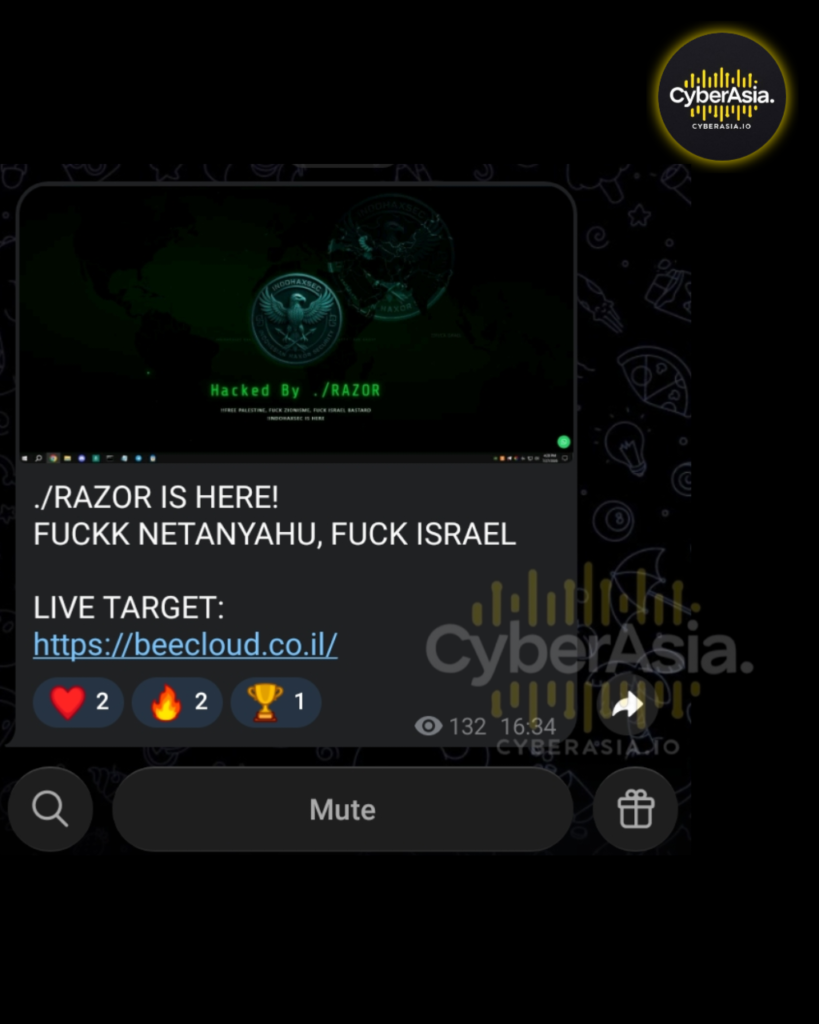
IndoHaxSec, a hacker group operating under the pseudonym ./RAZOR, has publicly claimed responsibility for a cyberattack targeting BeeCloud, an Israeli-based cloud security provider. The operation was executed through the live target https://beecloud.co.il/, with the claim broadcast via social media platforms on 28 July 2026.
Security researchers at CyberAsia.io have verified the screenshots shared by the group. The incident involves defacement of the BeeCloud website accompanied by prominent pro-Palestine messaging.
This attack represents one of the latest in a series of state-aligned cyber operations against Israeli digital infrastructure. No data exfiltration or ransomware deployment was reported in the initial claim.
Geopolitical Context & Motivation
The timing of the attack coincides with heightened tensions surrounding the ongoing conflict in the Middle East, specifically the Palestinian cause. IndoHaxSec has repeatedly framed its actions as support for Palestinian self-determination and opposition to Israeli policies.
IndoHaxSec’s stated ideology includes messages such as “FREE PALESTINE, FUCK ZIONISM, FUCK ISRAEL !!BASTARD” and “!INDOHAXSEC IS HERE”. The group also incorporated imagery referencing “JOK ISRAEL / GHOST” and “INDOHAXSEC ISRAEL SLX_94” into the defaced interface.
Such operations align with broader patterns of cyber activism by pro-Palestine hacktivist collectives, which have increased since the escalation of regional hostilities in 2023. The target BeeCloud.co.il provides cloud infrastructure services to multiple Israeli government and private-sector clients.
Technical Analysis: TTPs
Evidence indicates the attack relied on website defacement techniques rather than sophisticated malware deployment. Screenshots show the BeeCloud homepage replaced with a custom graphic featuring a glowing green IndohaxSec eagle emblem superimposed over an outline of the Israeli map.
Two prominent circular emblems were displayed: one larger version of the eagle over a dark map background, and a smaller version directly below it. The text “HACKED BY ./RAZOR” appeared in bright green neon-style lettering at the center of the defaced page.
The claim was distributed through a live target reference (https://beecloud.co.il/) and shared via a social media platform, where the handle ./RAZOR posted “./RAZOR IS HERE! FUCKK NETANYAHU, FUCK ISRAEL” along with engagement metrics. This matches classic hacktivist TTPs documented by the MITRE ATT&CK framework (Tactic: Initial Access – T1190; Technique: Web Defacement).
No evidence of lateral movement, credential dumping, or data exfiltration was present in the public screenshots or accompanying claims. The operation appears to have been limited to visual disruption and propaganda dissemination.
Impact Assessment
The direct impact on BeeCloud.co.il appears to be limited to reputational damage and temporary website downtime. As a cloud infrastructure provider, the company likely maintains redundant systems and business continuity plans that minimize long-term disruption to its paying clients.
For the Israeli cybersecurity sector, this incident underscores the persistent risk of hybrid physical-cyber threats. Cloud providers handling government and critical infrastructure data remain attractive targets for state and non-state actors seeking political leverage.
Broader industry implications include increased scrutiny on Israeli digital assets by pro-Palestine groups and potential ripple effects on regional cloud service agreements. No confirmed breaches of sensitive customer data were reported in the initial disclosure.

Mitigation Recommendations
-
- Immediately review and update website security policies, including Content Security Policy (CSP) headers and web application firewall (WAF) rules, to prevent future defacements.
- Implement real-time monitoring for unauthorized changes to DNS records and website source code using services such as those recommended by the CISA Cybersecurity Advisory Program.
- Conduct regular penetration testing and code reviews on all cloud-hosted applications, especially those handling government or critical infrastructure data.
- Ensure all team members receive targeted training on recognizing and responding to hacktivist claims and social media propaganda campaigns.
- Establish a 24/7 incident response team capable of isolating affected systems within minutes of detection.
For more in-depth analysis on similar hacktivist campaigns, visit CyberAsia.io.
Mitigation & Prevention Strategies
Exploitation of vulnerabilities in critical infrastructure and edge devices requires immediate remediation to prevent catastrophic disruption:
- Patch Management: Apply vendor-supplied security patches or firmware updates immediately. For legacy systems, deploy virtual patching via network firewalls.
- Isolate OT Networks: SCADA and OT environments must be strictly isolated from corporate IT networks (the Purdue Model) to prevent spillover attacks.
- Continuous Monitoring: Deploy Endpoint Detection and Response (EDR) solutions and monitor network traffic for indicators of compromise (IoCs) associated with known exploits.
> INTELLIGENCE_NOTICE
The report above detailing IndoHaxSec Hacker Claims Attack on BeeCloud: Critical Threat to Israeli Cloud Infrastructure – 2026 Threat Advisory is part of the CyberAsia public archive. For organizations requiring real-time Indicators of Compromise (IoCs), YARA rules, and extended mitigation strategies for hacktivism threats, please refer to our Secure Drop or contact the research desk.