 hacktivism
~/ › hacktivism › article
hacktivism
Nullsec Nigeria Banned Within 24 Hours of Fake China University Breach
> By Haider | Aug 04, 2026 | 4 min read
Less than 24 hours after claiming a massive data breach against the National Open University of China, the primary Telegram channel for Nullsec Nigeria has been permanently banned by platform administrators.
⚠️ THREAT INTELLIGENCE ADVISORY:
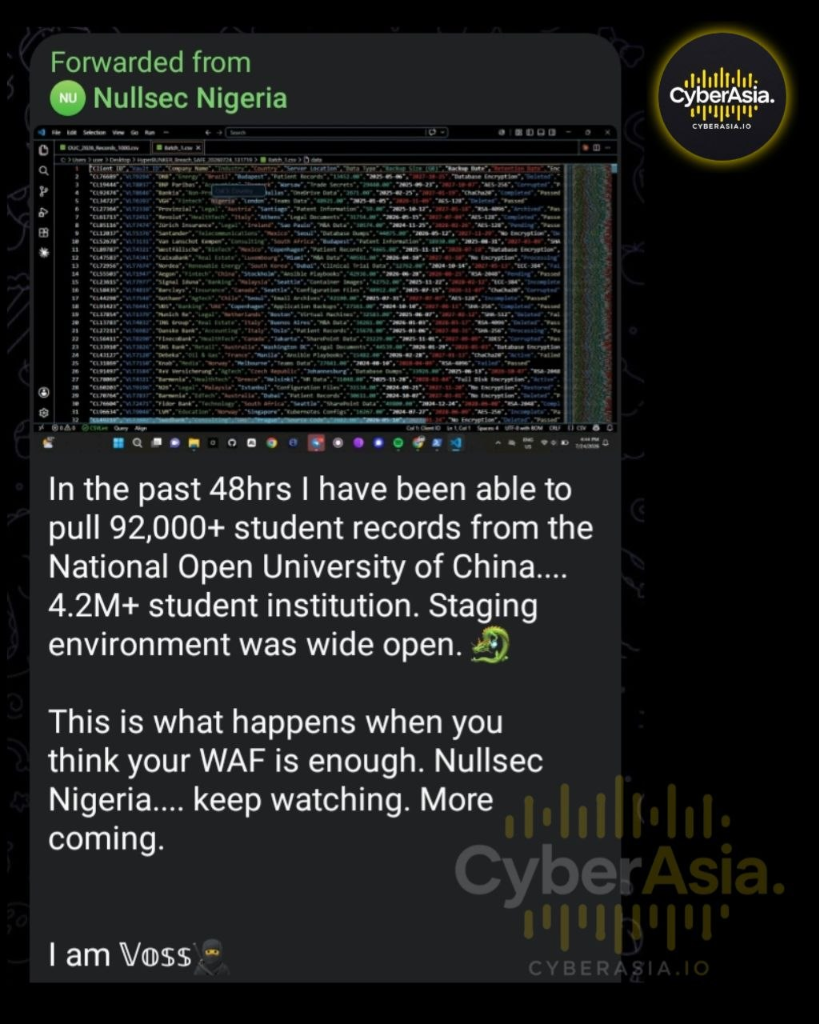
The Nullsec Nigeria collective recently claimed to have compromised 92,000 student records from a Chinese university. CyberAsia analysis confirms this is a fake breach claim, as the sample data provided by the actor explicitly shows European financial institutions rather than Chinese educational records.

> key_takeaways
- Nullsec Nigeria’s Telegram channel was banned within 24 hours of their latest claim.
- The actor attempted to pass off recycled or fabricated European banking data as Chinese student records.
- Threat intelligence analysts must strictly verify actor-provided data samples before issuing downstream alerts.
Context of the Nullsec Nigeria Fake Breach
On August 4, 2026, the threat actor known as Nullsec Nigeria announced via their Telegram channel that they had successfully breached the staging environment of the National Open University of China. The actor boasted about pulling over 92,000 student records from an institution with over 4.2 million students, mocking the university’s Web Application Firewall (WAF).
Analysis of the Fabricated Data
Despite the bold assertions, a closer inspection of the screenshot provided by Nullsec Nigeria reveals glaring inconsistencies. The tabular data displayed in their terminal explicitly lists entries such as Bankia (Spain), Vanguard (Finance), and Revolut (Italy). There is absolutely no correlation between the leaked dataset and Chinese educational records.
This tactic is a common hallmark of lower-tier threat actors attempting to build a reputation through intimidation and fabricated successes, relying on the hope that observers will not scrutinize the provided evidence.
Mitigation Recommendations
- Organizations must establish rigorous verification protocols for threat intelligence, ensuring that claims are corroborated by technical evidence before initiating incident response.
- Security teams should actively monitor and report malicious Telegram channels to platform administrators to disrupt the operational infrastructure of fraudulent actors.
- Do not engage or negotiate with threat actors who have a documented history of fabricating breaches, as this only incentivizes further extortion attempts.
CyberAsia will continue monitoring alternative channels for any resurgence of this group. For more advisories, browse the CyberAsia threat intelligence updates.
Strategic Threat Landscape & Layer 7 Disruption Analysis
The escalation of this specific cyber incident reflects a broader, systemic shift in the global threat landscape regarding distributed denial-of-service (DDoS) methodologies. Threat intelligence analysts continuously observe that the tactics, techniques, and procedures (TTPs) deployed here are rapidly becoming the standard operational blueprint for regionally aligned hacktivist collectives seeking high-visibility disruption.
In recent months, there has been a documented pivot away from traditional volumetric attacks (Layer 3/4) towards highly sophisticated Layer 7 application-layer disruptions. These attacks bypass traditional scrubbing centers by mimicking legitimate user behavior, exhausting server resources through complex database queries or API abuse. This evolution enables attackers to cripple critical infrastructure and governmental portals with significantly smaller botnets.
In addition, the convergence of geopolitical tensions and cyber operations has transformed DDoS from a mere nuisance into an instrument of international policy disagreement. Hacktivist syndicates now leverage decentralized proxy networks and compromised IoT devices to launch these campaigns anonymously, targeting organizations based on ideological alignment rather than financial gain.
Defensive Evolution & Proactive Mitigation
From a defensive standpoint, legacy perimeter security models and basic rate-limiting are no longer sufficient. Organizations must urgently transition to adopting advanced, AI-driven Web Application Firewalls (WAFs) capable of behavioral analysis and bot mitigation.
To combat this evolving threat matrix, continuous monitoring of web traffic baselines and the deployment of elastic, cloud-based infrastructure are critical. In addition, the integration of automated Threat Intelligence Platforms (TIPs) allows organizations to proactively block malicious IPs and known proxy exit nodes before an attack reaches critical mass.
> subscribe_to_intel
Get CyberAsia threat intelligence updates by email. No spam promises we cannot keep, unsubscribe anytime.
Privacy Policy.
style=”border: 1px solid #333;margin: 40px 0″ />
Disclaimer: The information presented in this threat intelligence report is for educational and cybersecurity research purposes only. CyberAsia reports on cyber incidents to help organizations understand and defend against emerging threats. We do not provide hacking instructions, host stolen data, or endorse illegal activities.
Mitigation & Prevention Strategies
Exploitation of vulnerabilities in critical infrastructure and edge devices requires immediate remediation to prevent catastrophic disruption:
- Patch Management: Apply vendor-supplied security patches or firmware updates immediately. For legacy systems, deploy virtual patching via network firewalls.
- Isolate OT Networks: SCADA and OT environments must be strictly isolated from corporate IT networks (the Purdue Model) to prevent spillover attacks.
- Continuous Monitoring: Deploy Endpoint Detection and Response (EDR) solutions and monitor network traffic for indicators of compromise (IoCs) associated with known exploits.
>
> INTELLIGENCE_NOTICE
The report above detailing Nullsec Nigeria Banned Within 24 Hours of Fake China University Breach is part of the CyberAsia public archive. For organizations requiring real-time Indicators of Compromise (IoCs), YARA rules, and extended mitigation strategies for hacktivism threats, please refer to our Secure Drop or contact the research desk.