 hacktivism
~/ › hacktivism › article
hacktivism
Alliance-Wide Ban: Muslim Cyber Coalition Exposes JundAlNabi PK as Internal Spy
> By Haider | Aug 23, 2026 | 7 min read
ALLIANCE_SECURITY_ALERT // THREAT_LEVEL: CRITICAL
ORIGINATING_BODY: PAK DIGITAL RESISTANCE
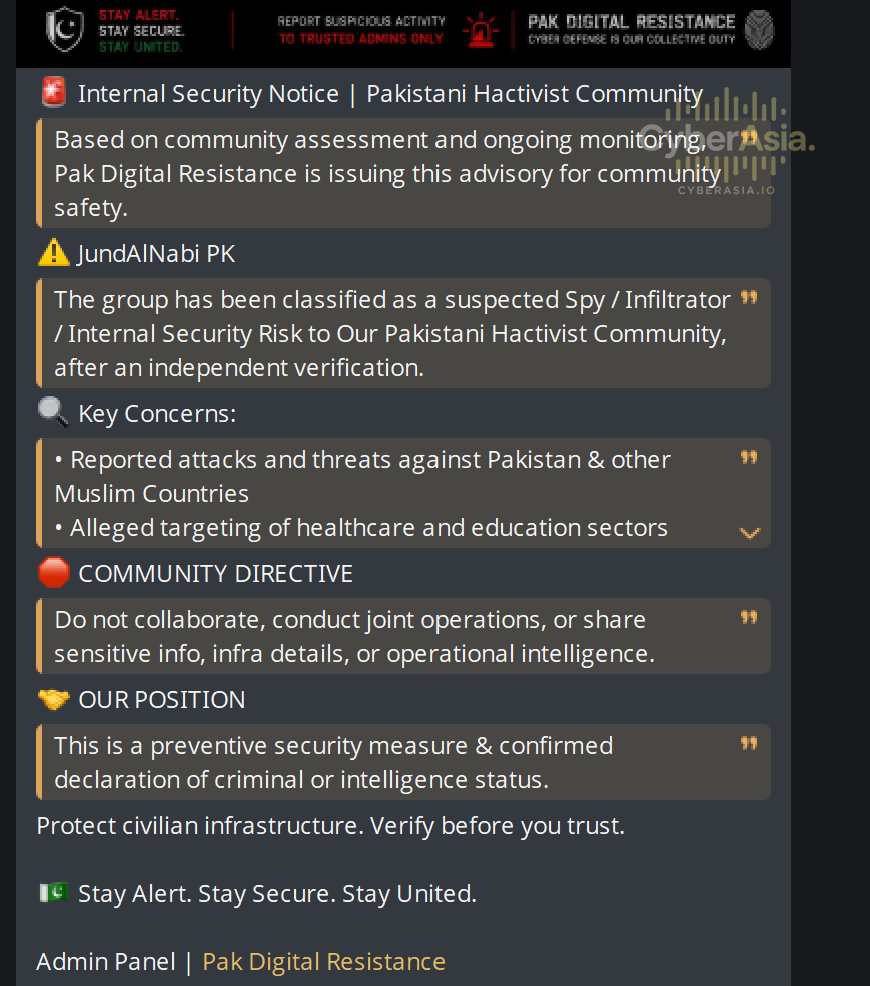
In an unprecedented cross-border underground purge, the Muslim Cyber Coalition Exposes JundAlNabi PK as a hostile intelligence mole and rogue operational cell. An emergency security bulletin released by Pak Digital Resistance officially designates the group as an internal threat, triggering an immediate alliance-wide ban across prominent South and Southeast Asian hacktivist networks.

> TABLE_OF_CONTENTS [toggle]
- > The Infiltration Dossier: Hostile Targeting and Rogue Operations
- > The Chronology: Leader’s Defiance and Rejection of Moral Rebuke
- > Cross-Border Education Attacks: Iraqi University Database Dumps and Boasting
- > Alliance-Wide Blacklist: Directives and Multi-Group Consensus
- > Cross-Border Solidarity: Major Asian Collectives Enforce the Ban
- > Strategic Threat Intelligence Implications
- > Mitigation Recommendations
- - For Healthcare, Education, and Critical Infrastructure Administrators:
- - For Organizations and Internet Users:
The Infiltration Dossier: Hostile Targeting and Rogue Operations
The advisory stems from an independent verification initiative conducted by senior administrators within the Pakistani cybersecurity sphere. According to the published findings, JundAlNabi PK, which utilizes a keffiyeh-clad lion insignia, deviated sharply from grassroots ideological hacktivism, engaging in disruptive cyber strikes against domestic infrastructure and harvesting intelligence on fellow operators, as documented in our CyberAsia Threat Actors Directory.
These official accusations directly corroborate previous investigative findings published by CyberAsia documenting the JundAlNabi PITB Data Breach on the Punjab Health and Hygiene Portal. In that incident, the group compromised the Punjab Information Technology Board (PITB) infrastructure, leaking administrative databases and exfiltrating civilian healthcare records. The targeting of essential health and public services drew fierce condemnation from regional peer groups, serving as a primary catalyst for the current blacklisting.
> KEY_CONCERNS_IDENTIFIED // INDEPENDENT_VERIFICATION
• Domestic and Regional Attacks: Documented threats and cyber disruptions directed against infrastructure in Pakistan and allied regional nations.
• Targeting of Civilian Sectors: Intrusions launched against public healthcare facilities, hospitals, and educational institutions (including the PITB Punjab Health portal).
• Covert Intelligence Collection: Suspicious communication telemetry indicating systematic harvesting of IP addresses, staging server configs, and administrator handles.
• State Influence and Infiltration: Behavioral indicators suggesting external intelligence steering designed to compromise alliance operators.
• Targeting of Civilian Sectors: Intrusions launched against public healthcare facilities, hospitals, and educational institutions (including the PITB Punjab Health portal).
• Covert Intelligence Collection: Suspicious communication telemetry indicating systematic harvesting of IP addresses, staging server configs, and administrator handles.
• State Influence and Infiltration: Behavioral indicators suggesting external intelligence steering designed to compromise alliance operators.
The Chronology: Leader’s Defiance and Rejection of Moral Rebuke
The definitive boiling point that triggered massive outrage across Muslim hacktivist circles was the group’s overt exploitation of Islamic religious identity. While adopting the moniker JundAlNabi (translated as “Soldiers of the Prophet”), the leader of the group actively defended and celebrated destructive operations against non-combatant civilians, schools, and hospitals.
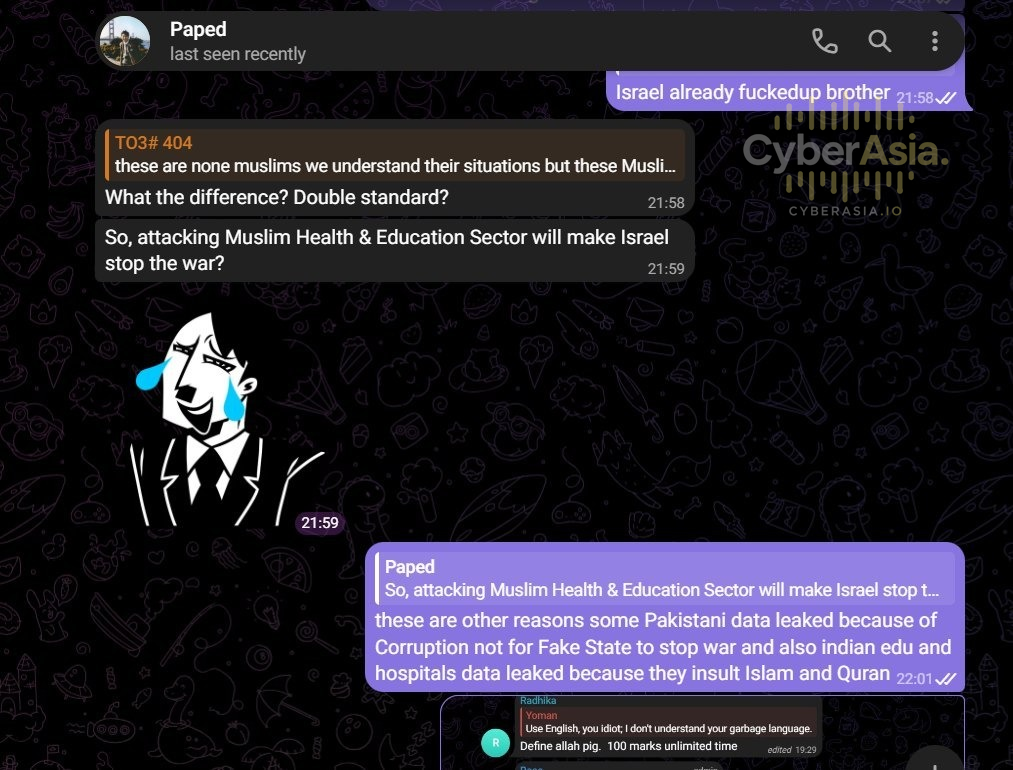
A concerned civilian user (Paped) directly reached out to the leader of JundAlNabi (TO3# 404) in private messaging, challenging the moral legitimacy of leaking student records and disabling hospital systems.
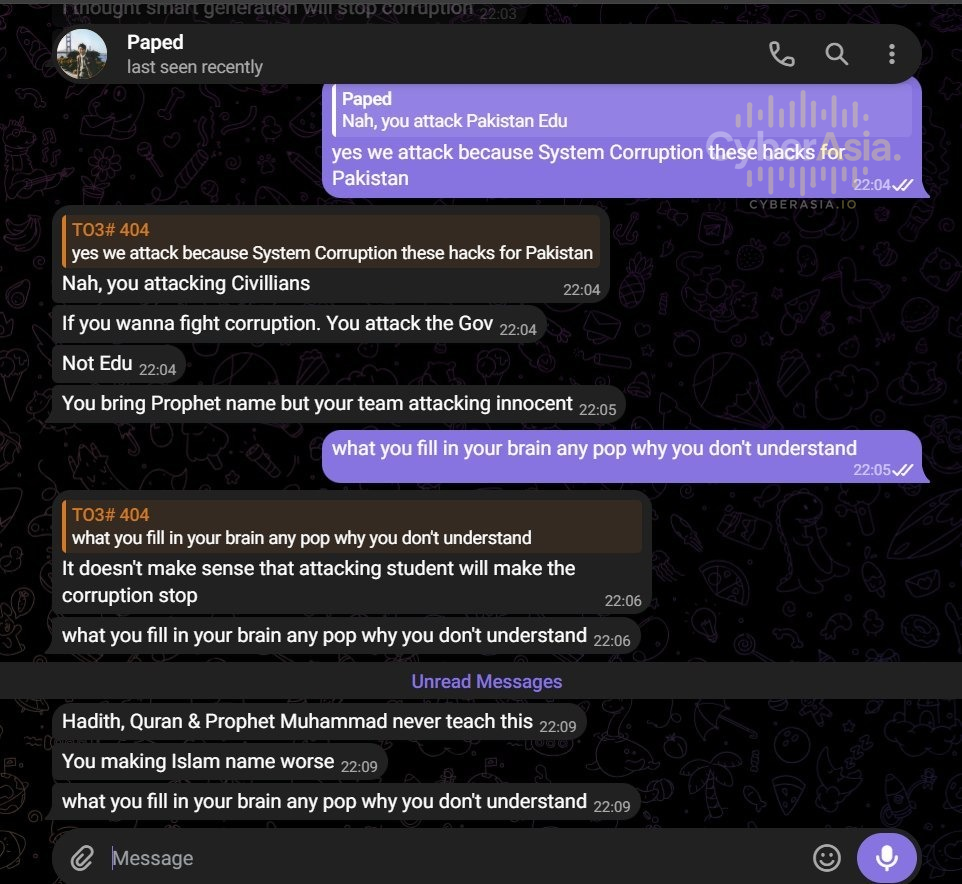
During the exchange, the JundAlNabi leader adamantly insisted that attacking Pakistani educational institutions and hospitals was justified under the claim of “fighting systemic corruption,” while targeting Indian hospitals because “they insult Islam and the Quran”:
💬 RAW_INTERCEPTED_LOGS // JUNDALNABI LEADER DEFIANCE
Civilian (Paped): “So, attacking Muslim Health & Education Sector will make Israel stop the war? … What the difference? Double standard?”
JundAlNabi Leader (TO3# 404): “These are other reasons some Pakistani data leaked because of Corruption not for Fake State to stop war and also Indian edu and hospitals data leaked because they insult Islam and Quran.”
Civilian (Paped): “Nah, you attack Pakistan Edu … Nah, you attacking Civilians. If you wanna fight corruption, you attack the Gov. Not Edu. You bring Prophet name but your team attacking innocent.”
JundAlNabi Leader (TO3# 404): “Yes we attack because System Corruption these hacks for Pakistan … what you fill in your brain any pop why you don’t understand.”
Civilian (Paped): “It doesn’t make sense that attacking student will make the corruption stop. Hadith, Quran & Prophet Muhammad never teach this. You making Islam name worse.”
Crucially, instead of accepting the civilian’s ethical reminder, the JundAlNabi leader obstinately rejected the rebuke. He mocked the user with dismissive remarks and arrogantly broadcasted the full conversation onto his public Telegram channel (JundAlNabi Official), accompanied by a laughing meme to boast about his operations.
Cross-Border Education Attacks: Iraqi University Database Dumps and Boasting
Hard telemetry published by the group directly substantiates the advisory’s specific charge regarding “attacks and threats against Pakistan & other Muslim Countries.” Forensic tracking reveals that JundAlNabi executed widespread intrusions against prominent higher education establishments across Iraq:
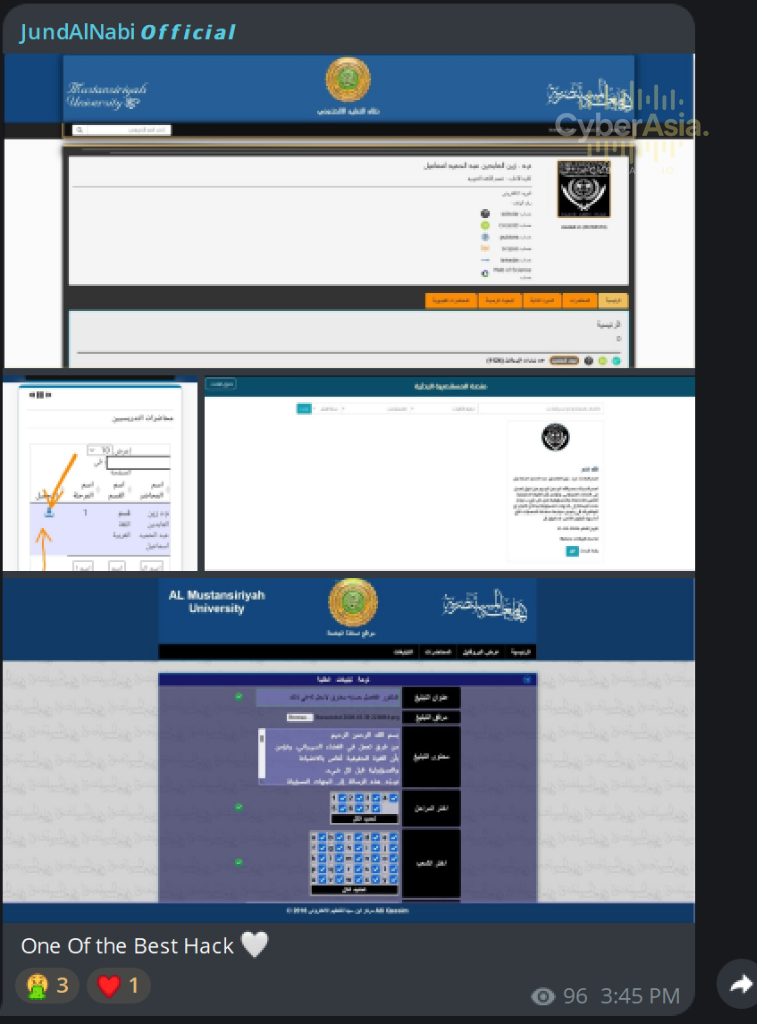
In Baghdad, the group breached the web portal infrastructure of Al Mustansiriyah University, gaining administrative access to its content management system (CMS), injecting malicious defacement notifications, and tampering with academic faculty records. The JundAlNabi leader publicly celebrated the intrusion on Telegram, boasting with the caption “One Of the Best Hack 🤍”.
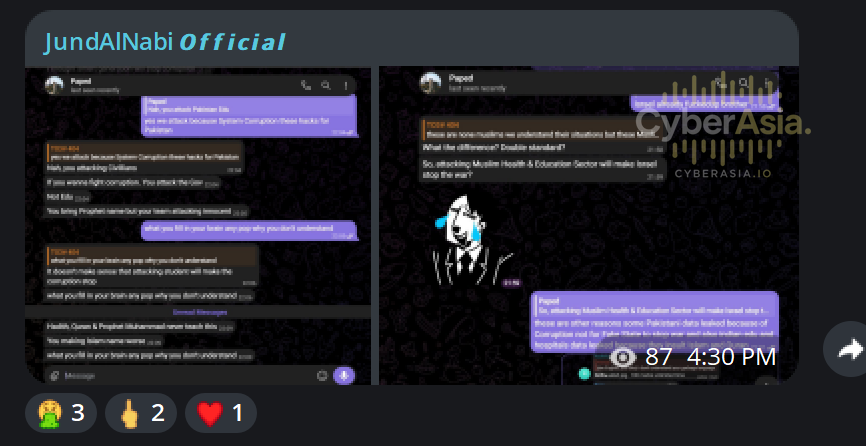
The assault expanded into multi-institution database dumps targeting other Iraqi academic centres:
> COMPROMISED_IRAQI_ACADEMIC_INSTITUTIONS // EVIDENCE_LOGS
• Al Mustansiriyah University (Baghdad): Backend portal takeover, faculty profile compromise, and administrative notification hijacking.
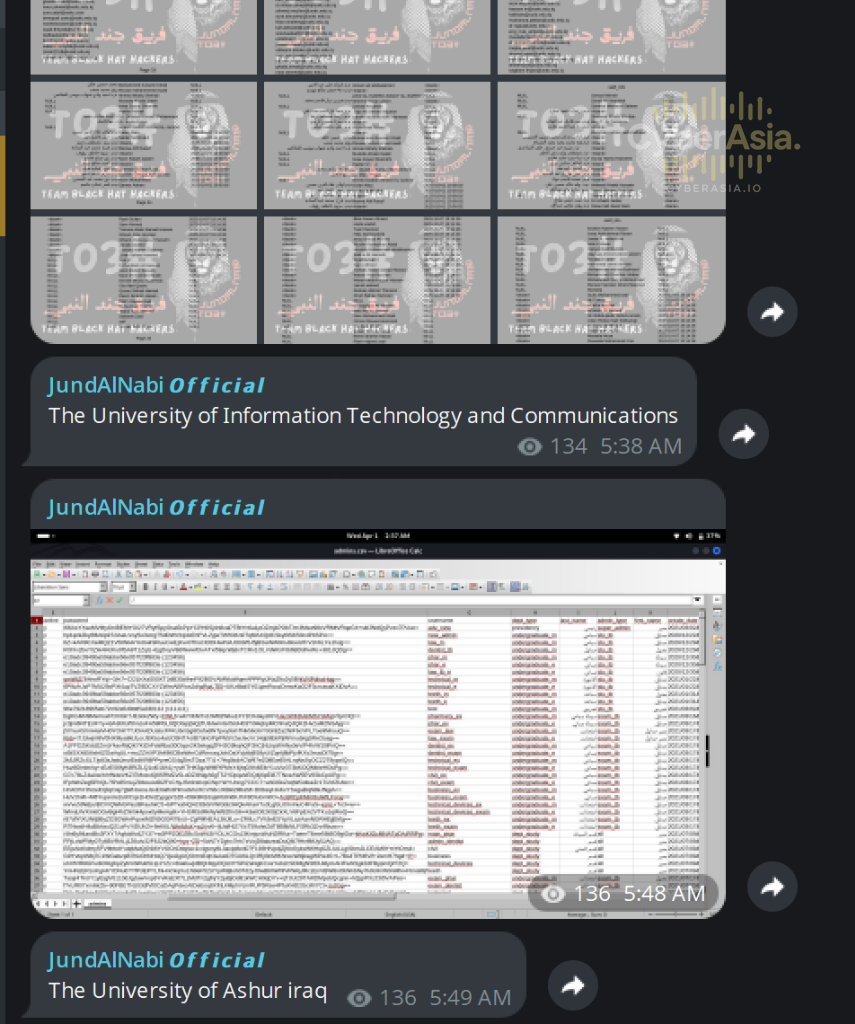
• University of Information Technology and Communications (UOITC): Student registry exfiltration stamped with official
• Ashur University (Iraq): Exfiltration and public distribution of complete administrative credential databases (
• University of Information Technology and Communications (UOITC): Student registry exfiltration stamped with official
TO3# TEAM BLACK HAT HACKERS watermarks.• Ashur University (Iraq): Exfiltration and public distribution of complete administrative credential databases (
admins.csv) containing usernames, encrypted hashes, full Arabic names, and departmental roles.
These cross-border attacks on Iraqi students and universities completely dismantled any remaining pretext of ideological integrity, demonstrating an indiscriminate appetite for disrupting non-combatant educational assets across Muslim-majority nations.
Alliance-Wide Blacklist: Directives and Multi-Group Consensus
Following the advisory, the alliance issued strict operational directives to prevent deanonymization and network contamination:
> UNDERGROUND_SECURITY_DIRECTIVES // ACTIVE_RESTRICTIONS
- Zero Collaboration: Complete cessation of joint attack campaigns, shared stresser tooling, and data distribution.
- Information Blackout: Immediate prohibition on sharing operational intelligence, infrastructure details, or private communication mirrors.
- Civilian Protection Mandate: Reaffirmation of strict operational guidelines barring destructive attacks on public medical and educational institutions.
Cross-Border Solidarity: Major Asian Collectives Enforce the Ban
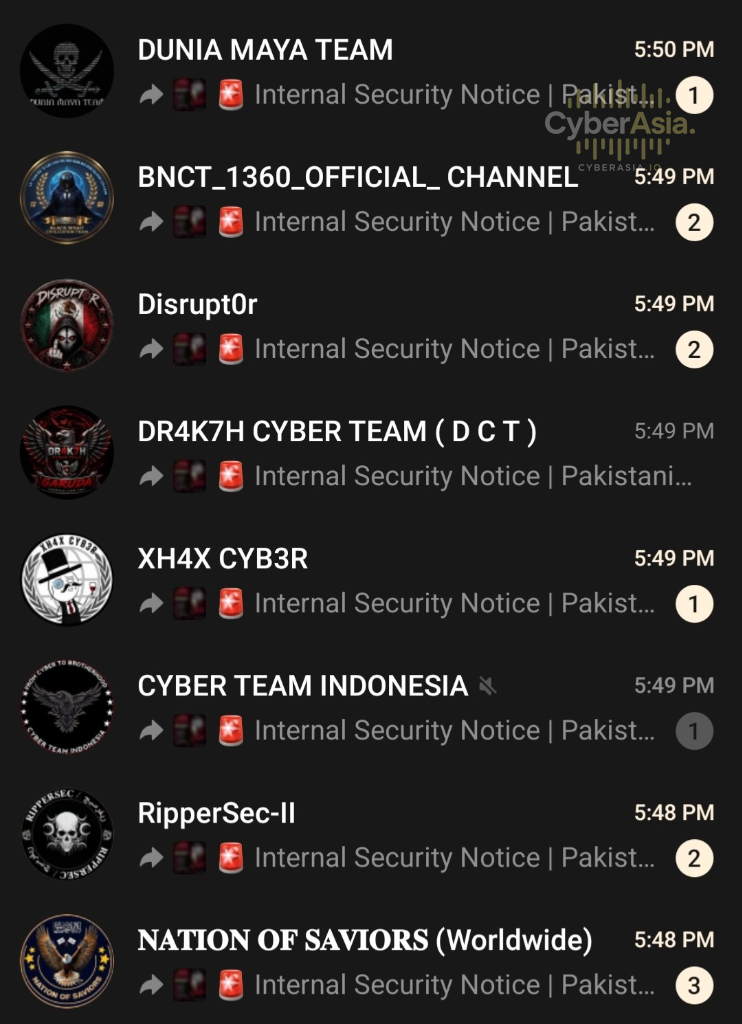
The speed with which the red alert propagated underscores deep coordination among Asia-Pacific cyber groups. Within minutes of publication by Pak Digital Resistance, the alert was mirrored and pinned across top-tier regional channels:
> ENDORSING_ALLIANCE_CHANNELS // BROADCAST_NETWORK
• NATION OF SAVIORS (Worldwide)
• RipperSec-II (Southeast Asia)
• CYBER TEAM INDONESIA
• XH4X CYB3R
• DR4K7H CYBER TEAM (DCT)
• Disrupt0r
• BNCT_1360 (Black Night)
• DUNIA MAYA TEAM
Strategic Threat Intelligence Implications
The purge of JundAlNabi PK represents a critical case study in counter-intelligence paranoia within decentralised hacktivist alliances. As national law enforcement bodies and threat intelligence firms intensify undercover penetration of Telegram channels, collectives are increasingly enforcing rigorous internal audits.
When ideological factions turn rogue by attacking sensitive civilian targets, regional peers act swiftly to ostracize them to prevent heightened state scrutiny and coordinated law enforcement takedowns against the broader ecosystem.
Mitigation Recommendations
For Healthcare, Education, and Critical Infrastructure Administrators:
- Enhance Healthcare & Academic Perimeter Security. Audit and segment internal university networks, student information systems (SIS), electronic health record (EHR) portals, and laboratory management servers against unauthorized external access.
- Block Rogue Telemetry Signatures. Integrate emerging threat indicators and IP blocklists linked to rogue South Asian threat cells into perimeter firewall rules.
- Conduct Immediate Credential Audits. Enforce multi-factor authentication (MFA) across all administrative consoles and verify that retired personnel credentials are fully revoked.
- Establish 24/7 Incident Response Channels. Ensure rapid communication protocols exist between institutional IT teams and national CERT coordinators to contain sudden DDoS or extortion events.
For Organizations and Internet Users:
- Exercise extreme caution regarding unverified software tools or botnet panels circulated in public Telegram groups.
- Ensure all organizational web assets utilize modern SSL certificates and updated CMS frameworks.
- Report suspected cyber extortion or unauthorized scanning activities to official cybersecurity law enforcement desks immediately.
> DISCLAIMER
This intelligence report is compiled strictly for educational, defensive, and threat awareness purposes. CyberAsia documents cyber activity utilizing open-source intelligence and raw threat telemetry. CyberAsia does not endorse, facilitate, or condone unauthorized access to computer systems or malicious digital disruption.
Notice: This report forms part of CyberAsia’s ongoing tracking of threat actor coalitions, underground factional splits, and critical infrastructure protection across the Asia-Pacific region. Verified researchers may request extended IoCs via our Secure Drop portal.
Disclaimer: The information presented in this threat intelligence report is for educational and cybersecurity research purposes only. CyberAsia reports on cyber incidents to help organizations understand and defend against emerging threats. We do not provide hacking instructions, host stolen data, or endorse illegal activities.
> INTELLIGENCE_NOTICE
The report above detailing Alliance-Wide Ban: Muslim Cyber Coalition Exposes JundAlNabi PK as Internal Spy is part of the CyberAsia public archive. For organizations requiring real-time attack telemetry, check-host latency records, and edge firewall mitigation strategies for hacktivism incidents, please refer to our Secure Drop or contact the research desk.

> ABOUT_AUTHOR: Haider
> related_intel --suggest
hacktivism
 Threat Intelligence
Hacker vs Hacktivist: 5 Dangerous Differences in Modern Cyber Warfare
> read hacktivism