 Threat Intelligence
~/ › Threat Intelligence › article
Threat Intelligence
Romania DDoS Attack: Server Killers Target National Cybersecurity Infrastructure
> By Haider | Aug 09, 2026 | 4 min read
The resilience of European critical infrastructure is being tested as threat intelligence analysts monitor a coordinated Romania DDoS attack. A hacktivist collective operating under the moniker “Server Killers” has successfully executed volumetric disruption campaigns against the core nodes of Romania’s national cybersecurity defense network.
⚠️ THREAT INTELLIGENCE ADVISORY:
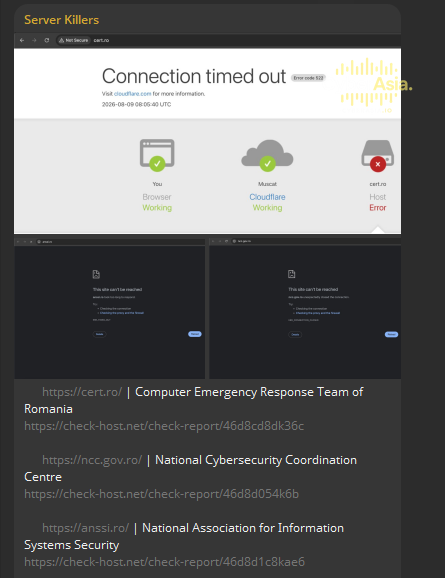
The threat actor “Server Killers” has launched sustained Distributed Denial of Service (DDoS) attacks against primary Romanian cybersecurity domains, including the Computer Emergency Response Team (CERT.ro), the National Cybersecurity Coordination Centre (NCC), and the National Association for Information Systems Security (ANSSI). The attacks have resulted in verifiable Cloudflare 522 timeouts.
Context Behind the Romania DDoS Attack
In a public broadcast distributed via Telegram, the Server Killers group published proof-of-concept Check-Host logs confirming the offline status of multiple high-profile Romanian government domains. Targeting national cybersecurity agencies is a calculated psychological operation. By disrupting the very institutions tasked with mitigating cyber threats, hacktivist groups project dominance and attempt to erode public trust in state-level digital defenses.
While the specific geopolitical or ideological motivations driving this particular campaign remain under investigation, Eastern Europe continues to experience elevated levels of hacktivist activity linked to broader regional conflicts. Organizations in the region are frequently targeted by proxy groups seeking to disrupt critical communication channels.
Technical Analysis of the Disruption
The visual evidence provided by the threat actors displays standard Cloudflare Error 522 (Connection timed out) screens. This error specifically indicates that while the Cloudflare edge network is active, the origin servers hosting cert.ro and associated government domains are failing to respond to requests within the required timeout window.
This behavior is consistent with Layer 7 (Application Layer) DDoS attacks, such as HTTP floods, which exhaust server resources rather than simply saturating bandwidth (Layer 3/4). Threat actors frequently utilize automated botnets to overwhelm origin servers, bypassing standard rate-limiting filters by mimicking legitimate user traffic.
Impact Assessment
The immediate severity of this incident is classified as Medium. Volumetric DDoS attacks do not typically result in data exfiltration, lateral movement, or ransomware deployment. The primary consequence is a loss of availability.
However, the disruption of a Computer Emergency Response Team (CERT) presents a unique operational risk. If a concurrent, highly destructive cyberattack (such as a widespread ransomware event) were to occur simultaneously, the unavailability of the primary incident response coordination portal could significantly delay national mitigation efforts.
Mitigation Recommendations
Organizations facing sustained volumetric attacks must implement robust traffic filtering and routing protocols. We recommend the following defensive postures:
- Edge Defense Hardening: Administrators should review their Web Application Firewall (WAF) configurations, specifically lowering rate-limiting thresholds and activating “Under Attack” modes on reverse proxies like Cloudflare during active campaigns.
- Traffic Analysis: Security Operation Centers (SOC) must analyze the incoming request headers to identify anomalous user-agent strings or geographic traffic concentrations to implement precise IP blocklists.
- Origin Server Protection: Ensure that origin server IP addresses remain strictly confidential and are configured to only accept incoming traffic routed through the designated CDN/WAF infrastructure, preventing direct IP flooding.
- Redundant Communications: Critical emergency response teams must maintain alternative, out-of-band communication platforms hosted on entirely separate infrastructure to ensure continuity of operations during primary domain outages.
CyberAsia continues to monitor hacktivist operations targeting critical state infrastructure. Read our latest Cyber Attack analysis for more updates on global disruption campaigns.
Reference: Romanian National Cyber Security Directorate (DNSC).
> DISCLAIMER
The information provided in this article is for educational and threat intelligence purposes only. CyberAsia does not condone, promote, or encourage any illegal activities, including data breaches or unauthorized access to systems. The claims made by threat actors are unverified and reported strictly for awareness and defensive mitigation.
> subscribe_to_intel
Join 5,000+ analysts. Get uncensored threat intelligence and breach alerts delivered directly to your inbox. Privacy Policy.
Mitigation & Prevention Strategies
Exploitation of vulnerabilities in critical infrastructure and edge devices requires immediate remediation to prevent catastrophic disruption:
- Patch Management: Apply vendor-supplied security patches or firmware updates immediately. For legacy systems, deploy virtual patching via network firewalls.
- Isolate OT Networks: SCADA and OT environments must be strictly isolated from corporate IT networks (the Purdue Model) to prevent spillover attacks.
- Continuous Monitoring: Deploy Endpoint Detection and Response (EDR) solutions and monitor network traffic for indicators of compromise (IoCs) associated with known exploits.
> INTELLIGENCE_NOTICE
The report above detailing Romania DDoS Attack: Server Killers Target National Cybersecurity Infrastructure is part of the CyberAsia public archive. For organizations requiring real-time Indicators of Compromise (IoCs), YARA rules, and extended mitigation strategies for threat intelligence threats, please refer to our Secure Drop or contact the research desk.

> ABOUT_AUTHOR: Haider
> related_intel --suggest
Threat Intelligence
 Threat Intelligence
Middle East Cyber Warfare: UAE Thwarts Major Attack as Breach Costs Hit $8 Million
> read Threat Intelligence